National Storage Brand Guidelines
A Brisbane merger of 2000, an ASX listing in 2013 and a private owner in 2026.
Aa
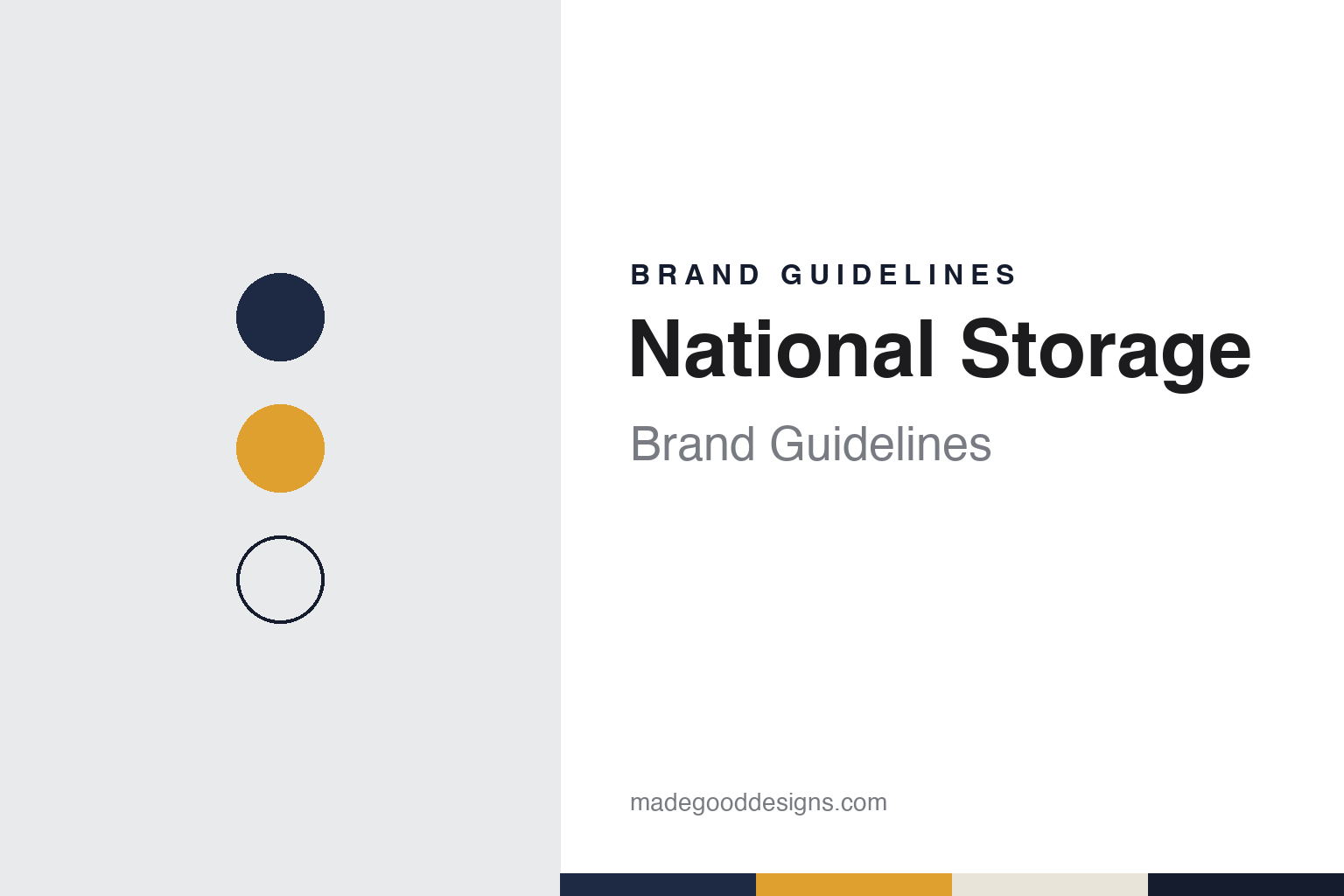
Two constants: a deep blue, amber and stone palette and a plain-spoken sans register. Abstract homage — not a National Storage asset; no building, sign or logo is reproduced.
Brisbane, 2000
Three storage businesses and a 2013 listing.
National Storage is a self-storage business from Brisbane. English Wikipedia dates it to December 2000, when three operators, Stowaway Self Storage, National Mini Storage and Premier Self Storage, merged; the trade title Inside Self-Storage, in a November 2025 report, gives 1995 as its founding year instead. Both sources agree on the next step. In December 2013 the business listed on the Australian Securities Exchange as National Storage REIT, under the code NSR, with its head office in Brisbane.
The listing gave the company a description it used for years. Inside Self-Storage, in reports from 2020 to 2025, called it the first independent, internally managed and fully integrated owner and operator of self-storage centres to be listed on the ASX, and Wikipedia uses the same wording. Put simply, the same company owned the centres and ran them.
The Sydney Morning Herald measured how far it had come in February 2020: the trust had first listed in 2013 as a small vehicle and by then owned and managed 167 storage facilities in Australia and New Zealand. Its managing director through that period was Andrew Catsoulis, named in the Herald report and in company statements quoted by Inside Self-Storage.
The range offered at the centres, according to Wikipedia, covers household and business storage, climate-controlled wine storage, vehicle storage, vehicle and trailer hire, packing materials and insurance. The brand has also been visible in sport: Wikipedia lists sponsorships of the Brisbane Broncos rugby league club and the Richmond Football Club, and a major sponsorship of the Brisbane Lions in the Australian Football League from 2013 to 2015.
Colour
Gaw, Warburg Pincus and Public Storage in 2020.
A listed company can be bought, and in 2020 three suitors tried. On 28 January 2020, Inside Self-Storage reported, the Hong Kong real-estate investor Gaw Capital Partners made a non-binding proposal to buy all of National Storage, which then ran more than 170 centres. The US operator Public Storage followed with an offer on 14 February, and on 18 February the board disclosed a third, from the New York private-equity firm Warburg Pincus. The Sydney Morning Herald called it a “three-way takeover tussle” and said the company had opened its data room to all three. Every approach was unsolicited, the company said.
None reached a deal. Gaw and Warburg Pincus withdrew in late February, and on 19 March 2020 Public Storage withdrew too, citing market conditions, Inside Self-Storage reported. Andrew Catsoulis said the company had stayed focused on its core business throughout the talks. Within weeks a listed rival, Abacus Property Group, had built a stake of about 7 per cent, the same title reported in May 2020; National Storage kept Abacus out of a capital raising that month, calling it a direct competitor.
The company kept growing. Inside Self-Storage placed it eleventh on its 2019 Top Operators list of facility owners. In 2018 the Sydney Morning Herald, citing the research firm IBISWorld, put National Storage’s share of the Australian market at about 8 per cent, behind the family-owned Kennards Self Storage and Storage King. In June 2024 it formed a development partnership with Singapore’s sovereign investor GIC, the National Storage Ventures Fund, according to Mingtiandi and Inside Self-Storage, and in April 2025 it bought a stake of about 4.8 per cent in the listed Abacus Storage King. By November 2025 Inside Self-Storage counted 274 facilities in the network.
Typography
How storage operators present themselves.
Self-storage is a property business that has to sell itself to people at a moment of change: a move, a renovation, a smaller home or a growing stock of inventory. The way operators present themselves follows from that. The building is the first advertisement, and cladding, roll-up doors and roadside signs can all carry a brand colour. Where a company publishes its building colours or signage system, this guide reports them as the company’s own description.
Online, the category has settled on a familiar set of tools. An operator’s website can lead with a store finder, a unit size guide that explains what fits in each space, a choice of unit types such as heated or drive-up storage, packing supplies and an account page for paying rent and booking. When one owner runs several regional brands, those sites can share a single template, with only the name, the city list and the colours changing, as StorageVault’s Access Storage and Sentinel Storage sites did in November 2026.
Campaigns and characters do the work the buildings cannot. Some operators use mascots, slogans or sports sponsorships to make a functional service memorable; StorageVault, for example, took stadium and broadcast signage with the Toronto Blue Jays in 2023, according to Inside Self Storage. When a guide mentions a mascot or campaign, it says where and when the company used it.
Behind the shop front sits a corporate layer. Some operators are listed companies or real estate investment trusts, or are owned by private-equity firms and family groups, and their investor pages explain store counts, rentable area, acquisitions and listings. Those figures are given here only as a dated source states them, and mergers or takeovers that have not closed are described as pending, with the date they were announced.
Aa
A plain-spoken sans for a name that states the service. (Specimen set in Archivo, a sans STAND-IN; NOT the National Storage logo.)
National Storage
Taken private in May 2026.
The GIC partnership came before the sale. In November 2025 a consortium of the Canadian investor Brookfield and GIC made an unsolicited, non-binding proposal for all of National Storage, Inside Self-Storage reported. On 8 December 2025 the REIT signed a binding scheme implementation deed with the consortium, and its board unanimously recommended the all-cash offer, The Motley Fool Australia reported, noting that the trust would leave the ASX if the scheme went ahead. The independent expert, Kroll, found the offer fair and reasonable, the same report said. Brookfield knew the sector: it had bought the American operator Simply Self Storage in 2016 and sold it to Blackstone Real Estate Income Trust in 2020, Mingtiandi noted.
The scheme then went through its formal steps. Securityholders voted at meetings on 15 April 2026; Australia’s Foreign Investment Review Board and New Zealand’s Overseas Investment Office had already cleared the deal, the Motley Fool said. The court gave final approval on 21 April 2026, and the securities stopped trading on the ASX at the end of that day, according to Inside Self-Storage. The deal was completed on 8 May 2026. Mingtiandi reported on 10 May that unitholders had been paid, that the buyers described it as the largest take-private of an ASX-listed REIT, and that the business had more than 300 centres serving over 100,000 customers across Australia and New Zealand.
The name on the centres is unchanged, but National Storage is no longer a listed trust: since May 2026 it has been privately owned by Brookfield and GIC.
For a design guide, National Storage shows how a name that simply states the service can carry a business through a merger, a listing and a change of owner; compare Public Storage, the American operator that bid for it in 2020, and Kennards Self Storage, its family-owned rival. For this guide we use a deep blue, a warm amber and a pale stone with a sans, an unofficial interpretation; no product or logo is reproduced.
Explore & save
Keep National Storage’s identity on hand — save it to a board in the Made Good inspiration library.
National Storage identity set
Pin the deep blue, amber and stone palette and the plain-spoken sans register to your own board.