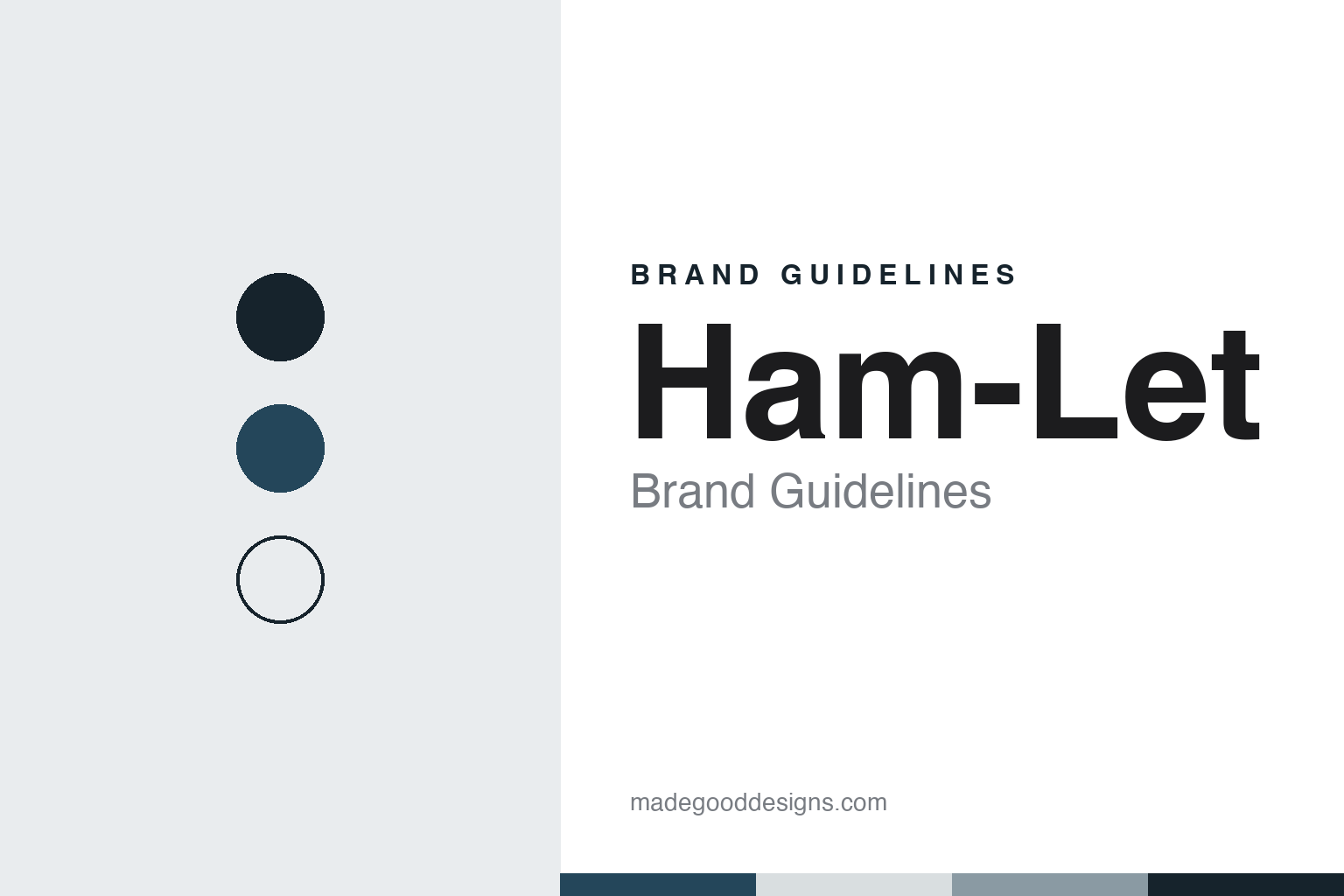
Ham-Let Brand Guidelines
A Haifa workshop, a hyphenated name and a business unit of UCT.
Aa
Two constants: a steel, slate and ink palette and a technical sans register. Abstract homage — not a Ham-Let product or mark; no fitting, logo or nameplate is reproduced.
From Hamevlat to Ham-Let
A small Haifa workshop and a letter swapped for a hyphen.
Ham-Let traces its start to Haifa in 1950. Hebrew Wikipedia says the business began that year as a workshop of only a few square metres, where tin cans were turned into heel plates for shoes, and where bottle caps and door hinges were also made. UCT, the American company that owns Ham-Let today, gives 1950 as the founding year in its 2021 press release.
The company itself was set up in 1961 by Zvi Topaz, Hebrew Wikipedia says, under the name “Hamevlat”, after the mevlat, an embossing press for the metal trades that he had bought. The name did not last long. After stamps had been ordered and letterhead printed with a logo, it turned out that another company already used it, so the letter in the middle of the word was replaced with a hyphen, and the result was Ham-Let.
With the press, Topaz opened a small plant for pipe fittings in Kiryat Ata. Its products went mainly to oil refineries, petrochemical plants, the food industry and pharmaceutical makers. In the 1980s his sons Shmuel and Dan Topaz joined the business. Until then it had been a family firm selling mostly in Israel; from that point it began exporting and moved into a new field, the semiconductor industry.
That move shaped the company. In 1991 Ham-Let set up a subsidiary, HTC, to make fittings for industrial monitoring and control systems in electronics, chiefly for chip making. To pay for more production capacity it brought in outside investors, among them the American companies Applied Materials and Kinetics, Hebrew Wikipedia says; HTC was merged back into Ham-Let in 2000. In 1994 Ham-Let’s shares were listed on the Tel Aviv Stock Exchange. Since 1996 its headquarters and main plant have been in the Tzipori industrial park in Israel, and it also runs plants in Thailand and Malaysia.
Colour
Discount Investments, FIMI, then UCT.
Ownership changed several times after the listing. Early in 2004 the Topaz brothers sold half of their holding to Discount Investments, which became the controlling shareholder with about 40 percent of the shares, Hebrew Wikipedia says; in April 2009 it completed the purchase of the brothers’ remaining shares. In 2012 control passed to the private equity fund FIMI.
On 16 December 2020 Ultra Clean Holdings, known as UCT, a Nasdaq-listed supplier to the semiconductor industry based in Hayward, California, announced a definitive agreement to acquire Ham-Let (Israel-Canada) Ltd., then a public company on the Tel Aviv exchange. The release noted that Ham-Let was already a supplier to UCT and that its customers included semiconductor equipment makers and chip makers. UCT announced on 31 March 2021 that the acquisition was complete. Hebrew Wikipedia says Ham-Let then became a business unit of UCT called UCT Fluid Solutions, and that about 97 percent of its sales were exports as of 2024.
UCT’s 2021 release describes the Ham-Let Group as a developer, manufacturer and distributor of industrial flow control systems: connectors, fittings and valves for high-pressure and high-temperature lines carrying gases and liquids. It lists the markets served as semiconductor, power generation, chemical, oil and gas, petrochemical and high purity, and gave the group at that time 14 branches and five manufacturing sites, with a worldwide distribution network.
The UCT Fluid Solutions pages now group what they call the Ham-Let product portfolio by market. For semiconductor work they list ultra clean valves, ultra clean fittings and modular substrate components; for power and energy and for the process industries they list ranges such as compression tube fittings, instrument pipe fittings, IIoT valves and quick connectors. The same pages also list Astava, S&S, Rovac and Norvalves among the energy-sector lines.
Connected valves have been part of the story for some time. In May 2018 Automation World reported that Siemens had announced Ham-Let Group was using MindSphere, the Siemens cloud-based operating system for industrial devices, running on Amazon Web Services, to connect its control and instrumentation components to the cloud. The company described valves that could sense the medium passing through them and conditions such as temperature, pressure, vibration and humidity, with a gateway that displayed the readings and history of each valve.
Typography
How flow-control makers present themselves.
Valve and flow-control makers sell to engineers, and their public material reads that way. Product pages are built around clear photographs of the hardware itself — a valve body, a fitting, an actuator housing — usually on a plain ground, so that shape, connection ends and materials can be read at a glance. Where a maker publishes cutaway drawings or sectioned views, they serve the same purpose: to show how a part is put together rather than to set a mood.
Colour on valves, fittings and pipes can be technical as well as decorative. Where a product range uses colour to mark a material, a medium or a pressure class, the maker’s own catalogue is the place to check what each colour stands for, since meanings can differ between companies, materials and markets. For a design guide, that is a reason to keep brand colour on paper and screens separate from the colours of the products themselves.
Much of the work happens in catalogues and tools. The tradition is old: Georg Fischer says its first fittings brochure, in 1865, listed 91 items for gas lighting. Today the same makers organise their websites by product family, industry and application, and offer downloads and online tools; Rotork, for example, publishes a sizing and selection toolkit for its actuators. Product range names, such as Rotork’s IQ, often do as much brand work as the company name.
The corporate pages tell a story of owners and divisions. Many of these companies have been reshaped by acquisitions, disposals and renamed divisions, and their sites set out which brands sit under which parent. This guide follows that record — when each company was founded, who owns it, and what it says about its own history — and marks clearly what rests on a company’s own word.
Aa
A technical sans for a maker of fittings and valves. (Specimen set in IBM Plex Sans, a sans STAND-IN; NOT the Ham-Let logo.)
Ham-Let
A name built around a hyphen.
The hyphen is the most distinctive part of the name, and it is there because of a clash with another firm, not a design choice: that is the account Hebrew Wikipedia gives of the change from Hamevlat in the early years. The spelling has stayed in use for more than six decades, through the family years, the stock-market listing, two controlling shareholders and the sale to UCT.
Today the name lives inside a larger company. UCT’s 2021 release speaks of Ham-Let Group and Ham-Let (Israel-Canada) Ltd.; its current product pages speak of UCT Fluid Solutions and of the Ham-Let portfolio within it, alongside UCT’s own name. The company’s own background, as UCT tells it, is a half-century of work on high-purity and process control applications.
The product range itself is the visual material. Fittings, valves, hoses and connectors appear in catalogues and on product pages by type and by market, from ultra clean components for chip-making equipment to instrumentation for energy and process plants. UCT’s pages sort them into those families and markets, which gives the brand its working vocabulary.
For a design guide, Ham-Let shows how a small workshop name, fixed by a hyphen in 1961, can carry on as a product brand inside a listed American group. Compare Swagelok, whose name also comes from a tube fitting, and Aalberts, another name in flow control. For this guide we use steel grey, a slate blue and a deep ink with a technical sans, an unofficial interpretation; no product or logo is reproduced.
Explore & save
Keep Ham-Let’s identity on hand — save it to a board in the Made Good inspiration library.
Ham-Let identity set
Pin the Ham-Let steel, slate and ink palette and the technical sans register to your own board.