Sydney Water Brand Guidelines
An 1888 board, four names and a state-owned corporation.
Aa
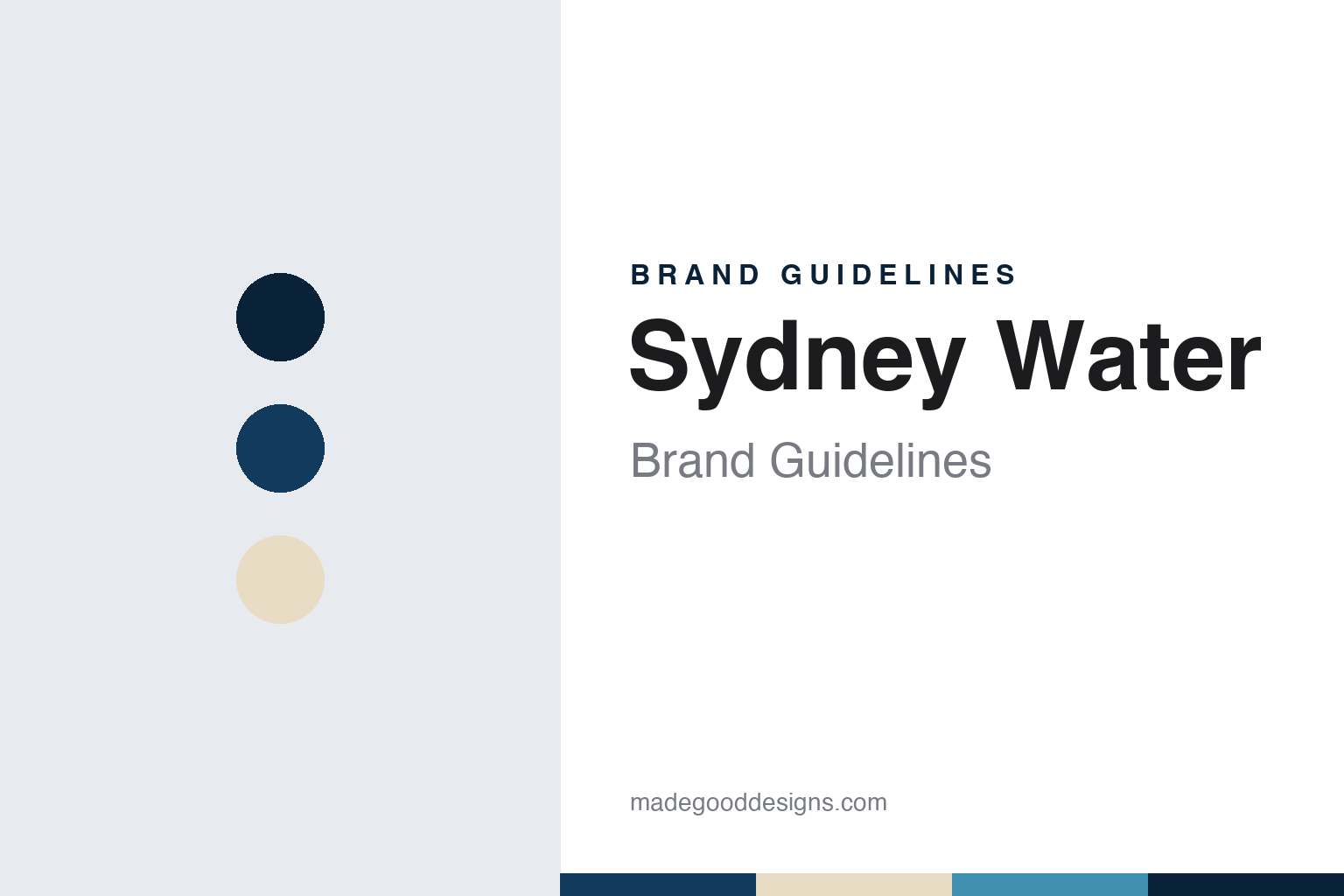
Two constants: a Sydney Water harbour blue and sandstone palette and a plain sans register. Abstract homage — not a Sydney Water mark; no logo, sign or asset is reproduced.
From the 1888 board
A Sydney board, renamed several times.
Sydney Water — formally the Sydney Water Corporation — supplies drinking water, wastewater, recycled water and stormwater services to Greater Sydney, the Illawarra and the Blue Mountains. The corporation says it serves 5.6 million people, and it calls itself “Australia’s largest water utility”. It describes itself as a statutory State Owned Corporation, wholly owned by the NSW Government, operating under the Sydney Water Act 1994; its shareholder ministers are the Treasurer and the Minister for Finance, and its portfolio minister is the Minister for Water.
The corporation dates its operations to 1888. English Wikipedia says the Metropolitan Water and Sewerage Amendment Act, 1888 was enacted on 26 March 1888, moving the water supply and sewerage powers of Sydney’s Municipal Council to a new Board of Water Supply and Sewerage. That board became the Metropolitan Board of Water Supply and Sewerage in 1892 and, in 1925, the Metropolitan Water, Sewerage and Drainage Board, known by its initials, MWS&DB. Museums of History NSW, the state’s archives and museums body, says the MWS&DB was established on 31 March 1925 under a 1924 Act, with responsibility for water supply, sewerage and stormwater drainage in and around the County of Cumberland.
In 1987 the board was reconstituted as the Water Board — for much of the twentieth century the everyday name for the organisation, Wikipedia notes. Museums of History NSW says the Water Board was abolished in 1994 and Sydney Water Corporation Limited was established as its successor in 1995. Wikipedia adds that “Limited” was dropped in 1999, when the company became a statutory state-owned corporation, the form it keeps today.
Colour
Dams, outfalls and recycled water.
Much of Sydney’s supply system was built by the earlier boards. Wikipedia lists the Cataract Dam (1907–1915) and the Cordeaux, Avon, Nepean and Woronora dams, completed between 1926 and 1941, along with ocean outfall sewers built from 1916 onwards. Sydney Water says the Burragorang Valley is the source of 70% of its water. Since 1 January 2015 a separate state body, WaterNSW, formed from the Sydney Catchment Authority and State Water Corporation, has supplied raw water to Sydney Water, according to Wikipedia.
More recent work leans on desalination and recycling. Wikipedia records the Sydney Desalination Plant at Kurnell opening in 2010, operated under a licence granted to Veolia, and the St Marys Advanced Water Recycling Plant starting the same year. In 2012 the NSW Government leased the desalination plant for 50 years to a company owned by pension and infrastructure funds, Wikipedia says, tying Sydney Water into a long-term supply agreement.
The wastewater side has its own landmarks. Between 1984 and 1990, Wikipedia says, deepwater ocean outfalls were built at the Bondi, North Head and Malabar treatment plants; the wider Malabar system now serves more than a third of Sydney’s population, according to Sydney Water figures cited there. Wikipedia also records the Blue Mountains water supply scheme passing to the board in 1980, the Prospect Water Filtration Plant being completed in 1996 and the Northside Storage Tunnel being built afterwards to reduce wet-weather sewer overflows into Sydney Harbour.
In September 2026 Sydney Water opened the Badu Yarragul Water Resource Recovery Facility at Kemps Creek in Western Sydney. ABC News reported on 6 October 2026 that the facility treats 35 million litres of wastewater a day, with plans to double that to 70 million litres as the city grows, and that it has capacity to connect 140,000 new homes and businesses across Western Sydney, including the new airport. Sydney Water told the broadcaster that the treated water is meant for non-drinking uses in homes, industry and agriculture, and for greening public spaces. The corporation’s managing director told ABC News that a decision on purified recycled water for drinking would need to be made within the next ten years.
Typography
Design and documentation.
Most of what the public sees of a water company is practical rather than promotional: the vans that turn up to fix a main, the signs on the gates of treatment works and pumping stations, the bill that arrives through the door, and the notices posted when roads are dug up. For a design reader, those everyday pieces carry the identity more often than any advertisement does, because they are seen by every household in a supply area.
A bill is a working document, setting out what is owed, how to pay and where to find help, and a customer campaign is usually a single request; for a design reader, both are worth studying as type, layout and tone. Group names matter too: Pennon, for example, lists South West Water, Bournemouth Water, Bristol Water and SES Water as separate businesses on its own website, so one owner can sit behind several regional brands.
Photography leans on the landscape the companies manage. Reservoirs, moorland catchments, rivers, coastlines and the buildings of treatment works appear again and again, and some sites double as visitor places: English Wikipedia notes public access to Southern Water’s Bewl Water and guided tours of the Victorian sewers of Brighton and Hove, and a charity, South West Lakes Trust, that manages inland water sites across Cornwall, Devon and West Somerset.
Corporate pages carry a different kind of information. In the UK, water companies sit under the economic regulator Ofwat and the Environment Agency, and the Environment Agency publishes dated press releases on prosecutions; owners, regulators and court outcomes are therefore part of the record. This guide treats them as dated facts, set out alongside the history of each company and the palette and type choices made for it.
Aa
A plain sans for a plain place-name. (Specimen set in Work Sans, a sans STAND-IN; NOT the Sydney Water logo.)
Sydney Water
History on the street.
Some of Sydney Water’s visual history sits in the street. Storm drain covers in Western Sydney still carry the MWS&DB initials of the 1925–1987 board, Wikipedia notes, and the board’s former headquarters on the corner of Pitt and Bathurst streets, with its art deco façade, has been redeveloped as a hotel. The corporation moved its head office to Parramatta in May 2009, according to Wikipedia.
It also looks after a large heritage estate. Its heritage register lists more than 200 heritage assets that it owns, occupies or manages, the corporation says, from wastewater pumping station No. 2, built in 1904, to the Crown Street Reservoir, which has State significance. Wikipedia lists parks and golf courses on the historic Botany Water Reserves among its landholdings, mostly licensed or leased to councils and clubs for public use. The corporation says some of its sites, from reservoirs to pumping stations and vacant land, are open to the public and can be used for picnics, photo shoots or leasing.
Readers should keep the bodies apart: Sydney Water runs the pipes, treatment plants and customer service, while dams and raw water sit with WaterNSW. Older residents may still call the corporation the Water Board, Wikipedia says. Its website is sydneywater.com.au.
For a design guide, Sydney Water shows how a public utility can carry a long institutional record — several names since 1888 — into a single, plain place-name brand. Compare Watercare, Auckland’s council-owned water company, and Scottish Water, another publicly owned utility. For this guide we use a harbour blue and a sandstone with a sans, an unofficial interpretation; no product or logo is reproduced.
Explore & save
Keep Sydney Water’s identity on hand — save it to a board in the Made Good inspiration library.
Sydney Water identity set
Pin the Sydney Water harbour blue and sandstone palette and the plain sans register to your own board.