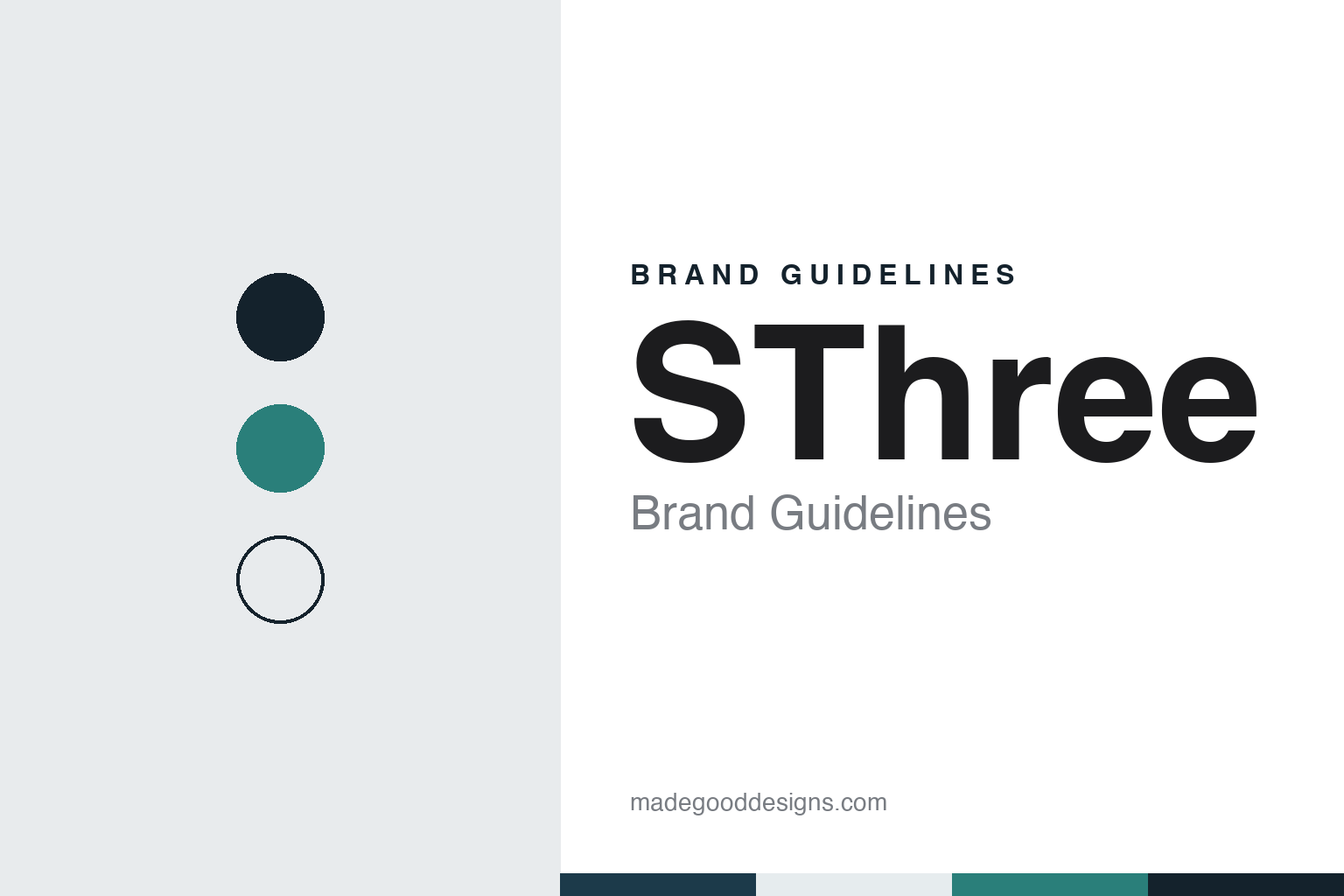
SThree Brand Guidelines
A 1986 London recruiter whose specialist brands now sit under one parent name.
Aa
Two constants: a deep blue, teal and grey palette and a geometric sans register. Abstract homage — not an SThree asset; no logo, wordmark or brand mark is reproduced.
Two founders, 1986
A systems analyst and a recruitment consultant.
SThree began in London in 1986. Its founders were Bill Bottriell, an IT systems analyst, and Simon Arber, a recruitment consultant, the London Evening Standard reported in 2005, when both men still sat on the board. English Wikipedia describes the company as a specialist recruitment business from its founding, and the newspaper described its trade as supplying contract and permanent technology staff.
Outside money came late. In 1999 the founders sold a minority stake to Barclays Private Equity, which, the Evening Standard said, advised on streamlining the corporate structure and helped the business grow. By the spring of 2005 the paper counted more than 1,000 employees in more than 40 offices in Britain, France, Germany and Belgium, more than 4,000 freelance IT professionals working on assignment, and about three-quarters of the company owned by its management and staff. It also reported that the business had placed a candidate in a permanent role every 20 minutes of every working day in the previous year, that the board was chaired by a former chairman and chief executive of IBM UK, and that the investment bank UBS had been appointed to manage the planned float.
SThree floated on the London Stock Exchange in 2005, English Wikipedia says, and it is still listed there under the ticker STEM. The ticker and the later positioning line point the same way: the company has come to describe itself through the four letters of science, technology, engineering and mathematics rather than through recruitment in general.
From the start the group name sat behind other names. SThree sells its services through separate specialist brands, each aimed at one field of hiring, while the listed parent stays in the background, an arrangement that shapes almost every design question about the company.
Colour
Computer Futures, Progressive, Real and Huxley.
Staffing Industry Analysts, writing in September 2026, listed the main SThree brands as Computer Futures, for IT staffing; Progressive, for engineering staffing; Real, for life sciences; and Huxley, for IT staffing with a focus on financial services and other industries. English Wikipedia’s list adds Global Enterprise Partners and gives the longer forms Real Staffing Group and Huxley Associates.
The group now sums itself up in a single phrase. In its results for the year to 30 November 2025, SThree called itself “the global STEM workforce consultancy,” placing specialist workers in the industries where, it says, they are needed most. The same document claims 40 years of experience, a team with local expertise across 11 countries and around 6,000 clients, and says it covers Engineering, Life Sciences and Technology roles with both permanent hires and flexible contract talent. Staffing Industry Analysts summarised the footprint as Europe, the United States and Japan, and the 2025 results named the USA and Japan as the two of its top five countries that grew that year.
Contract work sits at the centre of the business. The 2025 results divide the Contract side into independent contractors and employed contractors, and call the employed model the most complex and value-added part of what the group sells. They also say SThree finished rolling out a Technology Improvement Programme across all 11 countries during the year, a project the company says was designed to unify its systems and streamline operations.
That mix of specialist names, a technical client base and a contractor workforce explains why the company speaks in two registers at once: the trade name a candidate meets on a job advert, and the group voice an investor or a large client meets in results and reports.
Typography
How staffing firms present themselves.
Executive search and staffing firms sell judgement about people, so their public material leans on people too. Spencer Stuart’s website points visitors to a directory where they can find an expert and to a list of global locations, while Egon Zehnder’s invites them to meet its consultants and find its offices. Consultant profiles and office pages, rather than products, carry most of the visual weight, and the photography on them is whatever each firm chooses to publish.
Candidate-facing design is one of the points this guide compares across the category: the job boards and application portals of staffing companies on one side, and on the other the careers pages, alumni network and client log-in that Spencer Stuart lists in its own site menus. Each site is described as the company presents it, without judging how well it works.
Thought leadership supplies much of the category’s printed and digital output. Spencer Stuart says it published its first US Board Index in 1987 and now produces more than 20 Board Indexes a year, and in October 2026 it released a survey of more than 1,400 board chairs, directors and CEOs. Egon Zehnder publishes CEO studies, a podcast and HBR Executive, a partnership with Harvard Business Review. Report covers, chart styles and survey branding therefore do much of the work that packaging does in consumer categories.
Ownership is part of the story, and each firm states it differently. Spencer Stuart says its founder offered his whole shareholding to a group of employees in 1974, and German Wikipedia says Egon Zehnder’s international partners own that firm in equal stakes. For listed staffing groups, investor and stock-listing pages form a further part of the corporate presentation this guide looks at. This guide sets out who founded each firm, who owns it and what it says about itself, and marks clearly what rests only on the company’s own word.
Aa
A clean geometric sans for a group that talks in STEM terms. (Specimen set in Manrope, a sans STAND-IN; NOT the SThree logo.)
One parent brand
A refresh that moved the group name to the front.
The clearest design decision of recent years is a change of hierarchy. During the first half of its 2025 financial year SThree announced a branding refresh, and its 2025 results describe the aim as a “unified brand architecture”: bringing the go-to-market brands together “under the strength and endorsement of the SThree parent brand.” In plain terms, the group name moved from the back office to the front, endorsing the specialist names rather than standing behind them. The company says the refresh drew strong feedback from customers and partners. The results end their notes to editors with the line “Outpace tomorrow, together.”
Ownership was an open question in the autumn of 2026. On 9 September 2026 SThree confirmed an unsolicited preliminary approach from the US-based Circle8 Group, and on 11 September its board rejected it as significantly undervaluing the company, Staffing Industry Analysts said. Circle8 returned with a revised proposal on 7 October, and SThree twice extended the deadline under the UK Takeover Code for a firm offer, saying there was no certainty one would be made. No firm offer had been announced at the time of writing.
For a design guide, SThree shows how a listed group can step forward as an endorsing parent over long-standing specialist trading names, and how a four-letter field such as STEM can carry a whole positioning line. Compare Hays, another London recruiter, and Harvey Nash, a London technology recruiter now held privately. For this guide we use harbour deep blue, lab teal and mist grey with a geometric sans, an unofficial interpretation; no product or logo is reproduced.
Explore & save
Keep SThree’s identity on hand — save it to a board in the Made Good inspiration library.
SThree identity set
Pin the SThree deep blue, teal and grey palette and the geometric sans register to your own board.