Karmod Brand Guidelines
Istanbul’s prefab, steel-house and cabin maker since 1986.
Aa
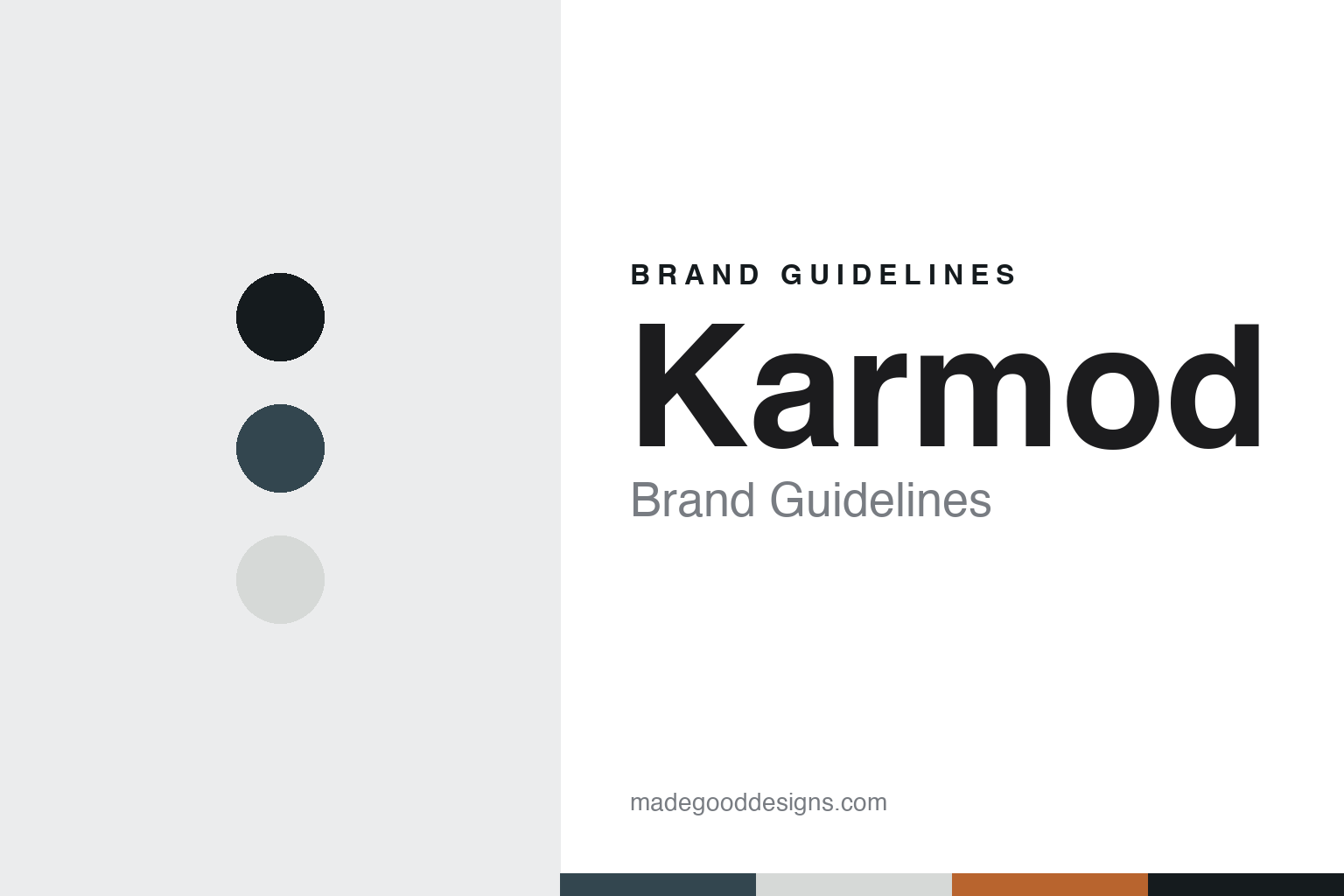
Two constants: a panel slate, galvanised grey and site orange palette and an industrial sans register. Abstract homage — not a Karmod product or mark; no building, cabin, logo or nameplate is reproduced.
A workshop in Kartal
From one Istanbul workshop to two plants in Tuzla.
Karmod is a Turkish maker of prefabricated buildings, steel-frame houses, site containers and modular cabins, based in Istanbul. Its corporate page dates the company to 1986 and gives its first premises as a workshop in Kartal, an Istanbul district. The trading company today is Karmod Prefabrik Yapı Teknolojileri Ltd. Şti., which the English pages render as Karmod Prefabricated Building Technologies Ltd.
The company’s own chronology sets out the growth that followed. A first factory opened at İçmeler, in the Tuzla district, in 1994; the first export came in 2004; a 10,000 m² plant in the Orhanlı area of Tuzla followed in 2008, and a second, 20,000 m² plant there in 2020, according to the Turkish version of the page. Karmod says it now works from these two production sites in the Orhanlı Industrial Zone, with about 30,000 m² of covered floor space, and describes itself as one of the largest prefabricated construction firms in Turkey.
Exports became the core of the business. The chronology marks the 50th export country in 2008 and the 100th in 2015; the corporate page now says Karmod’s buildings are used in 134 countries on six continents, while the home page puts the figure at more than 140. The company lists affiliates in Sudan (Pensa in 2002 and Precon in 2005), a foreign-trade affiliate in Turkey called ROTA (2006) and Elitech in South Africa (2020), as well as its own companies abroad: Karmod France in 2017, Karmod Deutschland and a UK company in 2021, and Karmod USA in 2022.
Independent reporting fills in parts of that picture. In September 2017 Business Post Nigeria reported that Karmod Nigeria had entered the Nigerian housing market in 2012. In January 2021, in a report on bottlenecks in shipping-container supply, Daily Sabah named Mehmet Çankaya as Karmod’s chief executive and reported that the company, which had made containers for years, said it was prepared to invest in certified freight-container production. By February 2024, when Anadolu Agency interviewed him for a report carried by Daily Sabah, Çankaya was described as the firm’s chairperson.
Colour
Panels, light steel, containers and cabins.
Karmod’s range rests on a handful of construction systems, which its corporate page lists as panel-system prefabricated buildings, light steel, structural steel, a hybrid steel system that combines light and structural steel in one building, container living spaces and modular cabins. The company presents the hybrid system and its Next-Gen Container, with a 12.5 cm sandwich-panel roof, as its own developments. Its catalogue runs from single- and two-storey houses and steel villas to modular offices, hotels and site buildings, plus flat-pack containers and kiosks.
The 2024 Daily Sabah report gives the commercial priorities in the chairperson’s words: a push on “premium steel villa housing” in Europe and the U.S., and construction work for oil, natural gas and gold mines in Africa. Çankaya said the firm had direct sales offices in the U.K., Germany and France, a sales office in the U.S., dealers in the Czech Republic, Portugal and Spain, and a network in Nigeria, Kenya, Ghana and Djibouti. He added that Karmod had reinforced its technical office and foreign-trade team, including a group that studies building statics and insulation requirements in different European countries.
The cabins are where Karmod’s work meets other companies’ identities. The company’s project pages describe 12 GRP-panel kiosk cabins it supplied in 2011 to Manchester United at Old Trafford for ticket sales and club merchandise, covered with digital wraps mainly in the club’s colours.
Typography
Design and documentation.
Modular and portable-building firms sell something people mostly see from the roadside: a cabin at the edge of a building site, a stack of steel modules beside a school, a row of storage containers in a depot yard. Their websites lean on that picture. Product pages show single units and stacked blocks photographed outside and in, often with the furniture and fittings that turn a box into an office or a classroom, and case studies show finished complexes from the air.
The units themselves carry much of the identity. A company name on the side of a cabin is seen by everyone who passes a site, and colour can become a signature: Algeco says the dark grey finish it introduced with its Progress range in 2005 is now emblematic of the market. Some names have become so familiar that the companies ask for them not to be used as generic words; Algeco’s French website has a page making exactly that request.
Much of the selling now happens online. WillScot’s website, rebuilt in 2024 when it folded the Mobile Mini site into its own, offers configurable packages for furniture, entrances and fencing, a fencing estimator and a search for units on sale. Configurators of this kind let a buyer assemble a building from named parts before anyone visits the site.
Behind the cabins sit corporate pages written for investors. Firms in this sector publish fleet sizes, country counts and the names of their owners: Modulaire Group, for example, gives its fleet as more than 330,000 modular space and storage units across 24 countries. This guide uses such figures only as dated, attributed statements, and notes where a claim rests on a company’s own word.
Aa
An industrial sans for a factory brand. (Specimen set in Archivo, a sans STAND-IN; NOT the Karmod logo.)
Karmod
A factory brand that wears its clients’ colours.
Karmod presents itself as a manufacturer that sells direct, across many markets. Its website runs in ten languages, among them Turkish, English, French and Arabic, with a selector for dozens of countries. The catalogue is organised by building type, with technical-specification pages for cabin models such as the Panel Cabin and the Metropol Cabin, floor plans for containers and cabins, and project pages that set out each job’s building system, floor area, year and completion time.
The written identity is plain and functional. The corporate page states a mission “to produce new settlement structures in open and closed spaces” with prefabricated building solutions for individual and institutional users, and a separate page says the company wants to sustain a good image of Turkish brands in international markets while giving its staff a friendly and creative place to work. The company’s headline figures, from more than 50,000 customers to more than 1,500 projects, appear on its home page as its own counts.
Much of Karmod’s public news comes through its own statements. Its divisions include Karmod Prefabrik and Karmod Kabin. The 2024 Daily Sabah interview remains the clearest independent account of its strategy, with its emphasis on steel villas for Europe and the U.S. and on sales offices that study local building rules.
For a design guide, Karmod shows how a factory brand can work as a carrier for other identities: its project pages show cabins and kiosks finished in a client’s colours, as at Old Trafford, while its own catalogue stays neutral and technical. Compare Portakabin, the British portable-building name, and Algeco, the European modular-space group. For this guide we use a slate blue, a galvanised grey and a site orange with a sans, an unofficial interpretation; no product or logo is reproduced.
Explore & save
Keep Karmod’s identity on hand — save it to a board in the Made Good inspiration library.
Karmod identity set
Pin the Karmod panel slate, galvanised grey and site orange palette and the industrial sans register to your own board.