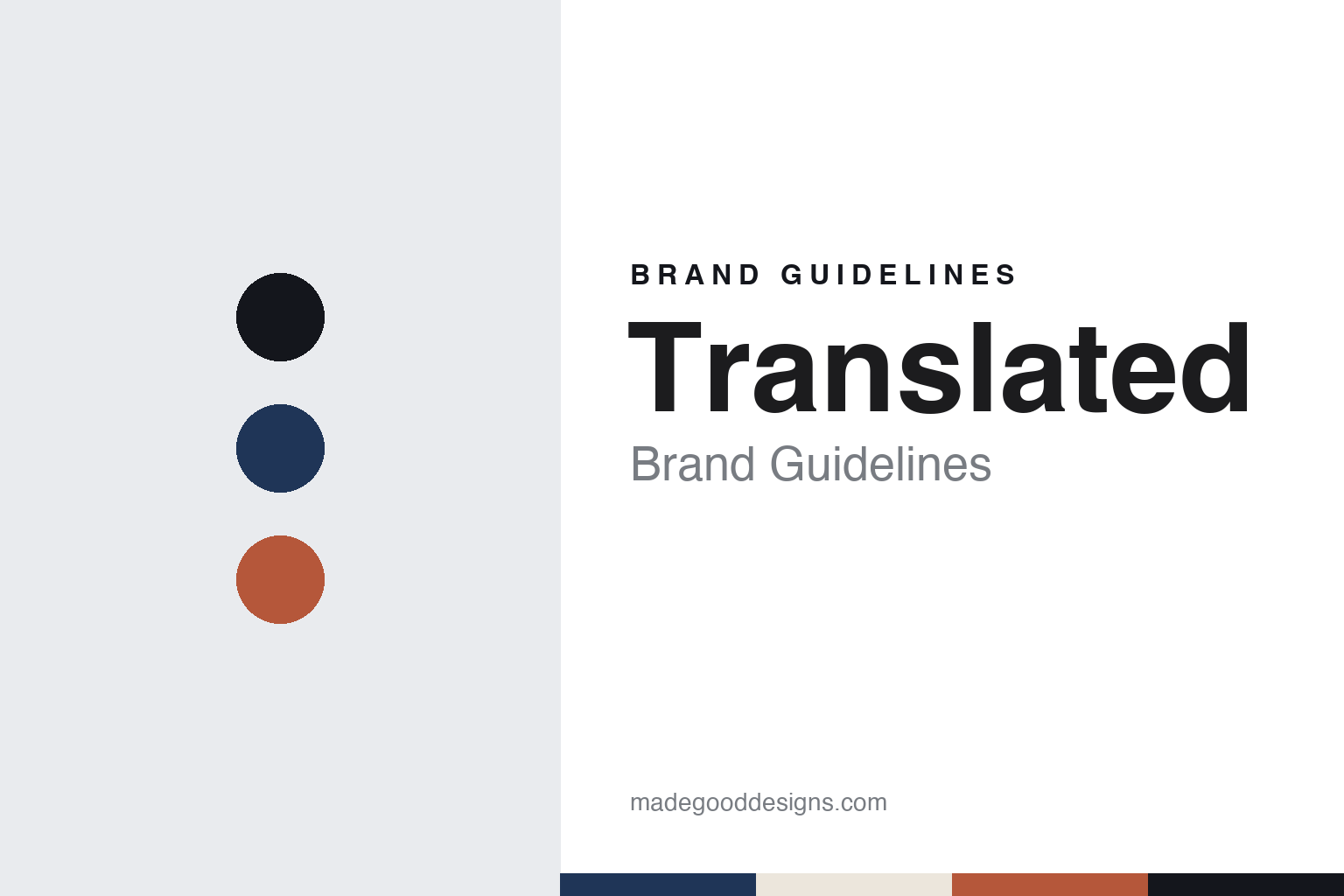
Translated Brand Guidelines
A Rome language company built around named translation tools.
Aa
Two constants: an ink blue, terracotta and stone palette and a clean sans register. Abstract homage — not a Translated product or mark; no logo or interface is reproduced.
Rome, 1999
A linguist, a computer scientist and a web domain.
Translated was founded in Rome in 1999 by the linguist Isabelle Andrieu and the computer scientist Marco Trombetti, the company says on its About page. Italian Wikipedia gives the same year and founders, and the Italian technology news site Key4biz described the pair in December 2024 as a French linguist and a Roman computer scientist, calling Translated a Roman company. That article was based on the founders’ talk at the 18th Premio Vincenzo Dona, an event run by the consumer association Unione Nazionale Consumatori in Rome. EconomyUp, the Italian innovation news site, reported in June 2021 that the founders began by buying the domain translated.net and launching an online translation agency; the company now trades from translated.com.
From the start the business paired professional translators with software. The company says it introduced adaptive machine translation in 2011, meaning models that learn from the corrections translators make as they work. Italian Wikipedia says that in 2010 Trombetti brought together the Fondazione Bruno Kessler in Trento, the University of Le Mans and the University of Edinburgh in a consortium that built Matecat, an open-source computer-assisted translation tool released in 2014. English Wikipedia describes Matecat as a European Union research project that ran from November 2011 to October 2014, led by the Fondazione Bruno Kessler with Translated, the Université du Maine and Edinburgh as partners, and released under the LGPL licence. The company says Matecat won the TAUS Innovation Contest in 2014.
Translated also became a backer of other start-ups. EconomyUp reported that profits from Translated funded Pi Campus, a Rome start-up district and venture fund, and the company says many of its staff came through Pi Campus companies or through Pi School, its training programme for AI specialists.
Colour
Matecat, ModernMT and Lara.
The products carry short, coined names. ModernMT was founded in 2015 by Trombetti and the researcher Marcello Federico, funded by Translated and the Fondazione Bruno Kessler, Italian Wikipedia says; it describes ModernMT as a neural machine-translation system that improved in real time from the corrections it received, and says it was merged into Translated in 2022. The company says ModernMT was named in Gartner’s Cool Vendors list for speech and natural language in 2019.
The current flagship is Lara, which the company calls a translation AI that weighs the whole document, explains its choices and asks for clarification, for example over gendered words in Italian and German. Italian Wikipedia dates the launch of Lara Translate, the public tool, to 2024. Key4biz reported in December 2024 that Lara offers faithful, fluid and creative modes, and the language-industry research firm Nimdzi Insights, in its 2026 Nimdzi 100 report published in April 2026, named Lara among machine-translation systems that run on large language models. The same report says Translated is working on Meetween, an EU-funded multimodal AI project for virtual meetings.
The company says Lara reaches translators through its translation software, enterprises through its service platform and the public through Lara Translate. It describes its offer as AI combined with more than 10,000 expert translators and copywriters drawn from a network of more than 500,000 professionals. Key4biz put the figure at about 10,000 professional translators a year, working in 200 languages and more than 40 specialist sectors, while EconomyUp reported 194 languages and a network of 200,000 translators in 2021. EconomyUp named Airbnb, Google and Uber among the technology platforms Translated served at that time; Key4biz in 2024 put the client count at more than 300,000, naming Airbnb, Uber and Glovo. The same Key4biz article reported a research project announced by Translated and Cineca, the consortium that runs the Leonardo supercomputer in Bologna, to train an Italian–English translation model on Translated’s data.
Typography
Language maps, people and platforms.
Translation and localisation companies sell a service that is hard to picture, so their public material tends to lean on numbers and names. RWS describes a network of more than 250,000 data specialists and language experts in its regulatory announcements, and TransPerfect’s standard press-release text, as used in 2026, lists offices in more than 150 cities on six continents and services in more than 200 languages. For a designer, those counts work as a kind of map: the reach of the company is shown through cities, countries and languages rather than through a product on a shelf.
Platform names carry much of the identity. RWS keeps Trados, a translation-memory tool it gained through its 2020 merger with SDL, as a product brand, and in March 2026 added Language Weaver Pro, an AI translation model it says was built with Cohere. TransPerfect gathers its software under GlobalLink, with GlobalLink Media for subtitling and dubbing. This guide describes them only as their makers do.
The companies also explain themselves through their structure. RWS sorts its reports into three named segments, Generate, Transform and Protect, while TransPerfect runs divisions such as TransPerfect Media, TransPerfect Gaming and TransPerfect Legal Solutions under one compound name. Acquired businesses can be renamed into these families: Moravia, bought by RWS in 2017, became RWS Moravia in 2018, and RWS completed its purchase of Acolad’s parent company in November 2026.
Corporate pages on owners and offices are part of the same picture. A listed company such as RWS publishes its headquarters, market and deals through regulatory announcements; a private one such as TransPerfect states its global and regional headquarters in its press releases. This guide follows those documents, and marks plainly what rests on a company’s own word.
Aa
A clean sans — a plain, technical register. (Specimen set in IBM Plex Sans, a sans STAND-IN; NOT the Translated logo.)
Translated
A plain-word name and a direct voice.
Translated has stayed under its founders’ leadership while taking outside capital. In June 2021 the French private-equity firm Ardian led an investment round in the company through its Ardian Growth fund, EconomyUp reported, calling it the company’s first funding round; the company says it partnered with Ardian that year to scale its combined human and AI translation offer. Trombetti is chief executive, the company says, and the 2026 Nimdzi 100 lists Andrieu as co-founder and chair. Nimdzi lists Translated under Italy in that ranking.
The company says it has offices in Europe and the United States and a team of more than 230 people, including project managers, AI researchers and customer-success staff; EconomyUp reported offices in Italy and the United States in 2021. It also runs Imminent, a research centre that it says funds language-data research and gives awards for work on international communication.
The brand voice is direct. The About page opens with the line “We believe in humans,” calls the company “naive” in the sense of taking on challenges others call impossible, and frames its approach as people and machines working together. The company name is a plain English word, and it sits alongside coined product names such as Matecat, ModernMT and Lara.
For a design guide, Translated shows how a translation company can build its identity around named tools as well as a service. Compare DeepL, the Cologne translation company, and Argos Multilingual, another European language-services firm. For this guide we use a deep ink blue, a warm terracotta and pale stone with a clean sans, an unofficial interpretation; no product or logo is reproduced.
Explore & save
Keep Translated’s identity on hand — save it to a board in the Made Good inspiration library.
Translated identity set
Pin the ink blue, terracotta and stone palette and the clean sans register to your own board.