FitX Brand Guidelines
An Essen gym chain built around one letter.
Aa
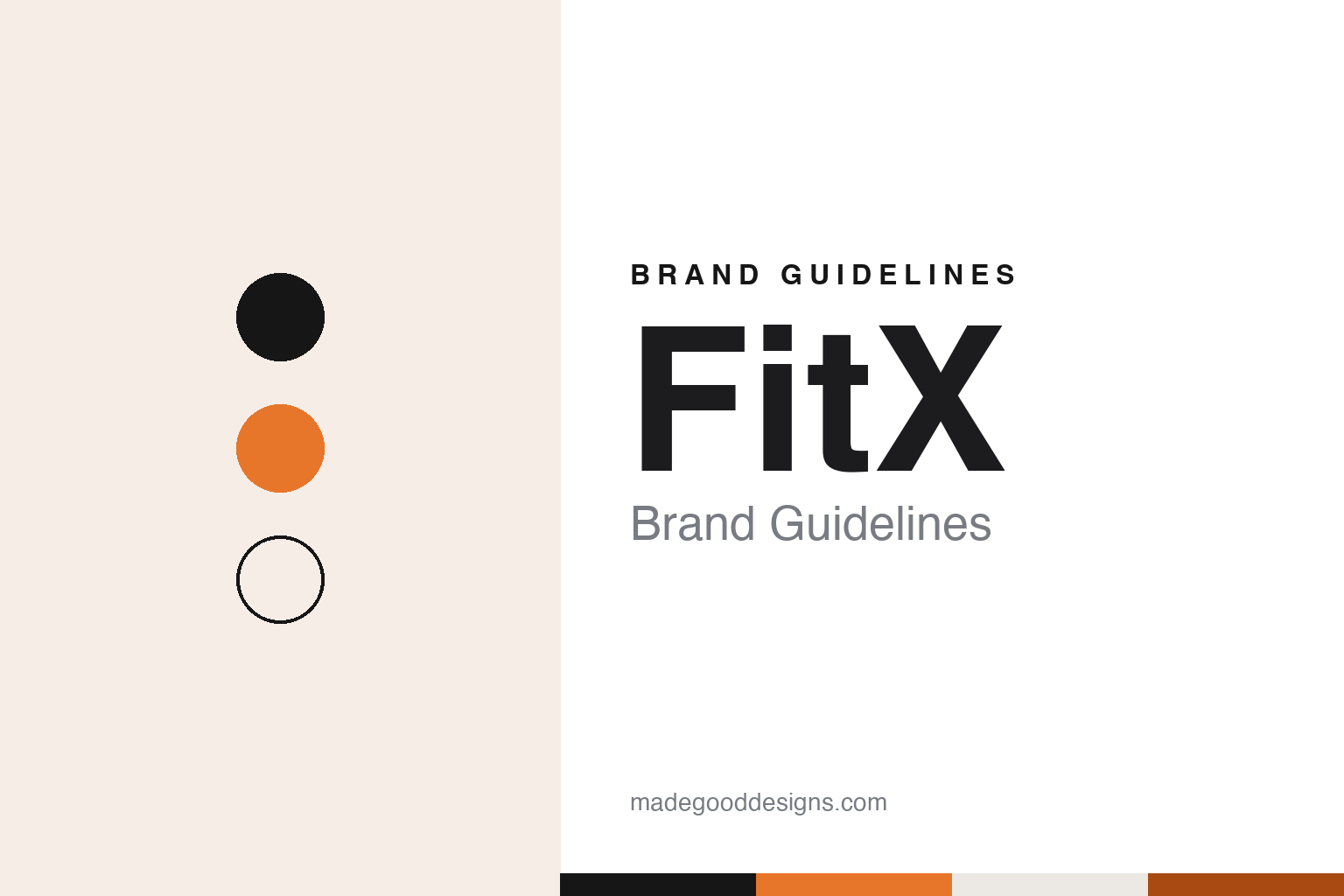
Two constants: a FitX black and orange palette and a Bold sans register. Abstract homage — not a FitX asset or mark; no logo, studio interior or campaign motif is reproduced.
Essen, 2009
A Ruhr gym chain.
FitX is a German chain of gyms based in Essen, in the Ruhr. The company says it was founded in 2009 in Essen and that its first studio opened that November in the Essen-Nordviertel district; German Wikipedia gives the founding date as 27 November 2009 and names the founder as Jacob Fatih. The trade magazine BODYMEDIA, reporting in January 2024, also dated the company’s founding and its first Essen studio to 2009.
The chain spread first through North Rhine-Westphalia and then beyond it. German Wikipedia says there were twelve sites by the end of 2013, that the first Berlin studio opened in August 2014 and the first in Hamburg in March 2015. On the company’s own milestone timeline, the 50th site opened at Limbecker Platz, the Essen shopping centre, and the 100th in Wuppertal-Vohwinkel. BODYMEDIA reported 105 sites in January 2024, more than half of them in North Rhine-Westphalia, and German Wikipedia counted 109 studios in January 2025, all open around the clock.
Ownership moved in two steps. German Wikipedia says the Schmidt-Gruppe, a family group, took a majority stake in 2011, and that in 2019 Fatih stepped down from management and sold his remaining shares to it; FitX’s own timeline records the Schmidt group first joining as a shareholder and later taking over 100 per cent. Today FitX SE in Essen is the parent of the FitX group, the studios are run by FitX Deutschland GmbH in Monheim am Rhein, and the group’s activities are held by FGS Beteiligungs GmbH in Coesfeld, which German Wikipedia attributes to the Schmidt family. The company says it also has offices in Berlin.
Colour
One letter, one claim.
The identity is built around one letter. German Wikipedia describes the logo as the word “Fit” in black followed by an orange X, and the X runs through the brand’s vocabulary. The course programme is called classx, a name the company says it has used since 2015, after the course concept was standardised across all sites in 2011; FitX says the whole course range is developed in-house by its own team, and that courses led by live coaches have been part of the offer since the first studio.
The current look dates from 2015. Horizont, the German marketing and media weekly, reported on 30 March 2015 that FitX had brought in the creative duo Rocket & Wink for a brand relaunch covering a new logo, a reworked corporate design and a changed interior design for its studios. FitX had not worked with an agency before, the paper noted, and it approached the designers directly rather than holding a pitch, a marketing employee told Horizont. The relaunch introduced the claim “For All Of Us,” flanked on campaign motifs by coined words built on the X, such as “Xuperdrauf” and “Xensationell.” German Wikipedia says the previous claim had been “… mein Studio,” or “… my studio.”
Horizont described the new look as a mix of emotional, reportage-style photographs and unusual illustrations and infographics, spread mainly online and on social media, with outdoor and print advertising tied to studio openings. The photographs in the studios and on the campaign motifs were made with the New York photographer Jörg Badura, and most of the people pictured were FitX employees, the paper reported. The stated aim, according to the company’s marketing head at the time, was to set the chain apart from the clichés of the industry and put the fun of exercise first.
The claim has lasted. In January 2024 the company’s chief executive, quoted by BODYMEDIA, described offering fitness “For all of us” as the vision FitX had followed from the start, and the company page today closes with the line “FitX – For all of us.”
Typography
Design and documentation.
Gym and health-club chains sell a place, so much of their visual identity lives in photographs of the clubs themselves: the equipment floor, the class studios, the changing areas and, increasingly, the details of a refit. The companies publish this imagery in their own press rooms and on club pages, and when a chain modernises, the new interior often becomes the story; RSG Group’s 2024 release on McFit described steel, concrete and wood rather than a new logo.
Many chains split one name into tiers and sub-brands. A club brand may run a premium line and a value line under separate colours, give its class formats their own names, or sell a training programme through its member app. Fitness First’s German owner, for example, separates BLACK and RED clubs, and the UK business launched a training service called “able” inside its app in 2025.
Campaign identities change faster than logos. Slogans, ambassadors and sports sponsorships give a chain public visibility for a few years, while a wordmark and its colours may last a decade or more. Where a rebrand is documented, it is usually in trade or marketing press at the time of the launch, and that is where the guides in this set look for it.
Ownership is often the least visible layer. Corporate websites, press releases and trade magazines record which investor owns a chain, how many clubs it counts and in which countries, and those figures change with each purchase or sale. The guides in this set give club, member and country counts only as a dated source states them, and name the owner as of that source.
Aa
A bold sans — a short word and a crossing letter. (Specimen set in Archivo, a sans STAND-IN; NOT the FitX logo.)
FitX
Studios in zones.
Inside, the company describes each studio in zones: a large cardio area, machine training on more than 60 machines from Technogym, a “Basics” area with six Hammer Strength machines, a free-weights area, a “Turnecke” — a gym corner — for functional training with medicine balls, kettlebells and ropes, and a women-only “Lady Gym” with a door that closes. The company says every site is renovated every six to eight years, with new equipment and an updated colour scheme. On its company page it describes itself as the second-largest fitness provider in Germany and gives more than 100 studios, more than one million members and about 3,750 employees in studios, logistics and offices in Essen, Berlin and Monheim am Rhein. BODYMEDIA reported the one-million-member mark in January 2024, in the company’s 15th year.
Partnerships carry the brand into sport. BODYMEDIA reported in May 2023 that FitX had become the official fitness partner of the NFL in Germany for three years, with content on social media and activities around the league’s games in Germany, and in March 2025 that it had become a premium partner of the Olympiastützpunkt NRW/Rhein-Ruhr, the Olympic training centre in Essen, whose athletes can train at FitX free of charge. German Wikipedia adds a 2024 sponsorship of the German men’s and women’s flag football teams through the national American football association. The company’s timeline also lists a first company-wide charity campaign, “FitX gibt zurück,” at its tenth anniversary, and support for the Essen social initiative Essener Chancen.
For a design guide, FitX shows how a single letter can carry a whole system, from the logo to the course brand and the campaign wordplay. Compare McFit, another German gym chain, and Basic-Fit, a European gym chain. For this guide we use a black and a bright orange with a sans, an unofficial interpretation; no product or logo is reproduced.
Explore & save
Keep FitX’s identity on hand — save it to a board in the Made Good inspiration library.
FitX identity set
Pin the FitX black and orange palette and the Bold sans register to your own board.