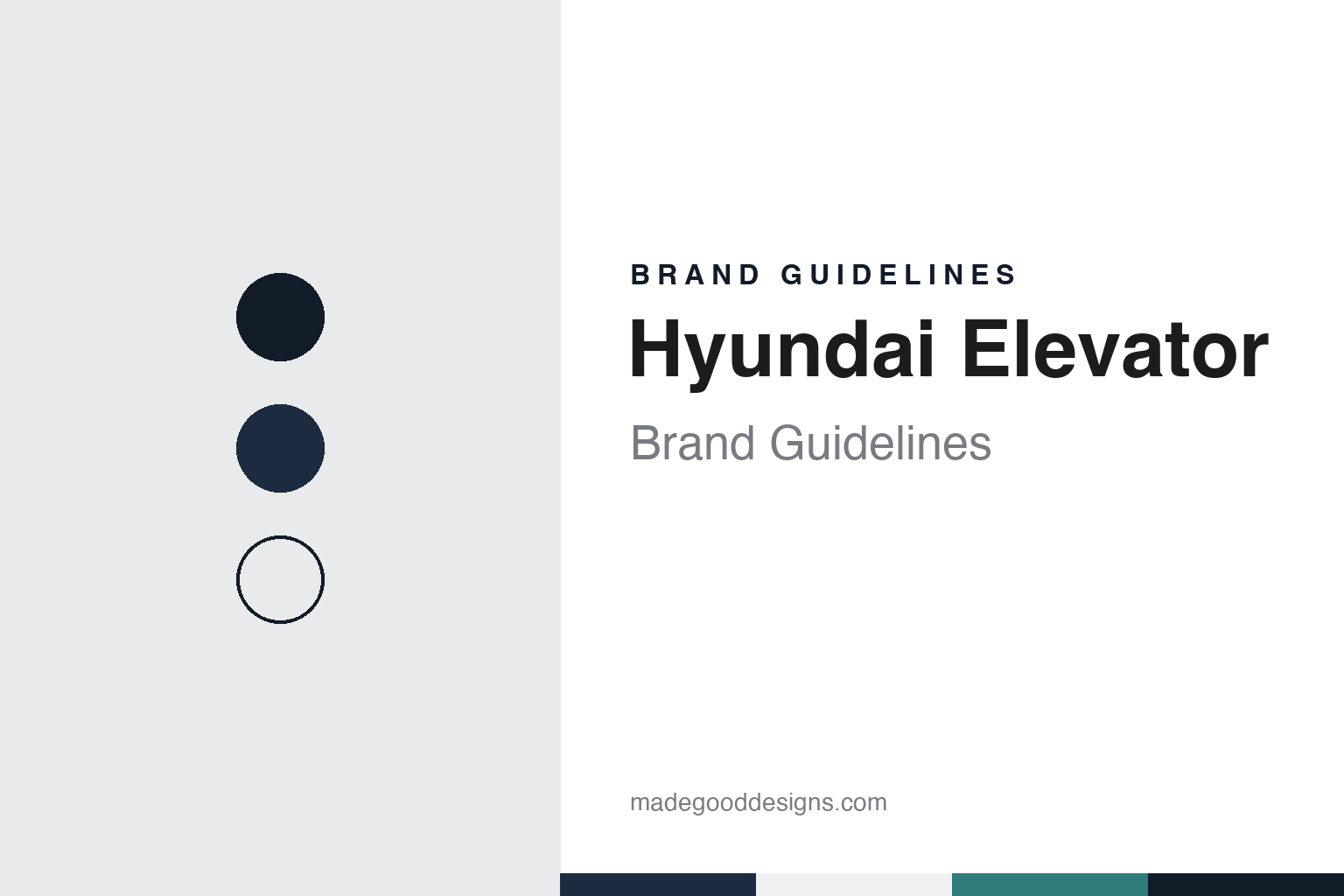
Hyundai Elevator Brand Guidelines
A 1984 Hyundai–Westinghouse venture now based in Chungju.
Aa
Two constants: a Hyundai Elevator ink blue, steel grey and teal palette and an Engineering sans register. Abstract homage — not a Hyundai Elevator product or mark; no lift, logo or nameplate is reproduced.
A Hyundai Joint Venture, 1984
From Ulsan to Icheon.
Hyundai Elevator grew out of the building boom that Hyundai Group’s construction business was riding at home and in the Middle East. Korean Wikipedia says that in the late 1970s Hyundai’s builders had to buy large numbers of lifts from foreign suppliers for housing projects in Saudi Arabia, and that an earlier plan to make its own came to nothing because no partner would share the technology. In March 1982, on the instruction of group founder Chung Ju-yung, a materials-handling division was set up inside the group’s electrical-equipment company, Hyundai Heavy Electric, and began building lifts at its plant in Ulsan with technology from Westinghouse, the American firm Hyundai already worked with on power-station projects.
The company itself followed two years later. Korean Wikipedia says a joint-venture contract was signed in January 1984, with Hyundai holding 60 percent and Westinghouse 40 percent, and that Hyundai Elevator Co., Ltd. was established on 23 May 1984; English Wikipedia also describes it as a 1984 joint venture between Hyundai Electrical Engineering and Westinghouse Electric. A large factory in Icheon, in Gyeonggi Province, was completed in May 1985, and the head office moved there that October. A research institute followed in 1986, along with a 64.5-metre test tower.
The Westinghouse link did not last. Korean Wikipedia says Westinghouse sold its lift business to Schindler in June 1989 without consulting Hyundai, and that Hyundai Elevator took over the 40 percent stake and ended the tie-up; English Wikipedia instead says Schindler succeeded to Westinghouse’s stake, so the two accounts differ. Through the 1990s the company added multi-storey parking systems, under a 1990 technology agreement with Japan’s Nippon Cable, and belt-type moving walks from 1993. It registered its shares for over-the-counter trading in 1994 and listed on the Korea Exchange on 3 July 1996, Korean Wikipedia says.
Colour
Test towers and a new campus.
Hyundai Elevator’s public story is built less on a single product than on a long run of dated engineering milestones. Korean Wikipedia lists a home-built permanent-magnet synchronous traction machine in 2000, a destination-dispatch system sold under the name HELIAS from 2006, and a 205.2-metre test tower in Icheon, completed in April 2009 and named Hyundai Asan Tower. Logistics systems and platform screen doors were spun off in 2017 into a separate company, Hyundai Movex.
In May 2019 the board decided to move the head office and factory from Icheon to an industrial estate in Chungju, North Chungcheong Province, and to sell the Icheon site, used since 1985, to the chipmaker SK Hynix, Korean Wikipedia says. Ground was broken in Chungju in July 2020, and English Wikipedia dates the head-office move to 2022. The Korea Herald reported in May 2025 that a new research centre had been completed there around a second Hyundai Asan Tower, 250 metres tall, which can test up to 19 lifts at once, including a model that travels at 1,260 metres per minute; the paper described Hyundai Elevator as Korea’s largest elevator manufacturer.
Herald Business reported in July 2026 that the Chungju Smart Campus serves as both the headquarters and the main domestic production base. It covers about 172,759 square metres and houses the research centre, sheet-metal and assembly buildings, a logistics facility and the test tower, with about 600 people working on site. The same report described it as a smart factory using AI vision, robots and the Internet of Things, with roughly 80 percent of work automated.
Abroad, English Wikipedia lists six subsidiaries — in China, Vietnam, Indonesia, Malaysia, Turkey and Brazil — and agents in 49 countries. The oldest is in Shanghai: Korean Wikipedia says a joint venture was set up there in 1993 and that Hyundai Elevator took full ownership in 2014. In April 2026 The Korea Times reported the launch of ENOBLOC, a modular system in which, the company says, more than 90 percent of key lift components are preassembled in a factory; it was installed in a 27-storey apartment building in Songdo, Incheon.
Typography
How home-lift and stairlift makers present themselves.
Home-lift and stairlift makers sell machines that end up in private hallways and living rooms, and two Swedish makers, Aritco and Cibes, present them that way. Aritco names its range around the home, with the HomeLift, HomeLift Compact and HomeLift Access, and credits the Swedish designer Alexander Lervik for several models; Cibes Lift Group says its customers choose from colour, material and function options picked by local design teams.
Naming often begins as engineering shorthand. Cibes still uses letter-and-number models such as the A5000, launched in 1992, and groups its lifts as A-lifts, with their own shaft walls, and B-lifts, which the company traces to a screw-and-nut design of the early 1970s. Aritco moved from numbered models, from the Aritco 7000 of 1995 to the Aritco 9000 cabin lift of 2013, to the named HomeLift and PublicLift lines from 2016 onwards.
Both companies describe selling largely through partners. Cibes Lift Group says it works through more than 270 certified distributors as well as its own offices in 20 countries; Aritco says it sells in 60 countries through more than 170 distributors, and that it set up a global network of installation and service partners in 2014. Cibes has also bought local lift companies and kept several of their names, such as Kalea, Aesy Liften and Apex Lifts.
Corporate pages fill in the rest: who owns the company and where the lifts are made. Cibes names its factories in Gävle, Jiaxing and the United States and a components unit in Gdańsk, and its owner, the investment company Nalka, lists it as a holding. Aritco describes its factory in Veddesta, outside Stockholm, and its place in Innovalift, a business area of Investment AB Latour. This guide sets out what can be checked for each brand, and marks what rests on the company’s own word.
Aa
An engineering sans for a lift maker that dates its milestones. (Specimen set in Inter Tight, a sans STAND-IN; NOT the Hyundai Elevator logo.)
Hyundai Elevator
A listed company inside Hyundai Group.
Hyundai Elevator’s ownership story is tied to the wider family of Hyundai companies. After the original group divided in the early 2000s into separate businesses, including the carmaker and the shipbuilder, Hyundai Elevator became in effect the holding company of the smaller Hyundai Group, Korean Wikipedia says. In 2003 the chemicals and building-materials maker KCC, run by a relative of the group founder, built up a large stake and announced a bid for control; after a regulator ordered KCC to dispose of shares bought without timely disclosure, the contest ended at a shareholders’ meeting in March 2004, and in March 2006 KCC sold its holding to Schindler, according to Korean Wikipedia. English Wikipedia puts the stake Schindler bought from KCC at 25.5 percent.
Schindler stayed a large and often critical shareholder for years. Over time it reduced its holding: Chosunbiz reported in July 2025 that it had cut its stake to 7.57 percent, leaving Hyundai Holdings Company as the largest shareholder with 19.3 percent.
The name needs care. Hyundai Elevator shares the Hyundai name with the carmaker, the shipbuilder and the construction company, all now separately owned, and its product names — HELIAS, ENOBLOC — are written in capitals that set them apart from the corporate name.
For a design guide, Hyundai Elevator shows how an industrial brand can carry a group name while building its own story from factories, test towers and dated engineering milestones. Compare Schindler, its long-time shareholder, and Otis. For this guide we use an ink blue, a steel grey and a teal with a sans, an unofficial interpretation; no product or logo is reproduced.
Explore & save
Keep Hyundai Elevator’s identity on hand — save it to a board in the Made Good inspiration library.
Hyundai Elevator identity set
Pin the Hyundai Elevator ink blue, steel grey and teal palette and the Engineering sans register to your own board.