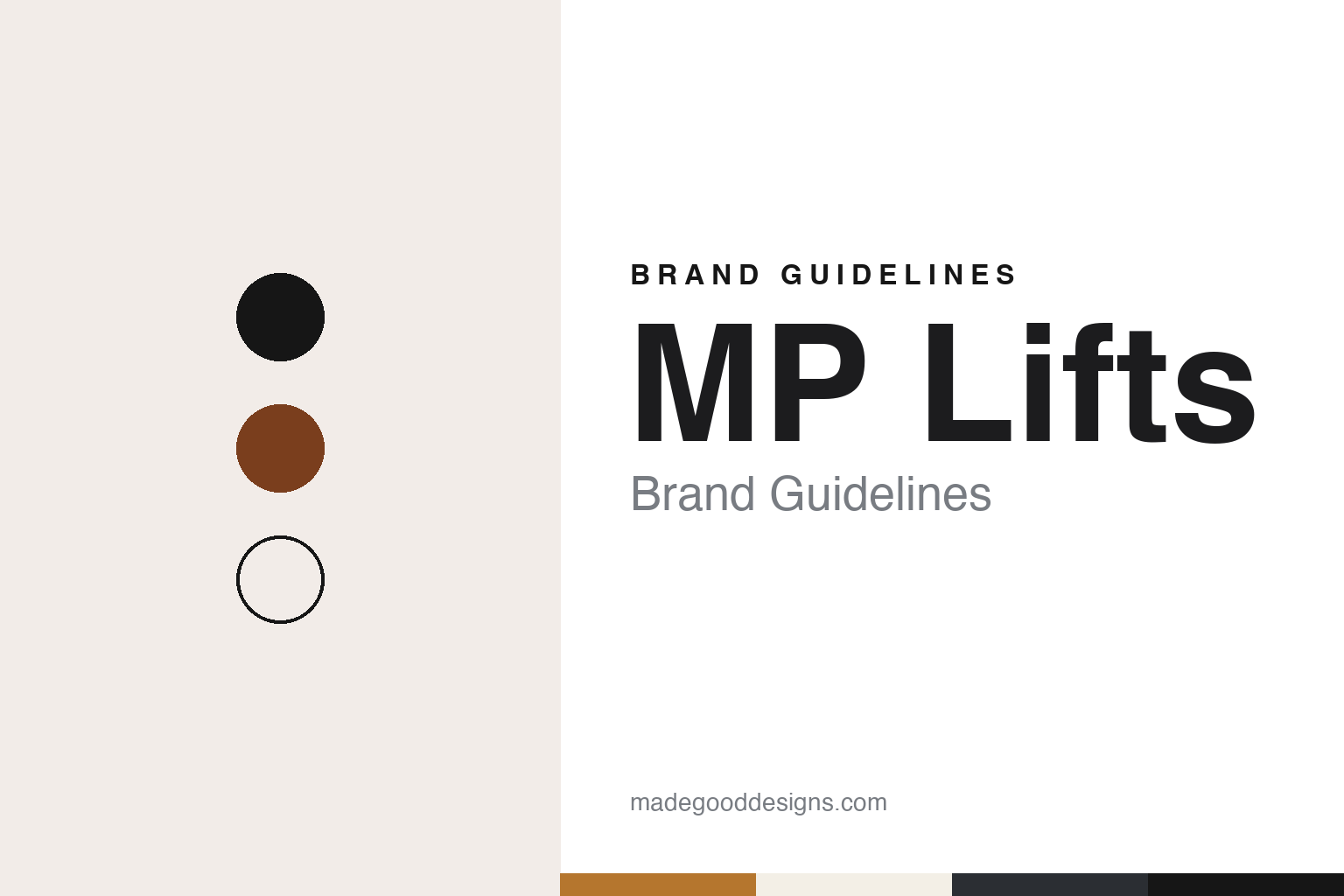
MP Lifts Brand Guidelines
The Seville family lift maker that grew from a 1970 parts firm.
Aa
Two constants: an MP Lifts ochre, carbon grey and lime-wash palette and a Rounded sans register. Abstract homage — not an MP Lifts product or mark; no lift, logo or nameplate is reproduced.
Mecanismos y Accesorios
A Seville parts maker that became a lift maker.
MP, which trades in English as MP Lifts and in Spanish as MP Ascensores, is a family-owned lift maker based in Seville. Its own history starts in 1970, when its founder, Valentín de Madariaga Oya, began with a small company called Mecanismos y Accesorios (MAC), which made mechanical and electromechanical parts for lifts. The company describes him as the father of its current owners and says it has more than 30 years in the lift industry.
The company dates the founding of MP itself to 1988, when, it says, his company VMO acquired all of MAC. The Seville edition of ABC gave the same year in June 2025, describing MP as founded in 1988 by Valentín de Madariaga and as entirely family-owned, with about 1,150 employees.
MP’s timeline then reads as a slow climb from component supplier to maker of complete lifts. The company lists a pre-assembled electrical installation for lift shafts, called PEI, launched between 1990 and 1993; the purchase of the door maker Puertas Aragón (PUARSA) between 1994 and 1997; and, from 1998 to 2001, the move to complete lifts sold under the MP brand, followed by international expansion and a new focus on research and development. From 2006 it added installation and maintenance services, and it describes a corporate restructuring between 2013 and 2015 that focused the business on MP Lifts. ABC reported in 2025 that MP had gone through financial difficulties in 2012 and had reduced its debt since then.
Colour
Two plants, a configurator and a slogan.
MP says it reunified its industrial plants between 2016 and 2018, and it now names two production centres. In Zaragoza, on the Malpica industrial estate, a plant of about 23,300 square metres handles engineering, complete lifts, standard and special cars, frames and a logistics centre. In Seville, on the Calonge estate, a plant of about 28,000 square metres makes automatic doors and hydraulic, mechanical, electrical and electronic parts and carries out component engineering, the company says.
Its catalogue is organised by building type rather than around a single hero product. For new buildings it lists gearless machine-roomless lifts under MP GO, the space-adaptable MP Flex, the hydraulic MP Hydro H and the high-capacity MP Mega, along with versions with a machine room. For homes it offers MP Mobi, and in March 2024 it introduced MP Mobi HOME for private houses, with cars for two to five people and a pit from 15 centimetres, according to the company. In October 2025 it showed the MP GO 200x and MP Flex 200 at Interlift in Nuremberg under the slogan “Connected to you,” together with a controller built into the lift door, the company says.
Software is a large part of how MP presents itself. Its website offers a car designer, a configurator called MP Deby and calculation tools for architects, and ABC reported in 2025 that the company had developed software that recommends a lift for a given space and generates its drawings by algorithm. The same report said the company specialises in made-to-measure lifts, and noted bespoke commissions, including lifts that stop automatically at every floor on the Sabbath.
MP sums up its purpose in two short lines: a mission of “designing smart mobility solutions” and a vision of “Moving People.” It calls itself “the smart choice” and lists five values, among them innovation, closeness, integrity and excellence, under the name “MP Way.”
Typography
How home-lift and stairlift makers present themselves.
Home-lift and stairlift makers sell machines that end up in private hallways and living rooms, and two Swedish makers, Aritco and Cibes, present them that way. Aritco names its range around the home, with the HomeLift, HomeLift Compact and HomeLift Access, and credits the Swedish designer Alexander Lervik for several models; Cibes Lift Group says its customers choose from colour, material and function options picked by local design teams.
Naming often begins as engineering shorthand. Cibes still uses letter-and-number models such as the A5000, launched in 1992, and groups its lifts as A-lifts, with their own shaft walls, and B-lifts, which the company traces to a screw-and-nut design of the early 1970s. Aritco moved from numbered models, from the Aritco 7000 of 1995 to the Aritco 9000 cabin lift of 2013, to the named HomeLift and PublicLift lines from 2016 onwards.
Both companies describe selling largely through partners. Cibes Lift Group says it works through more than 270 certified distributors as well as its own offices in 20 countries; Aritco says it sells in 60 countries through more than 170 distributors, and that it set up a global network of installation and service partners in 2014. Cibes has also bought local lift companies and kept several of their names, such as Kalea, Aesy Liften and Apex Lifts.
Corporate pages fill in the rest: who owns the company and where the lifts are made. Cibes names its factories in Gävle, Jiaxing and the United States and a components unit in Gdańsk, and its owner, the investment company Nalka, lists it as a holding. Aritco describes its factory in Veddesta, outside Stockholm, and its place in Innovalift, a business area of Investment AB Latour. This guide sets out what can be checked for each brand, and marks what rests on the company’s own word.
Aa
A rounded sans for a family lift maker with short product names. (Specimen set in Manrope, a sans STAND-IN; NOT the MP Lifts logo.)
MP Lifts
A Seville family firm with most of its sales abroad.
Most of MP’s business is now outside Spain. ABC reported in June 2025 that about 85 percent of its sales were abroad, that it had bought the Belgian company Europa Lift in 2023, and that earlier stakes gave it direct sales in France, Sweden, the Netherlands, Poland, the Czech Republic and Spain. The paper described MP as the seventh operator in the European lift sector and reported a strategic plan for 2025–2027 built on buying installation and maintenance businesses in Europe and growing in Germany, Italy and Asia.
The company’s own news pages track that plan. It announced a partnership with YugX to enter India in October 2025, the appointment of Rafael Ruiz Nieto as chief executive in January 2026, and the addition in March 2026 of a Czech lift company, which it says brought 500 lifts in Prague and Brno into its portfolio and which, it says, keeps operating as it did before. In June 2026 it said the Romanian maintenance company Koppel Romania Ascensoare had joined its Romanian branch, MP IFMA, adding 300 lifts in Bucharest. MP says it has more than 1,200 employees, more than 165,000 lifts installed and operations in over 100 countries.
The names need care. The brand appears as MP, MP Lifts and MP Ascensores depending on the market, and product names keep the two letters in front — MP GO, MP Flex, MP Mobi — so the family name of the range stays visible on every model.
For a design guide, MP shows how a parts maker can turn itself into a full lift brand through short product names, a configurator-led catalogue and a values statement it calls a way of working. Compare IGV Group, another southern European lift maker, and KONE. For this guide we use an ochre, a carbon grey and a lime-wash white with a sans, an unofficial interpretation; no product or logo is reproduced.
Explore & save
Keep MP Lifts’s identity on hand — save it to a board in the Made Good inspiration library.
MP Lifts identity set
Pin the MP Lifts ochre, carbon grey and lime-wash palette and the Rounded sans register to your own board.