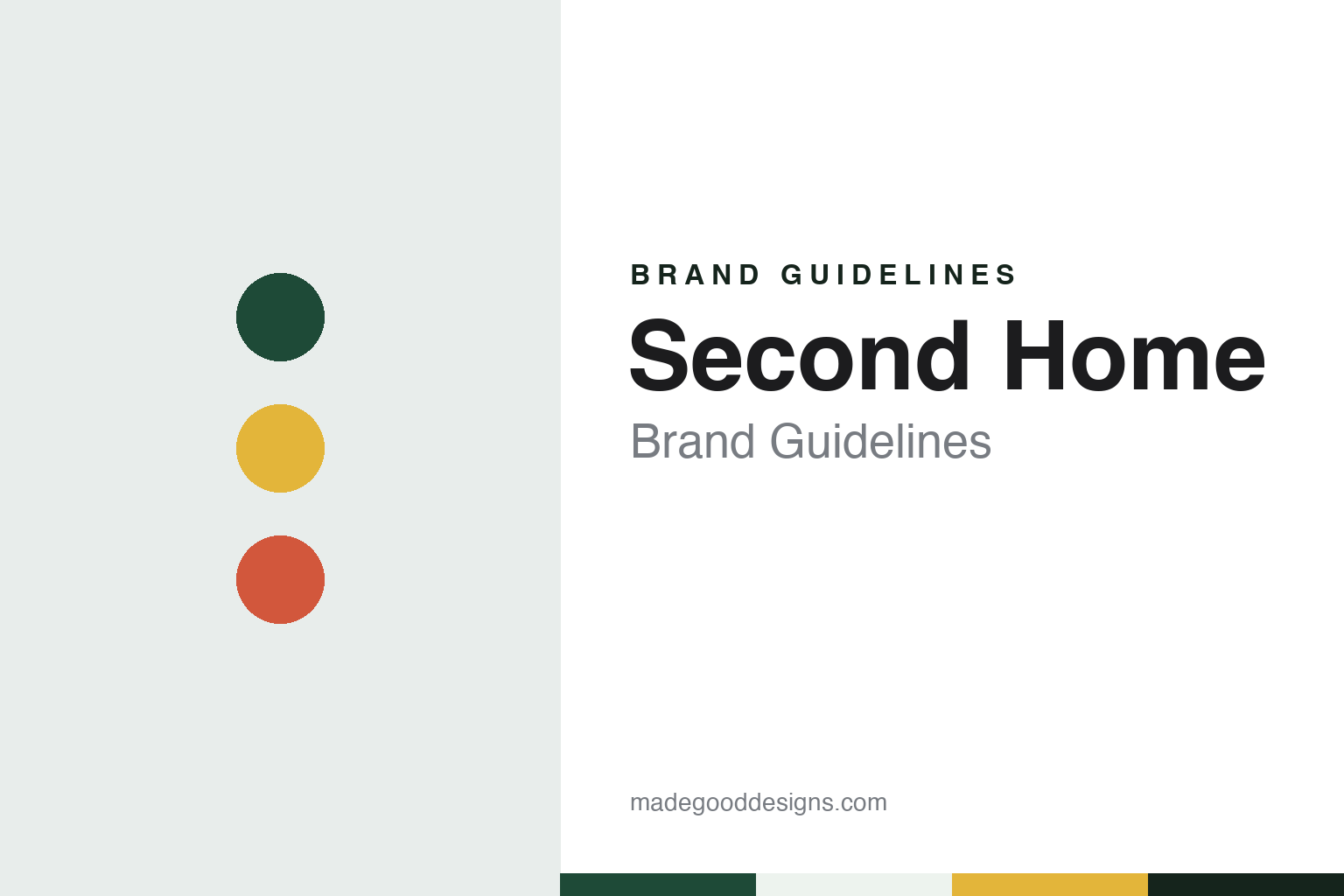
Second Home Brand Guidelines
The Spitalfields workspace built on architecture, plants and talks.
Aa
Two constants: a green, yellow and red palette and a rounded sans register. Abstract homage — not a Second Home building or mark; no logo, sign or photograph is reproduced.
Spitalfields, 2014
A creative workspace in East London.
Second Home is a workspace and cultural venue that opened in 2014 in Spitalfields, near Brick Lane in East London. Companies House records show that Second Home Ltd was incorporated on 18 October 2013, and the administrators’ statement filed in January 2025 says the company began trading in 2014. The website dates the opening the same way: “Since opening our doors in 2014,” it says, the business has supported more than 18,000 businesses, a figure it gives for itself.
The founders were Rohan Silva and Sam Aldenton. English Wikipedia names both as the people behind Libreria, the bookshop Second Home opened in Spitalfields on 25 February 2016, and the travel and trends site Globetrender described Aldenton as a Second Home co-founder in December 2019. The administrators’ summary of the company’s background describes it as a business supporting entrepreneurship and job creation, centred on coworking.
From the start the business paired desks with talks, food and culture. Its community page says the membership mix was inspired by MIT’s Building 20, the research building in Cambridge, Massachusetts, and lists members from advertising, architecture, film, fashion, food, technology and social-impact work. Its sustainability page says the company’s opening talk was given by the biologist E. O. Wilson, a writer on biophilia, the idea that people are drawn to living things. Its cultural programme has since hosted speakers including the designer Thomas Heatherwick and the fashion designer Stella McCartney, the website says.
The business spread from Spitalfields to other parts of London and abroad. English Wikipedia’s list of SelgasCano’s works dates Second Home London Office to 2014–2015, Second Home Lisbon to 2016–2017, Second Home Holland Park to 2017 and Second Home Hollywood, in Los Angeles, to 2019. Globetrender reported that the Hollywood campus opened in September 2019.
Colour
SelgasCano colour, plants and plastic.
Second Home’s look comes largely from one architecture practice. SelgasCano, the Madrid office founded in 1998 by José Selgas and Lucía Cano, designed its London, Lisbon and Los Angeles buildings, English Wikipedia says. The same article describes the practice’s constant use of polychromy, or many colours, and its liking for industrial plastics such as ETFE, acrylic and polycarbonate, often in translucent façades. It quotes the London Design Biennale director Christopher Turner on the “pop-art playfulness” of the pair’s colour, which he traced through projects “from east London to northern Kenya.”
Plants are the other constant. Second Home’s sustainability page says the company prefers to repair and reuse old buildings rather than build new, and calls itself a believer in biophilic design. It describes a “bubble roof” at Holland Park that responds to the weather, and a Lisbon roof that opens at night to let cool air in and closes before sunrise, with pipes of hot and cold water running under the floor. In Lisbon the workspace sits on the first floor of the Mercado da Ribeira, the market hall that houses Time Out Market, near Cais do Sodré; the company calls it “an urban jungle.”
The Hollywood campus took the idea furthest. Globetrender reported in December 2019 that it was made up of 60 circular offices with yellow roofs, built on the site of a former car park and set among gardens planted with 6,500 shrubs and 400 full-size trees, beside the former Anne Banning Community House, a 1964 building by the architect Paul Williams that was renovated for the project. From above, the site wrote, the roofs looked like giant yellow lily pads. It quoted Aldenton describing the aim as a home for “the 21st-century creative entrepreneur.”
Books are part of the identity too. English Wikipedia says Libreria, also designed by SelgasCano, was based on Jorge Luis Borges’s story “The Library of Babel,” with mirrored walls and ceilings and floor-to-ceiling shelves built by students from the Slade School of Fine Art. Its shelves are arranged by themes rather than by genre, phones are not to be used inside, and there is a printing press in the basement. In 2018 it opened a poetry outpost with the publisher Faber & Faber at Second Home Holland Park.
Typography
How workspace brands present themselves.
Flexible workspace operators sell something hard to photograph: the chance to rent a desk, a room or a whole floor for as long as a business needs it. Their websites lean on interior and lounge photography, usually wide shots of shared kitchens, meeting rooms and breakout areas published by the companies themselves, so a brand is often read through its furniture, lighting and materials rather than by its logo.
Naming does much of the work. Some operators keep the history of their buildings in view: Workspace Group, the London landlord, lets space in places it calls the Metal Box Factory, The Biscuit Factory and The Old Dairy. Others name tiers rather than buildings: JustCo, in Singapore, runs a premium main brand, a luxury line called The Collective and an essentials-focused concept written in lower case as the boring office, according to EdgeProp.
Membership is also handled through software. Operators list apps for booking rooms and desks, passes for using several centres, and virtual-office services, and their sites present these as part of the brand alongside the physical spaces. The words they choose for customers vary: members, tenants, teams or simply businesses.
Behind the lounges sit corporate pages on owners, buildings and cities. Some operators are listed companies or real estate investment trusts that publish their histories, portfolios and board changes; others are private or owned by property groups. This guide sets out what can be checked about each brand — who founded it, who owns it and where it operates — and marks clearly what rests only on the company’s own word.
Aa
A rounded sans — for a brand told through colour and planting. (Specimen set in Bricolage Grotesque, a sans STAND-IN; NOT the Second Home logo.)
Second Home
Administration, a sale and three spaces.
The business later ran into financial difficulty. According to the administrators’ statement of proposals filed at Companies House on 7 January 2025, trading had fallen short since early 2020 as fewer people commuted, and the company went through a restructuring and refinancing in August 2022 but was unable to clear its arrears to the tax authority and to landlords. Since February 2024, the statement says, it had left two of its original five London sites, and at the time of the appointment it ran three sites in London and one in Lisbon.
Second Home Ltd entered administration on 24 December 2024, Companies House records show. The same day, the administrators sold all of its business and assets in a pre-packaged sale to Harrington Acquisition Limited, which the proposals describe as connected to the company’s secured lender; Companies House shows that the buyer was incorporated in April 2024. The old company was still in administration in November 2026, with the period extended in December 2025 and a progress report filed in August 2026, while the Second Home website continued to offer memberships in London and Lisbon.
Today the website lists three spaces: Spitalfields in East London, Holland Park in West London, and the Lisbon space at Mercado da Ribeira. It sells Resident desks, Roaming hot-desk memberships, day passes and private offices, with meeting rooms and venue hire, and runs a cultural programme of talks and events alongside an in-house café, La Despensa. Its about page quotes Wallpaper* calling Second Home “a workplace utopia that fuses design, ecology, and community spirit.”
For a design guide, Second Home shows how architecture, planting and a programme of books and talks can carry a workspace brand further than a logo does. Compare Uncommon, another London workspace brand built around interiors and greenery, and Huckletree, another London workspace operator. For this guide we use a deep green, a sunflower yellow and a tomato red with a rounded sans, an unofficial interpretation; no product or logo is reproduced.
Explore & save
Keep Second Home’s identity on hand — save it to a board in the Made Good inspiration library.
Second Home identity set
Pin the Second Home green, yellow and red palette and the rounded sans register to your own board.