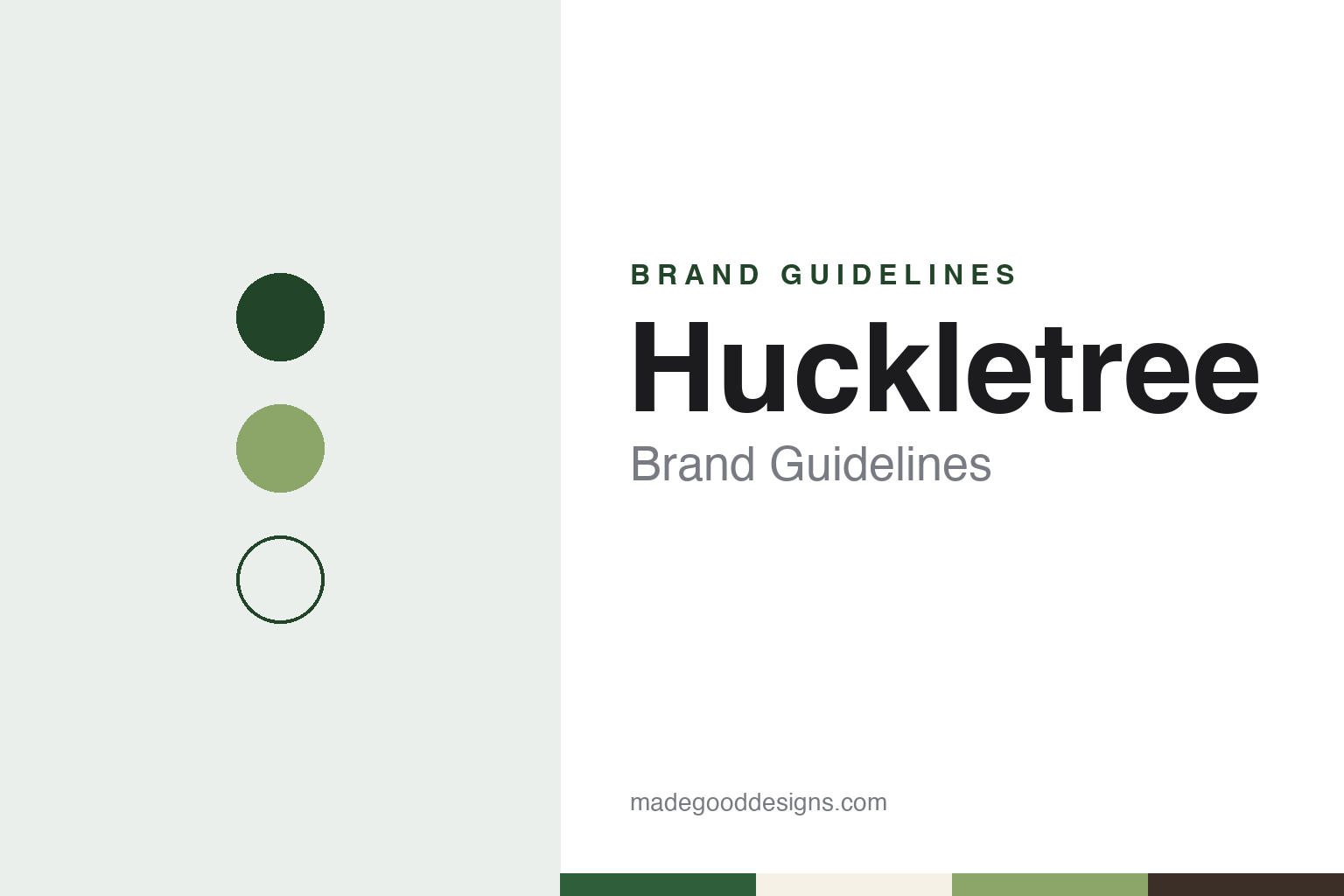
Huckletree Brand Guidelines
A London coworking company that curates each hub around an industry.
Aa
Two constants: a leaf green, bark and cream palette and a rounded sans register. Abstract homage — not a Huckletree asset; no logo, sign or interior is reproduced.
Clerkenwell
A shared office in New York, a first space in London.
Huckletree is a London-based coworking and flexible office company founded in 2014 by Gabriela Hersham, its chief executive, and Andrew Lynch, its chief operating officer. In an April 2022 profile, Silicon Republic reported Lynch’s account that the idea first came to Hersham in 2010, while she was working in the film industry in New York from a shared office, and that the first Huckletree space opened in Clerkenwell, London, in 2014. Property Week gave the same launch year in July 2023. Lynch told Silicon Republic he had worked in private equity and venture capital before joining the coworking business.
From the start the company described its spaces as communities built around particular kinds of business. Lynch told Silicon Republic that each hub is “dedicated to a specific vertical or industry”: Dublin around high-growth tech, SaaS and companies expanding internationally, Soho in London around a network of investors and venture capital firms. He described a working rule of curating about 80 per cent of members around a hub’s industry and keeping the other 20 per cent open to the advisers, lawyers, creative agencies and investors that industry needs. Alongside desks and offices, the magazine reported, the company offers innovation consultancy, educational programmes and events for members, investors and ambassadors.
The first move outside Britain was to Ireland. The Irish arm was set up in 2017, and Huckletree D2 occupies The Academy building in central Dublin, which Silicon Republic notes once housed Twitter’s European headquarters; the magazine counted almost 70 companies there in 2022, with members including Starling Bank and Tines. By December 2022, the same publication reported, the Dublin hub had provided space to more than 200 start-ups and businesses since it opened. The company’s website also lists a hub in the Ancoats district of Manchester.
Colour
White City, Oxford Circus and the City.
The White City hub shows how the company presented itself in its early years. In November 2017 Creative Boom toured Huckletree West at White City Place in west London, designed by the architects Studio RHE with private studios, open-plan desks and breakout areas; Bisnow later placed it on the ground floor of the MediaWorks building. The founders described a no-tech meditation yurt as a favourite corner, and set out the membership tiers: Unlimited and Light flexible memberships, the second allowing ten days a month, Resident memberships with a dedicated desk, and private studios, plus “Crosstown” access across the East and West London spaces and Dublin. They also referred to the company’s East London roots, and said members at West came from fields including virtual and augmented reality, fashion, fintech and film, with an events programme that included life-drawing classes run with their MediaWorks neighbour, Yoox Net-a-Porter.
Growth in London picked up from 2022. Silicon Republic reported in December 2022 that a two-storey, 22,000 sq ft hub on Oxford Street, aimed at Web3 and related technology, would be the company’s seventh across the UK and Ireland; Property Week reported in July 2023 that the Oxford Circus space had opened the previous September. The same article set out plans for 35,000 sq ft at 199 Bishopsgate, near Liverpool Street, for fintech and technology firms, and six floors in Kensington; both now appear among the hubs on Huckletree’s website. In May 2024 Property Week reported a 30,000 sq ft centre in 8 Bishopsgate, Mitsubishi Estate’s City tower, managed by its developer Stanhope, as part of a plan to take the company past 250,000 sq ft across the UK and Ireland.
Not every site stayed in the group. In July 2024 Bisnow reported that Huckletree (West), the subsidiary that leased the White City space, had gone into administration, with administrators from Quantuma Advisory appointed; the company told Bisnow the site was still open and trading and that its other locations and wider business were not affected. At that time Bisnow counted eight Huckletree locations in London, one in Manchester and one in Dublin. White City is not among the hubs listed on Huckletree’s website in November 2026.
Typography
How workspace operators present themselves.
Flexible workspace operators sell something hard to photograph: the chance to rent a desk, a room or a whole floor for as long as a business needs it. Their websites lean on interior and lounge photography, usually wide shots of shared kitchens, meeting rooms and breakout areas published by the companies themselves, so a brand is often read through its furniture, lighting and materials rather than by its logo.
Naming does much of the work. Some operators keep the history of their buildings in view: Workspace Group, the London landlord, lets space in places it calls the Metal Box Factory, The Biscuit Factory and The Old Dairy. Others name tiers rather than buildings: JustCo, in Singapore, runs a premium main brand, a luxury line called The Collective and an essentials-focused concept written in lower case as the boring office, according to EdgeProp.
Membership is also handled through software. Operators list apps for booking rooms and desks, passes for using several centres, and virtual-office services, and their sites present these as part of the brand alongside the physical spaces. The words they choose for customers vary: members, tenants, teams or simply businesses.
Behind the lounges sit corporate pages on owners, buildings and cities. Some operators are listed companies or real estate investment trusts that publish their histories, portfolios and board changes; others are private or owned by property groups. This guide sets out what can be checked about each brand — who founded it, who owns it and where it operates — and marks clearly what rests only on the company’s own word.
Aa
A rounded sans for a community-led coworking brand. (Specimen set in Manrope, a sans STAND-IN; NOT the Huckletree logo.)
Huckletree
A name used as a prefix for every place.
In November 2026 the website lists nine hubs: Leadenhall, Bishopsgate, Liverpool Street, Kensington, Oxford Circus, Westminster and Soho in London, Ancoats in Manchester, and Pearse Street in Dublin. It calls 40 Leadenhall “the newest addition” to the portfolio and uses the line “The home where businesses thrive.” Each hub description on the homepage names its district and the kinds of business it is aimed at, from scale-ups and enterprise teams at Liverpool Street to finance, technology and SaaS companies in Dublin.
The name carries the brand. The company uses Huckletree as a prefix for its places — Huckletree D2, Huckletree West, Huckletree Kensington, Huckletree Liverpool Street — so that a district or a building is always read as part of one network. The founders’ language in the sources is consistent across the years: “community,” “ecosystem” and “home,” from the 2017 Creative Boom interview to the 2022 Silicon Republic profile and the present website.
For a design guide, Huckletree shows how a coworking brand can organise its locations around industries and keep one name in front of every place. Compare Second Home, another London workspace brand, and WeWork. For this guide we use a leaf green, bark brown and cream with a rounded sans, an unofficial interpretation; no product or logo is reproduced.
Explore & save
Keep Huckletree’s identity on hand — save it to a board in the Made Good inspiration library.
Huckletree identity set
Pin the Huckletree leaf green, bark and cream palette and the rounded sans register to your own board.