Serendipity Labs Brand Guidelines
A 2011 Rye start, franchise partners and hotel-style Labs.
Aa
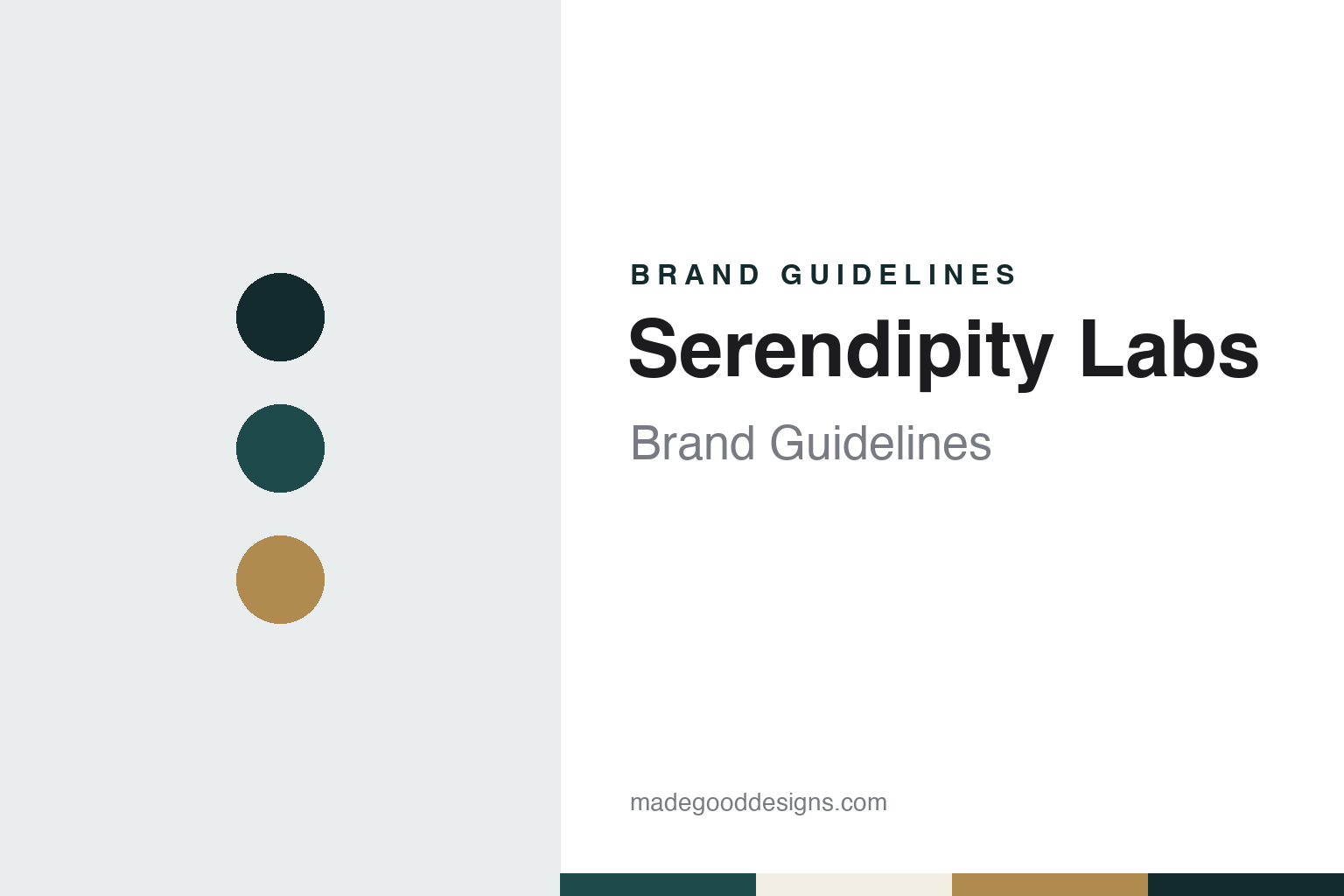
Two constants: a deep teal, brass and ivory palette and a hospitality serif register. Abstract homage — not a Serendipity Labs mark or interior; no logo, sign or photograph is reproduced.
A Rye start
A founder, a former car showroom and a members’ idea.
Serendipity Labs was founded in 2011 in Rye, New York, by John Arenas. The company gives that year on its own site, and the Westchester County Business Journal, published by Westfair Communications, gave the same year in 2017 and again in 2018, when it described Rye as Arenas’s hometown. In August 2012 the paper reported on the starting project: a former car dealership in Rye being converted into a members-only workplace of about 7,000 square feet, which Arenas saw as the start of a regional network of company-owned and franchised sites. The same report called Serendipity Labs Inc. the third company he had started since 1996.
That background shapes the brand. Arenas told the Business Journal in 2018 that his earlier venture, Stratis Business Centers, grew into a network of suburban office centres across 11 states before it was acquired by Regus, the group now known as IWG, and that he later built Worktopia, an online booking service for workspace that was acquired by SignUp4 in 2011. Serendipity Labs joined the two ideas: physical workplaces with a membership and booking platform behind them.
The 2012 report also set out the tone. The Rye general manager told the paper that the business was “about membership” rather than space, and that members would be served by a proprietary cloud-based technology platform. Arenas said he was looking for places that were busy “six days a week, 16 hours a day,” close to home and near shops and restaurants, and said suburban Labs were meant to ease the isolation of working from home. In July 2017 the paper listed Rye first among the company’s six established locations, and in August 2017 it described Rye as the company’s headquarters.
Colour
Franchise partners, a joint venture and landlords.
Growth came through partners rather than through one owner signing every lease. In July 2017 the Business Journal reported about 4,000 members across six established locations, a figure it attributed to Arenas: Rye; Stamford, Connecticut; Ridgewood, New Jersey; Aventura, Florida; Bethesda, Maryland; and Chicago. That month the company announced a joint venture with the Chinese coworking company UrWork, which opened a co-branded office in Manhattan’s Financial District; the paper reported that members of each network would be able to use the other’s locations in the US and China. In August 2017 the paper reported the opening of a Serendipity Labs in Columbus, Ohio, run by the franchise development partner Renascent Hospitality.
By July 2018 Arenas counted 13 locations, he told the Business Journal. In July 2019 TechTarget reported the launch of LINC, a Serendipity Labs streaming and content platform for talks, seminars, product launches and training, first available at the Manhattan location. The company said the name stood for learn, inspire, network and collaborate, and that it had more than 100,000 square feet of meeting and event space.
The business model also shifted toward landlords. In January 2022 the Business Journal described a 14-state network and quoted Arenas explaining that landlords could bring in Serendipity Labs as a turnkey operator: the company handles design, construction, opening, technology, operations and management, and brings its brand with it. Arenas compared the experience to a hotel, where people arrive “as a valued guest,” and spoke of “branded behaviors” among staff. The paper noted that the Westport, Connecticut, location had opened at the start of 2020. In May 2022 the paper reported that Serendipity Labs had launched a subsidiary, WorkplaceCloud LLC, to license its technology platform to landlords who wanted to run flexible space without Serendipity branding or construction.
Typography
Design and documentation.
Flexible workspace operators sell something hard to photograph: the chance to rent a desk, a room or a whole floor for as long as a business needs it. Their websites lean on interior and lounge photography, usually wide shots of shared kitchens, meeting rooms and breakout areas published by the companies themselves, so a brand is often read through its furniture, lighting and materials rather than by its logo.
Naming does much of the work. Some operators keep the history of their buildings in view: Workspace Group, the London landlord, lets space in places it calls the Metal Box Factory, The Biscuit Factory and The Old Dairy. Others name tiers rather than buildings: JustCo, in Singapore, runs a premium main brand, a luxury line called The Collective and an essentials-focused concept written in lower case as the boring office, according to EdgeProp.
Membership is also handled through software. Operators list apps for booking rooms and desks, passes for using several centres, and virtual-office services, and their sites present these as part of the brand alongside the physical spaces. The words they choose for customers vary: members, tenants, teams or simply businesses.
Behind the lounges sit corporate pages on owners, buildings and cities. Some operators are listed companies or real estate investment trusts that publish their histories, portfolios and board changes; others are private or owned by property groups. This guide sets out what can be checked about each brand — who founded it, who owns it and where it operates — and marks clearly what rests only on the company’s own word.
Aa
A high-contrast hospitality serif. (Specimen set in DM Serif Display, a serif STAND-IN; NOT the Serendipity Labs logo.)
Serendipity Labs
A hotel register for office space.
Serendipity Labs presents itself in the language of hotels. Its site says the company is “in the hospitality business, not the office rental business,” describes an “upscale, hospitality-based workplace experience,” and calls each site a Lab. Spaces are named by use rather than by desk count: private offices, ideation studios, lounges and work bars, according to the company. Plans run from full-time dedicated offices to coworking and occasional drop-in use. The company says each Lab is staffed by people from the local community and that a mix of events and programming makes room for “serendipitous interactions,” the phrase that echoes its name.
In November 2026 the company’s location list covered sites in 13 US states, from California and Colorado to Texas, Tennessee and Wisconsin, plus two in the United Kingdom: Bristol, at Aztec West, and Cambridge North. The company says it runs company-owned and managed locations in more than 30 urban and suburban places and has more than 100 locations under development; these are its own figures. Its leadership page names Arenas as chairman and chief executive. The Business Journal was already calling the company a self-described “upscale hospitality brand” in 2017, and in 2018 Arenas told the paper that he had not invented coworking but had spent years arguing for networks of places to work, an interest he linked to his training as a civil engineer.
For a design guide, Serendipity Labs shows how a flexible workspace brand can borrow the vocabulary of a hotel lobby: named rooms, staff behaviour treated as part of the brand, and a calm, upscale tone instead of start-up energy. Compare it with Industrious, another US flexible workspace operator, and with Regus, the group that acquired Arenas’s earlier Stratis Business Centers. For this guide we use deep teal, brass and ivory with a serif, an unofficial interpretation; no product or logo is reproduced.
Explore & save
Keep Serendipity Labs’s identity on hand — save it to a board in the Made Good inspiration library.
Serendipity Labs identity set
Save the deep teal, brass and ivory palette and the hospitality serif register for your own workspace or hospitality project.