x+why Brand Guidelines
A Whitechapel mission hall, a member pledge and B Corp workspaces.
Aa
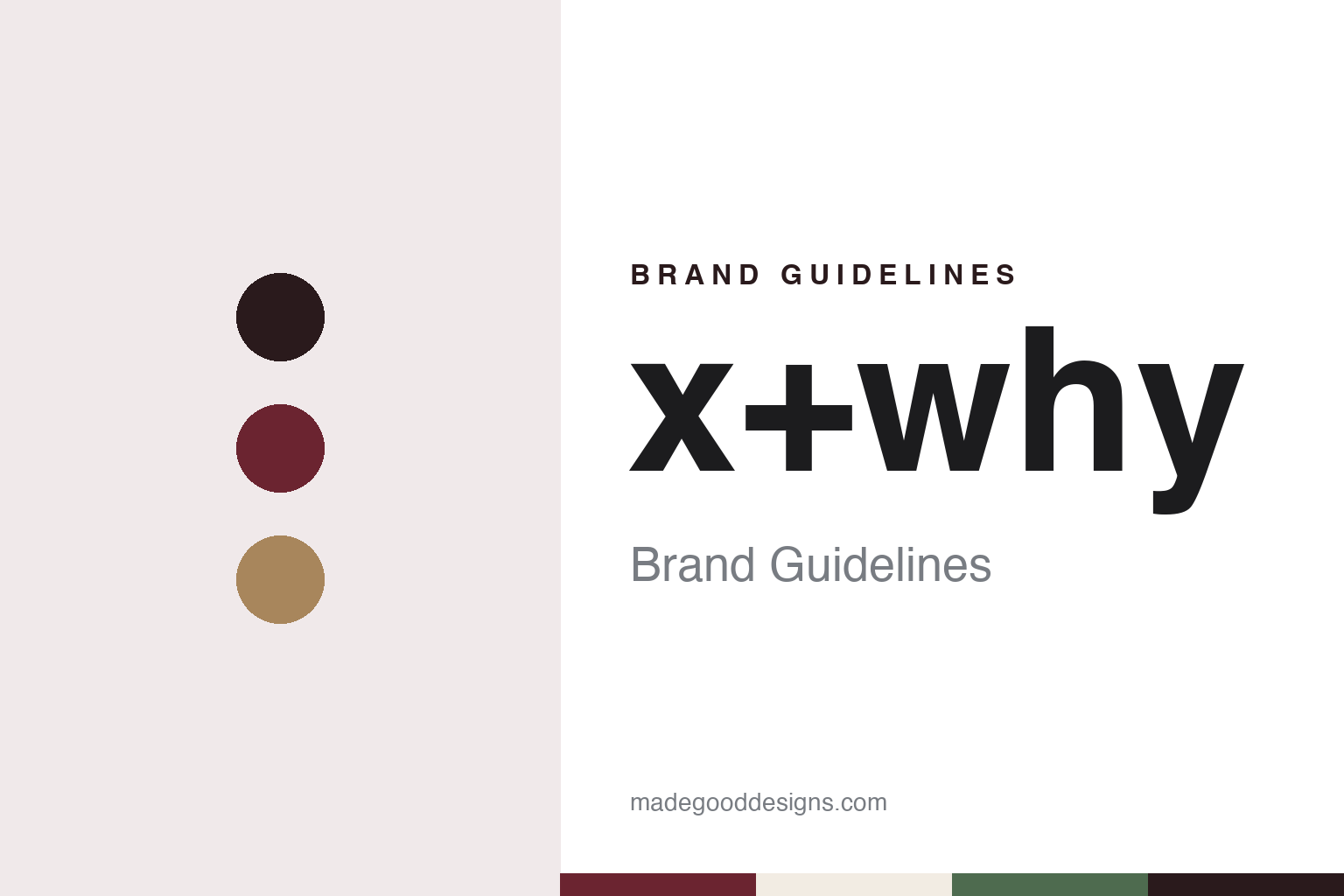
Two constants: an ox-blood, timber and moss palette and a grotesque sans register. Abstract homage — not an x+why mark or interior; no logo, sign or photograph is reproduced.
A mission hall in Whitechapel
Three founders, a pledge and a former traders’ hall.
x+why is a British flexible workspace company. The company names three founders: Rupert Dean, its chief executive, Phil Nevin, its chief creative officer, and Tanya Donald, its chief financial officer. The London design site we-heart named Dean and Nevin as the founders in October 2019. Companies House lists the operating company, X & Why Limited, as incorporated in September 2018, with its registered office at People’s Mission Hall in Whitechapel.
The company’s biographies explain the mix of skills. It describes Dean as a former corporate lawyer who ran businesses across Sub-Saharan Africa, including a flexible workspace business, before x+why; Nevin as the person responsible for the design of all of its buildings and as chairman of Big Change, a social impact accelerator he helped to found; and Donald as a chartered accountant who qualified with PwC and later held finance roles at companies including BSkyB.
The first home set the brand’s character. we-heart described the Whitechapel space in 2019 as a former East End traders’ hall, the People’s Mission Hall, on Whitechapel Road between Whitechapel and Aldgate stations. Its interiors were designed by the architecture practice Squire & Partners, the site reported, mixing robust materials and raw finishes with free-standing furniture, plants, locally sourced artwork and vintage pieces; booths lined with striped panels gave the floor what the article called a “market feel.” The founders told we-heart they wanted to “build a closer connection between profit and purpose in business,” and Nevin said he hoped start-ups and small firms would adopt the same way of thinking. The company still calls People’s Mission Hall its flagship site.
Colour
A pledge, a B Corp score and twelve buildings.
The idea behind the name is a membership rule. x+why says it asks every member to sign its pledge for better business, and calls the pledge non-negotiable: members do not have to be perfect, the company says, but they do have to commit to improve. we-heart reported in 2019 that members pledged to “unite, inspire, and amplify,” the same three verbs the company still uses to describe its aims, and listed Muslim Giving and Bethnal Green Ventures among the organisations already based there.
Certification runs through the brand. x+why says it is a certified B Corp and runs a WhyB programme that supports members applying for certification. In March 2026 the company wrote that it had re-certified with a score of 112.1, up from 98.3, that it was marking its fifth B Corp Month, and that almost 40 B Corps were based in its buildings, B Lab UK among them. It has hosted B Corp Month events at People’s Mission Hall and an official B Corp Bar with B Lab UK at its Orchard clubspace. Speakers at those events have come from other certified companies, among them Innocent, Brompton Bicycles and Ben & Jerry’s, the company says.
The network has grown well beyond Whitechapel. The company’s 2025 impact report gave 12 buildings across the UK, two of them opened in 2025, 787 member companies and about 500,000 square feet of space. It highlighted Arding & Hobbs at Clapham Junction, a former Edwardian department store, and Bloomsbury House, a set of Georgian townhouses. By November 2026 its location list covered London, Birmingham, Manchester, Milton Keynes and Leeds, and in July 2026 its blog announced The Hive, in Manchester’s Northern Quarter. Alongside offices, coworking and meeting rooms, the company runs private members’ clubspaces in London and Birmingham, among them The Orchard and The Arding Rooms. The same report sets out how the company says it “brings buildings to life”: a front-of-house and concierge team, flexible workspace, members’ clubspaces, meetings and events, WhyDesign and managed offices.
Typography
Design and documentation.
Flexible workspace operators sell something hard to photograph: the chance to rent a desk, a room or a whole floor for as long as a business needs it. Their websites lean on interior and lounge photography, usually wide shots of shared kitchens, meeting rooms and breakout areas published by the companies themselves, so a brand is often read through its furniture, lighting and materials rather than by its logo.
Naming does much of the work. Some operators keep the history of their buildings in view: Workspace Group, the London landlord, lets space in places it calls the Metal Box Factory, The Biscuit Factory and The Old Dairy. Others name tiers rather than buildings: JustCo, in Singapore, runs a premium main brand, a luxury line called The Collective and an essentials-focused concept written in lower case as the boring office, according to EdgeProp.
Membership is also handled through software. Operators list apps for booking rooms and desks, passes for using several centres, and virtual-office services, and their sites present these as part of the brand alongside the physical spaces. The words they choose for customers vary: members, tenants, teams or simply businesses.
Behind the lounges sit corporate pages on owners, buildings and cities. Some operators are listed companies or real estate investment trusts that publish their histories, portfolios and board changes; others are private or owned by property groups. This guide sets out what can be checked about each brand — who founded it, who owns it and where it operates — and marks clearly what rests only on the company’s own word.
Aa
A plain grotesque sans for a lower-case name. (Specimen set in Space Grotesk, a sans STAND-IN; NOT the x+why logo.)
x+why
A lower-case name with a plus sign.
The company writes its name in lower case with a plus sign, x+why, and writes it as “xandwhy” in its web address and social handles. That matters for anyone setting the name in type: the plus sign joins a single lower-case letter and a short word, with no spaces. Its programme names repeat the word “why,” from WhyDesign, its in-house design service, to the Why’s Words podcast and a #WhoWhatWhy series of member profiles. Its home page sums up the offer as “Work, Meet, Play,” and its about page states the mission as changing “the way the world works for good.”
Design is handled in-house. The company says its WhyDesign team has delivered nearly 400,000 square feet of design-led space for brands and landlords and can fit out suites to a member’s own brand; it lists a BCO regional award for workplace fit-out in 2024 and an A+ award from Architizer among its credits. It also says its buildings use living roofs, energy-efficient lighting, bike parks, standing desks and more than one plant per person. The colours of the first Whitechapel interior, as we-heart described them in 2019, were ox blood with dark metal and natural timber, with blues, greens and yellows on the floor.
For a design guide, x+why shows how a workspace brand can build its identity around a stated purpose and a membership rule: a short, typographic name, rooms that keep the character of old buildings, and programme names that repeat one word. Compare it with Second Home, another London workspace company, and with Huckletree, a London workspace operator. For this guide we use ox-blood red, timber and moss green with a sans, an unofficial interpretation; no product or logo is reproduced.
Explore & save
Keep x+why’s identity on hand — save it to a board in the Made Good inspiration library.
x+why identity set
Save the ox-blood, timber and moss palette and the grotesque sans register for your own workspace or community project.