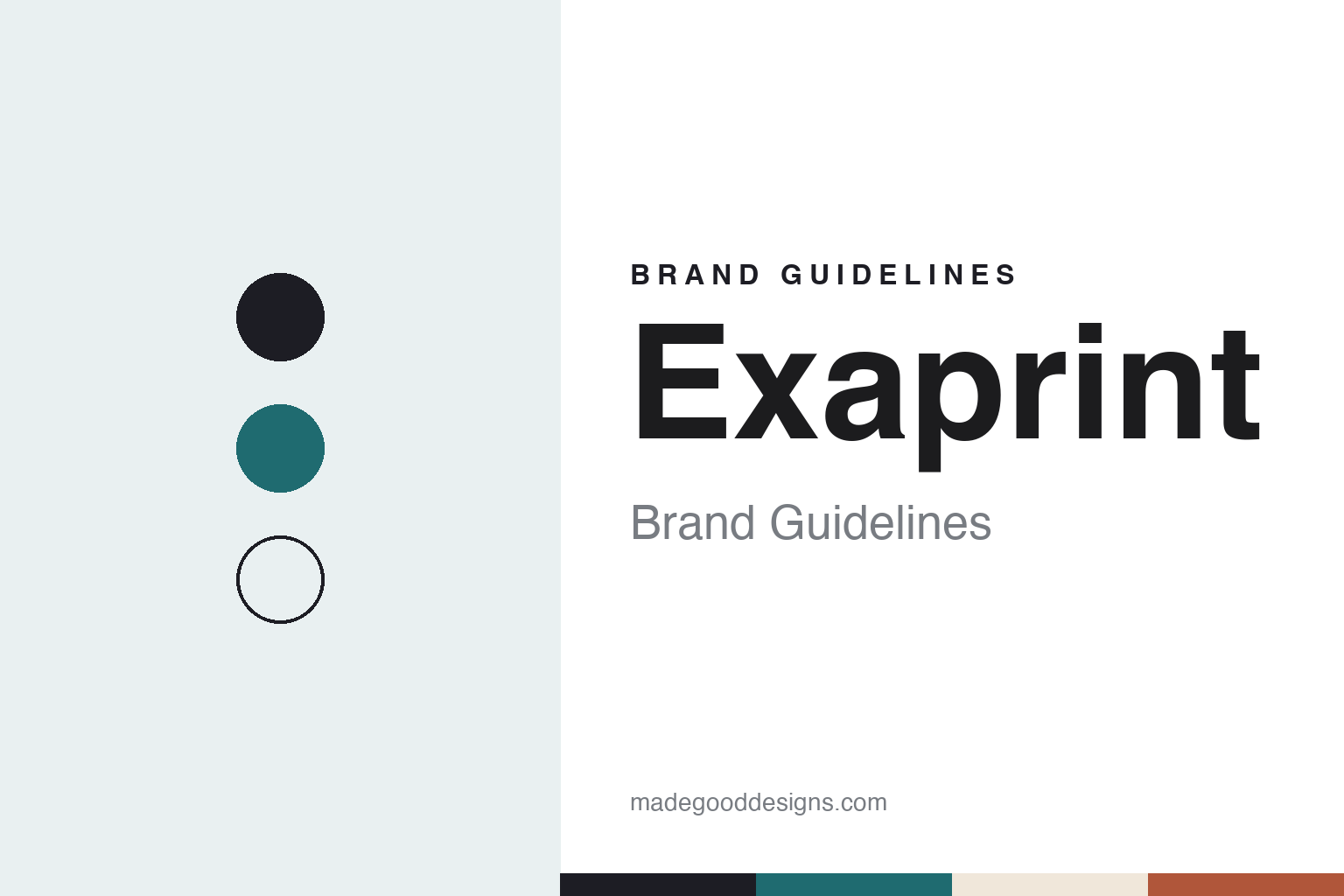
Exaprint Brand Guidelines
A Montpellier start-up that became a printer for professionals.
Aa
Two constants: an Exaprint ink, teal and terracotta palette and a grotesque sans register. Abstract homage — not an Exaprint product or mark; no print sample, logo or web page is reproduced.
Montpellier, 1998
A start-up selling print to professionals.
Exaprint was founded in 1998 in Montpellier, in the south of France. The company’s own history page names its founder as Philippe Dupuy, whom it describes as a young man with a keen interest in communication and marketing, and the regional radio station RTS gave the same founder and year in a report in May 2023. Midi Libre, the Montpellier daily, also dated the firm to 1998 in Montpellier when it covered the company’s 25th anniversary in April 2023.
The business moved online in stages. Exaprint’s timeline says it put the first version of its website online in 2000, and that in 2007, after several years of development, it turned the site into an online sales platform; the company says it was then handling 450 orders a day. In the same year, RTS reported, the company was taken over by Nicolas and Maryse Dematté.
Exaprint sold to professionals rather than to the general public from the start, and it still describes its customers that way. Its corporate pages list resellers first, followed by small and medium-sized firms, local authorities, large companies and industry. Alongside product families, the shop has sections for trade shows and events, for hotels and restaurants, and for signage and large-format work.
Exaprint marked its 25th year in 2023, and its history page now speaks of 28 years of activity. The company crossed the Pyrenees in 2009. According to its timeline it set up in Spain that year at Molins de Rei, near Barcelona, and it still describes the Spanish operation as an industrial site alongside its main base in France.
Colour
Cimpress and the Mauguio plant.
In 2015 Exaprint joined Cimpress, the group that also owns Vistaprint. Exaprint’s timeline describes the step as joining a global group that gave it access to international resources while it kept its local commitments and its service model. RTS, in 2023, likewise described Exaprint as belonging to the multinational Cimpress group while keeping a strong focus on its home region.
The company’s base is at Mauguio, a town near Montpellier. Exaprint says its plant there has a workshop of 10,000 square metres with more than 80 machines on 15 production lines, and that 80 per cent of its printed paper products are made in France. On 18 April 2023 it opened an extension of its Mauguio premises, L’Usine Nouvelle reported, and Midi Libre wrote that the new building brought its internet and printing businesses together on the Mauguio-Carnon site. RTS, covering the opening, called Exaprint the French leader in online printing, a description the company also uses for itself.
That spring Exaprint also launched Exalink, which RTS said went live in April 2023. The company’s executive director told the station that the platform joins two groups: end customers and the professional customers who have always been Exaprint’s core. A business can order printing through it and also run a communication campaign using the services of Exaprint’s professional clients, with Exaprint acting as a trusted third party between them. In the same interview he described the appeal of the trade as helping customers pass on their own know-how to their clients through printed media, and said it was more interesting still when that work was done through the internet.
RTS also described how the company recruits. Faced with hiring difficulties, Exaprint ran a campaign built on a simple message, that anyone who wanted to work and learn a trade should come to it, and it joined a group of regional employers to train newcomers; after a year, the station reported, those trainees received a certificate recognised by the employment authorities.
Typography
Design and documentation.
Online printers and print-on-demand platforms sell something the customer designs and the company makes. Their websites are therefore built around two things: the range of printed products on offer, and the steps for turning a file or an idea into an order. Product pages are organised by category — business cards, flyers and postcards, stickers and labels, signs and banners, packaging, apparel, and fabric or home goods — and each is shown through the company’s own photographs of finished pieces.
The ordering side is described in plain, practical terms. Customers either upload a finished print file or build a design in an editor that runs in the web browser, then choose size, quantity, paper and finish from a configurator. Cimpress, for example, describes its services as running from upload-and-print to logo design, with file checks before production. Papers and finishes are named rather than pictured in the abstract: weights in grams per square metre, coated or uncoated stock, matt or gloss lamination, and options such as rounded corners or spot varnish.
Behind the storefront, the companies differ in how they make things. Some run their own print plants; CEWE described SAXOPRINT’s Dresden site as a production facility when it agreed to sell it to Cimpress in May 2026. Others, such as HelloPrint in Rotterdam, describe themselves as platforms that pass orders to a network of partner printers and carriers. Several of the brands in this guide belong to larger groups, and their corporate pages set out owners, sites and the dates of takeovers.
This guide sets out what can be checked about each brand — who founded it, who owns it, where its products are made and how it presents itself — and attributes to the company anything that rests only on its own word.
Aa
A plain grotesque sans for a printer that speaks to professionals. (Specimen set in Work Sans, a sans STAND-IN; NOT the Exaprint logo.)
Exaprint
Papers, finishes and labels.
Exaprint’s catalogue is broad. Its website groups products into families including cards, flyers and brochures, labels and stickers, advertising displays, office stationery, trade-show and event equipment, signage and large format, packaging, promotional goods and branded clothing. The company says it offers more than 35,000 products and can process up to 5,000 orders a day, and its history page gives a staff of 420 and an average of 2,800 orders a day. It also offers gang-run printing, which it calls amalgame, and a connection for resellers’ own systems named Exaconnect.
Papers and finishes do much of the naming. Business cards are offered on classic, recycled or creative papers, with hot-foil gilding or a raised 3D varnish; flyers can carry a selective varnish; invitation cards come in a tear-resistant, washable version; and labels are sold on rolls for hand or machine application.
Environmental labels are placed prominently on the corporate pages. Exaprint says 99 per cent of its papers are FSC-certified, with more than 500 FSC-certified products in the range, and that it holds ISO 14001 certification and the Imprim’Vert label; it also says it uses vegetable-based inks, recycles about 3,000 tonnes of paper waste a year and has 2,000 square metres of solar panels at its site. The same pages set out service figures such as average production time and the share of orders produced in under four days, presented as a list of key indicators.
For a design guide, Exaprint shows how a Montpellier start-up selling print to professionals became a large industrial printer inside an international group while still presenting itself as a local French maker, with production in France and plant figures placed at the front of its corporate pages. Compare Vistaprint, another Cimpress business, and Cimpress, the parent group. For this guide we use an ink black, a Mediterranean teal and a terracotta with a sans, an unofficial interpretation; no product or logo is reproduced.
Explore & save
Keep Exaprint’s identity on hand — save it to a board in the Made Good inspiration library.
Exaprint identity set
Save the Exaprint ink, teal and terracotta palette and the grotesque sans register to your own board.