Sticker Mule Brand Guidelines
An Amsterdam, New York sticker printer with a mule name.
Aa
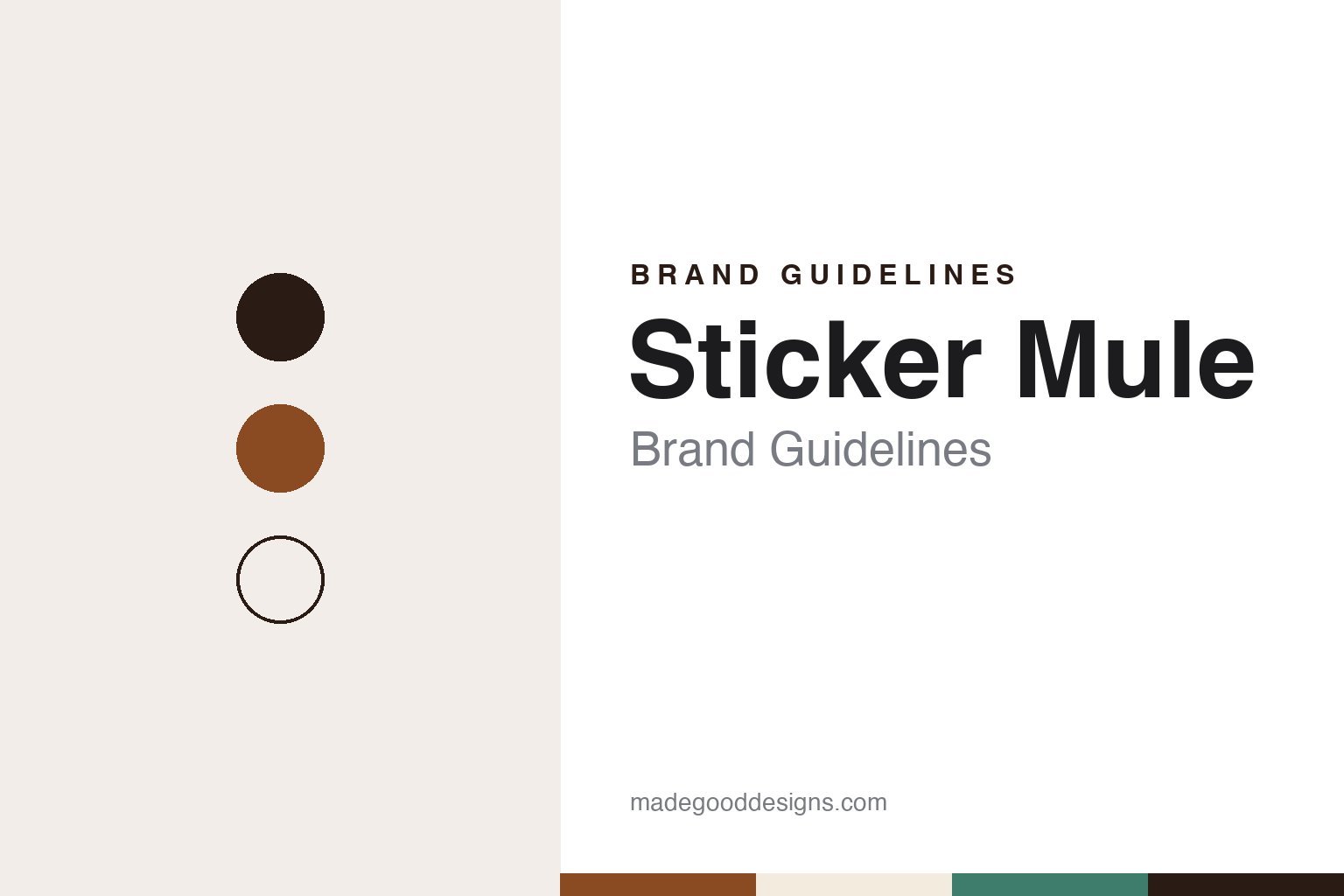
Two constants: a saddle brown, cream and green palette and a rounded sans register. Abstract homage — not a Sticker Mule product or mark; no mule, logo or sticker is reproduced.
A late-night idea
Two friends, one website and a choice of animal.
Sticker Mule is a custom printing company based in Amsterdam, New York English Wikipedia says it was co-founded in 2010 by Anthony Constantino and Tom Cummings, and that by June 2026 it employed more than 1,000 people around the world.
The company tells its own origin story in some detail. Its “About” page says that shortly before Christmas 2009 Cummings asked Constantino for help with his first computer; the conversation turned to the idea of putting a manufacturing business online, and the next morning Cummings arrived with a notepad of plans. Neither man, the company says, had set out to sell stickers. They hired the team behind Spree, an open-source e-commerce platform, to build an ordering website, and only then had to choose a product.
Neither founder came to the idea from nowhere. English Wikipedia says Constantino had earlier managed Noteworthy, a promotional products company founded by his father, while he was a student at Rensselaer Polytechnic Institute. The company adds that Spree’s chief executive, Sean Schofield, later let Constantino hire part of his development team to keep building the site, so that Sticker Mule began with its own software staff as well as a printing business, and it credits that open-source starting point for the way it still builds its customer service, manufacturing and software in-house.
The name came out of that choice. According to the company, Constantino and his brother Nicholas settled on stickers after trying out pairings of an animal and a product; Print Bear, Button Frog, Magnet Duck and Gorilla Bags were among the names dropped. A local designer, Dave Traver, who had never designed a website before, drew the first version of the site, and the company says it still looks much the same today. About three months after that first conversation the site went live, which the company dates to 2010.
Colour
From stickers to a catalogue.
Sticker Mule’s range started with custom stickers and has grown by product line. Its website now groups its catalogue under stickers, labels, magnets, buttons, packaging, apparel and acrylics, and the company says customers asked for t-shirts, keychains, yard signs, hats and hoodies as the range expanded.
Europe came in 2016. The company says the founder of Unixstickers, an Italian sticker shop, contacted Constantino through a website chat to ask why Sticker Mule did not sell in Europe; he then joined the company to start its European operations, with a customer service office in Bologna and manufacturing in Pisa. The company says it believes manufacturing should be local, with American factories serving America and European factories serving Europe, and that it has brought the making of temporary tattoos, keychains, pins and transfer stickers in-house and has begun making t-shirts in its own factories.
The company describes its chief executive as a fan of transparency, and Sticker Mule publishes a running statistics page, and in November 2026 its “About” page said it had processed more than 16 million orders from 7.8 million customers and collected more than 360,000 reviews; these are the company’s own figures. The site also runs a marketplace and Stores, which let sellers offer products that Sticker Mule makes, ships and supports, and Sticker Mule PRO, a suite of business software that the company says includes Notify for email and text marketing, Reply for customer service and Ship for shipping.
Typography
How online printers present themselves.
Online printers and print-on-demand platforms sell something the customer designs and the company makes. Their websites are therefore built around two things: the range of printed products on offer, and the steps for turning a file or an idea into an order. Product pages are organised by category — business cards, flyers and postcards, stickers and labels, signs and banners, packaging, apparel, and fabric or home goods — and each is shown through the company’s own photographs of finished pieces.
The ordering side is described in plain, practical terms. Customers either upload a finished print file or build a design in an editor that runs in the web browser, then choose size, quantity, paper and finish from a configurator. Cimpress, for example, describes its services as running from upload-and-print to logo design, with file checks before production. Papers and finishes are named rather than pictured in the abstract: weights in grams per square metre, coated or uncoated stock, matt or gloss lamination, and options such as rounded corners or spot varnish.
Behind the storefront, the companies differ in how they make things. Some run their own print plants; CEWE described SAXOPRINT’s Dresden site as a production facility when it agreed to sell it to Cimpress in May 2026. Others, such as HelloPrint in Rotterdam, describe themselves as platforms that pass orders to a network of partner printers and carriers. Several of the brands in this guide belong to larger groups, and their corporate pages set out owners, sites and the dates of takeovers.
This guide sets out what can be checked about each brand — who founded it, who owns it, where its products are made and how it presents itself — and attributes to the company anything that rests only on its own word.
Aa
A friendly, rounded sans for labels and stickers. (Specimen set in Rubik, a sans STAND-IN; NOT the Sticker Mule logo.)
Sticker Mule
A factory town and its printer.
Sticker Mule has stayed in Amsterdam, New York, and much of its public image is tied to the city. In October 2021 the Albany station CBS6 reported that the company was finishing Combat Mules, a sports training facility of more than 10,000 square feet in the former Mohawk Dairy building on the city’s Forest Avenue, which it had bought earlier that year, with free training for high-school students from ninth to twelfth grade and for professional athletes. The station said the building held locker rooms, a trainer’s room and an outdoor training area, and that free tutoring would be offered to student athletes; Constantino, named in the report as co-founder and chief executive, said the aim was to bring more excitement to Amsterdam and help young people become community leaders. The company says it also runs a community gym, Mule Fitness, and a local mixed martial arts league called Cage Wars, and supports public parks, schools, food pantries, youth sports and senior centres in the city.
The mule itself does the brand’s talking. The company’s own account presents the name as an animal-plus-product pairing chosen almost by chance, and its community page suggests that “Mule” alone may now fit better, since the business has moved beyond stickers into dozens of products and software. The original website design, by the company’s account, has changed little since 2010, and the same short, informal story of a late-night idea and a list of rejected animal names still opens its “About” page.
For a design guide, Sticker Mule shows how a single memorable name, a simple ordering flow and a habit of publishing its own numbers can carry a printing brand from one product to a whole catalogue. Compare Printful, which also prints on demand for online sellers, and Zazzle, another American custom-products company built around a website. For this guide we use a saddle brown, a dark brown-black, a vinyl cream and a green with a rounded sans, an unofficial interpretation; no product or logo is reproduced.
Explore & save
Keep Sticker Mule’s identity on hand — save it to a board in the Made Good inspiration library.
Sticker Mule identity set
Pin the Sticker Mule saddle brown, cream and green palette and the rounded sans register to your own board.