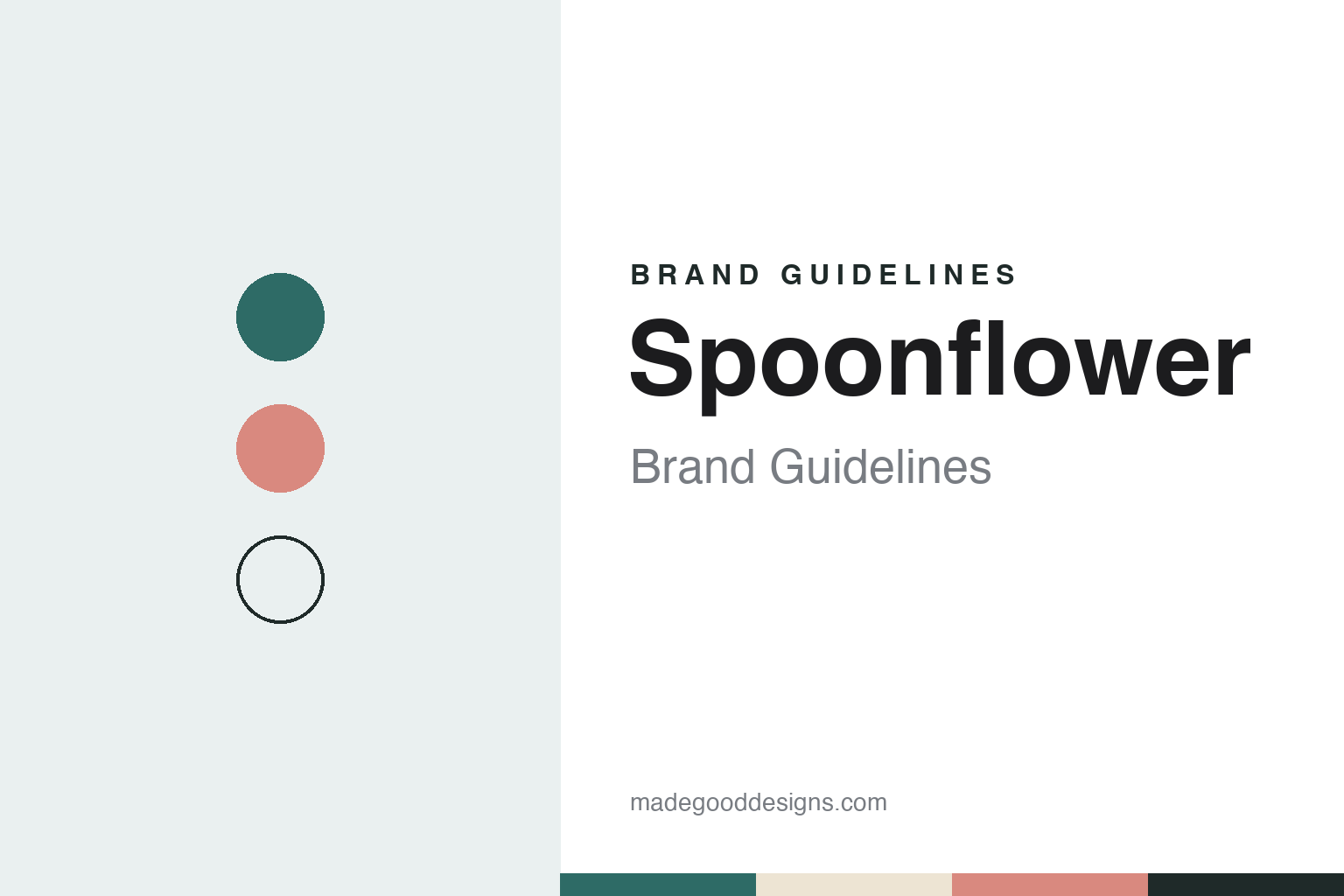
Spoonflower Brand Guidelines
Print-on-demand fabric from Durham, now part of Shutterfly.
Aa
Two constants: a teal, petal and linen palette and a soft editorial serif register. Abstract homage — not a Spoonflower product or mark; no fabric design, logo or pattern is reproduced.
A swatch of your own
Two former Lulu.com staff and a print-to-order idea.
Spoonflower began in North Carolina in May 2008. English Wikipedia names its founders as Stephen Fraser and Gart Davis, both formerly of Lulu, the self-publishing platform. Wired reported in August 2012 that Fraser had been Lulu’s marketing director, and that the idea took shape in 2007 around a simple wish: to print a pattern of one’s own choosing onto curtain fabric, rather than hunting for it in shops. If people could already put pictures on mugs or publish their own books, the reasoning went, there ought to be a way to print fabric to order. Fraser called a friend from Lulu, found a printer and built a website, Wired said.
The start was small. TechCrunch, in an April 2013 profile, described Spoonflower as a Durham company that began shipping fabric out of an old sock factory in 2008, using inkjet printing so that an order could be as small as a single swatch or as large as dozens of yards. The founders began with one printer in a dusty warehouse, the profile said, before moving to a new space with ventilated print rooms and plenty of room for cutting. English Wikipedia gives a slightly different early base, placing the headquarters in Mebane, North Carolina, until 2010 and in Durham afterwards.
The setting shaped the way the press told the story. TechCrunch framed the company as textile work returning to a former textile centre, with printers running day and night on hundreds of orders a day. Each printer was linked to a central management system that showed operators which jobs were running and which machines were low on ink, and staff could match particular fabrics to the printers that handled them well. In 2013, the profile added, the company was also working on wallpaper, decals and gift wrap.
Colour
Upload a design, choose a repeat, print a yard.
Spoonflower’s idea is that the customer supplies the pattern. A buyer uploads an image, chooses how it repeats across the cloth and orders it printed, or buys a design from the site’s marketplace instead. Wired explained in 2012 that designers could preview a repeat in rows, in diagonals or not at all before ordering a test swatch, and that people who sold patterns through the marketplace kept ownership of their work. By the time of the 2021 sale, the law firm Paul, Weiss, which advised the buyer, described Spoonflower as a global marketplace of more than one million designs by independent artists.
Wallpaper followed fabric. Wired reported in August 2012 that a wallpaper product was in beta testing; the company’s help centre now describes wallpaper, fabric by the yard and finished home decor, all printed on demand, across more than 50 products. Decor items such as table linens, bedding and curtains are sewn to order from the printed fabric, and the company says they are sewn in the United States.
The printing itself rests on two methods, according to Spoonflower’s help centre. Natural fibres such as cotton and linen are printed directly with water-based pigment inks, mixed on the fly from the design file. Polyester fabrics use dye-sublimation: the design is printed onto transfer paper, which is laid on the cloth, and heat and pressure carry the dye into the fibre. English Wikipedia describes the machines as large-format inkjet printers modified to run fabric.
The cloth comes from many places even though the printing does not. A help-centre table, updated in May 2025, lists where each base fabric originates: linen from Belgium, a cotton lawn from South Korea, a cotton twill from Pakistan and several knits from the United States, among others. The same page says every Spoonflower fabric is printed, sewn where relevant and shipped from the company’s manufacturing locations in the United States. Several of the base cloths carry plant names, among them Petal Signature Cotton and Celosia Velvet.
Typography
Design and documentation.
Online printers and print-on-demand platforms sell something the customer designs and the company makes. Their websites are therefore built around two things: the range of printed products on offer, and the steps for turning a file or an idea into an order. Product pages are organised by category — business cards, flyers and postcards, stickers and labels, signs and banners, packaging, apparel, and fabric or home goods — and each is shown through the company’s own photographs of finished pieces.
The ordering side is described in plain, practical terms. Customers either upload a finished print file or build a design in an editor that runs in the web browser, then choose size, quantity, paper and finish from a configurator. Cimpress, for example, describes its services as running from upload-and-print to logo design, with file checks before production. Papers and finishes are named rather than pictured in the abstract: weights in grams per square metre, coated or uncoated stock, matt or gloss lamination, and options such as rounded corners or spot varnish.
Behind the storefront, the companies differ in how they make things. Some run their own print plants; CEWE described SAXOPRINT’s Dresden site as a production facility when it agreed to sell it to Cimpress in May 2026. Others, such as HelloPrint in Rotterdam, describe themselves as platforms that pass orders to a network of partner printers and carriers. Several of the brands in this guide belong to larger groups, and their corporate pages set out owners, sites and the dates of takeovers.
This guide sets out what can be checked about each brand — who founded it, who owns it, where its products are made and how it presents itself — and attributes to the company anything that rests only on its own word.
Aa
A soft editorial serif for a pattern marketplace. (Specimen set in Fraunces, a serif STAND-IN; NOT the Spoonflower logo.)
Spoonflower
From a Durham print room to Shutterfly’s plants.
Spoonflower took outside investment before it was sold. English Wikipedia names Guidepost Growth Equity, of Boston, as its largest investor. In 2021 the company passed to Shutterfly, which Paul, Weiss described as a digital retailer and manufacturing platform for personalised products: the firm announced on 10 August 2021 that Shutterfly had completed its acquisition of Spoonflower. Paul, Weiss said the purchase added Spoonflower wallpaper, fabric, bedding and other soft home goods to Shutterfly’s range and connected Shutterfly’s users with Spoonflower’s community of designers.
Production has moved since then. English Wikipedia says Spoonflower ran a European production site in Neukölln, Berlin, from 2016 until it closed in 2022, and that manufacturing in Durham ended in 2023 when Shutterfly closed the Durham plant. Since August 2023, the same source says, all Spoonflower fabric and wallpaper has been printed in Shutterfly facilities in Fort Mill, South Carolina, and Tempe, Arizona, while the headquarters remain in Durham. The company’s own help pages, updated in 2025 and 2026, say that orders are made in the United States.
The help centre presents the business through its process. A welcome article walks a new buyer through each stage in plain steps — you place your order, we print your order, we inspect your order — and explains that each design is printed only when someone buys it, so the whole catalogue is always available without stock on shelves. Every order, the company says, passes automated and manual quality checks before it ships.
For a design guide, Spoonflower shows how a print-on-demand brand can be built around customers’ own patterns, from a single test swatch to a papered wall. Compare Lulu, where both founders worked before Spoonflower, and Zazzle, another print-on-demand marketplace in this series. For this guide we use a thread teal, a petal pink and a warm linen with a serif, an unofficial interpretation; no product or logo is reproduced.
Explore & save
Keep Spoonflower’s identity on hand — save it to a board in the Made Good inspiration library.
Spoonflower identity set
Pin the Spoonflower teal, petal and linen palette and the soft editorial serif register to your own board.