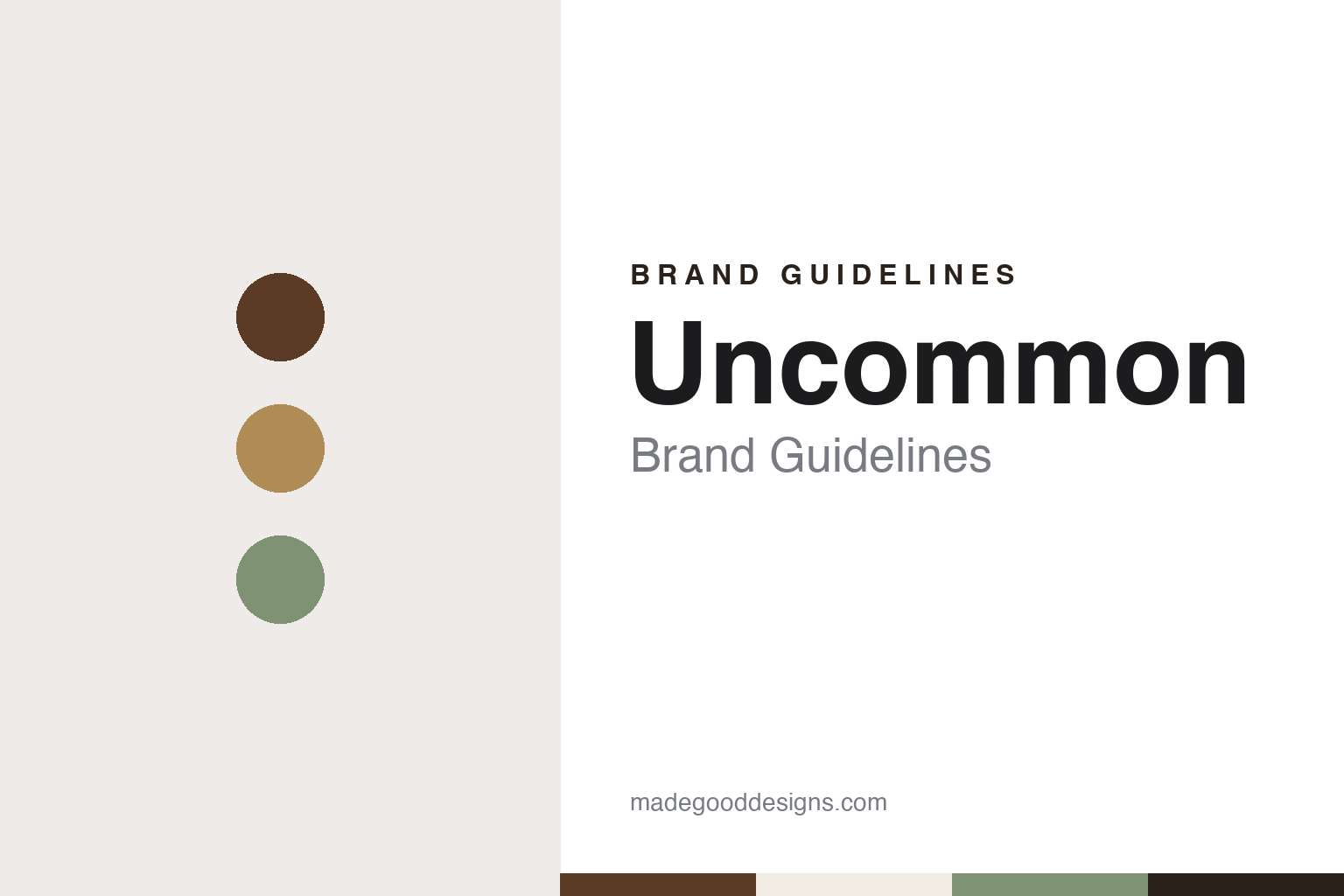
Uncommon Brand Guidelines
A London workspace brand told through walnut, marble and plants.
Aa
Two constants: a walnut, marble and sage palette and a soft serif register. Abstract homage — not an Uncommon interior or mark; no logo, sign or photograph is reproduced.
Highbury, 2016
A designer’s workspace brand.
Uncommon is a London flexible-workspace brand with five buildings in the capital. Its own timeline starts in 2016 with Highbury & Islington, a building in the north London neighbourhood that it calls the earliest Uncommon location it opened to members, and which it says was once a book bindery. The travel and trends site Globetrender named Tania Adir as Uncommon’s founder and interior designer in June 2019, and that design-led start shows in how the brand still describes itself.
Growth came quickly, by the company’s account. Its timeline says that in 2017 it secured investment from the private-equity firms The Carlyle Group and Blackstone, which it says allowed it to grow its team and the Uncommon brand; that it added sites in Fulham and Borough the same year, tripling its memberships; that it acquired its Liverpool Street building in 2018; and that in 2019 it acquired the Holborn building that became its central flagship, which it says was meant to hold more than 2,000 members. Those are the company’s own statements, and its site does not set out the terms of the investment.
Globetrender reported in June 2019 that the Liverpool Street space had opened in May that year, opposite the station, inside Crosspoint, a cylindrical building, and that it was the brand’s fourth coworking space after Borough, Highbury & Islington and Fulham. Holborn followed; in January 2026 the trade site Workplace Insight listed Uncommon Holborn among the projects shortlisted for the new Workspace Design Awards.
The later part of the company’s timeline turns from buildings to culture. It describes a 2021 relaunch of its internal ethos, which it calls “Uncommon 2.0,” an environmental, social and governance strategy launched in April 2022 with net-zero targets, and certification as a B Corp in 2023. Its B Corp page gives a B Impact Score of 98.2, which it describes as a start rather than an end point.
Colour
Walnut, marble and a lot of plants.
Uncommon’s identity is mostly an interior one. Globetrender’s 2019 report on Liverpool Street gives the clearest picture. The space drew on Scandinavian and Italian design, with two communal tables from the Italian maker Riva 1920 cut from single walnut trunks, meeting-room tables and sideboards from Cattelan, angular bars in polished Portoro marble, bronze and brass detailing, smoked-glass shelving and a fireplace made from perforated extruded metal. A five-metre Ficus tree stood over a stepped, theatre-style seating area hung with chairs; upstairs were a roof terrace, desks beside a living wall and walnut-clad nap pods. The space held more than 1,000 plants, the site said.
Adir explained the thinking to Globetrender: the company wanted people “to feel better about being at work,” and she said it had applied current thinking in “sound design, aroma, ergonomics and the psychology of productivity.” That language of comfort and calm runs through the brand’s pages today, which describe members’ lounges, focus zones with silent booths, studios for fitness classes, showers and bike storage, and, at Borough, a dog-friendly policy.
The website also sells design as a service. It says members can tailor a private office with help from an in-house design team, and it sells private offices, dedicated and hot desks, and day and weekend passes, alongside meeting rooms and event spaces that include roof terraces. Holborn’s page describes a members’ café, a roof terrace with a bar, a lounge for meetings and drinks, and a studio for fitness classes, and an Uncommon app handles bookings and member services across the buildings.
Holborn has drawn notice in the design trade. Workplace Insight’s January 2026 report on the Workspace Design Awards shortlist names Uncommon Holborn in three categories: office design of the year for projects over 3,000 square metres, where the entry is credited to Uncommon Capital Group with the architects tp bennett; workplace retrofit project of the year; and coworking or flexspace design of the year.
Typography
How workspace brands present themselves.
Flexible workspace operators sell something hard to photograph: the chance to rent a desk, a room or a whole floor for as long as a business needs it. Their websites lean on interior and lounge photography, usually wide shots of shared kitchens, meeting rooms and breakout areas published by the companies themselves, so a brand is often read through its furniture, lighting and materials rather than by its logo.
Naming does much of the work. Some operators keep the history of their buildings in view: Workspace Group, the London landlord, lets space in places it calls the Metal Box Factory, The Biscuit Factory and The Old Dairy. Others name tiers rather than buildings: JustCo, in Singapore, runs a premium main brand, a luxury line called The Collective and an essentials-focused concept written in lower case as the boring office, according to EdgeProp.
Membership is also handled through software. Operators list apps for booking rooms and desks, passes for using several centres, and virtual-office services, and their sites present these as part of the brand alongside the physical spaces. The words they choose for customers vary: members, tenants, teams or simply businesses.
Behind the lounges sit corporate pages on owners, buildings and cities. Some operators are listed companies or real estate investment trusts that publish their histories, portfolios and board changes; others are private or owned by property groups. This guide sets out what can be checked about each brand — who founded it, who owns it and where it operates — and marks clearly what rests only on the company’s own word.
Aa
A soft serif — for a brand told through materials. (Specimen set in Fraunces, a serif STAND-IN; NOT the Uncommon logo.)
Uncommon
Five London buildings and a B Corp label.
Today the Uncommon website lists five London locations: Holborn, near the British Museum and Covent Garden; Liverpool Street, in the City; Borough, beside Borough Market and London Bridge; Fulham, in West London; and Highbury & Islington, in North London. The company names its chief executive, Chris Davies, as the host of its podcast, Alive with Possibilities, in which he talks with founders and business leaders.
Sustainability is now central to how the brand presents itself. Its Positive Impact page summarises a 2025 impact report: the company says four of its buildings are BREEAM certified, with Holborn targeting an Excellent In-Use rating, and that it has aligned its net-zero target with the Science Based Targets initiative goal of 2050. It also says it turned Uncommon Fulham into a gallery space for emerging women artists, and that its members’ group on environmental topics, the Green Collective, ran a dozen workshops and initiatives. These are the company’s own statements.
The name needs care online. The address uncommon.com belongs to an unrelated private-equity and venture firm, and several unrelated British companies use “Uncommon” in their names; the workspace brand trades at uncommon.co.uk.
For a design guide, Uncommon shows how a workspace brand can be carried by materials — walnut, marble, brass and planting — and by a founder’s interior design rather than by a loud mark. Compare Second Home, a London workspace known for its architecture and planting, and Workspace Group, another London workspace business. For this guide we use walnut brown, marble cream, sage and brass with a soft serif, an unofficial interpretation; no product or logo is reproduced.
Explore & save
Keep Uncommon’s identity on hand — save it to a board in the Made Good inspiration library.
Uncommon identity set
Pin the Uncommon walnut, marble and sage palette and the soft serif register to your own board.