JM Bullion Brand Guidelines
A Dallas online bullion shop that lent its parent a name.
Aa
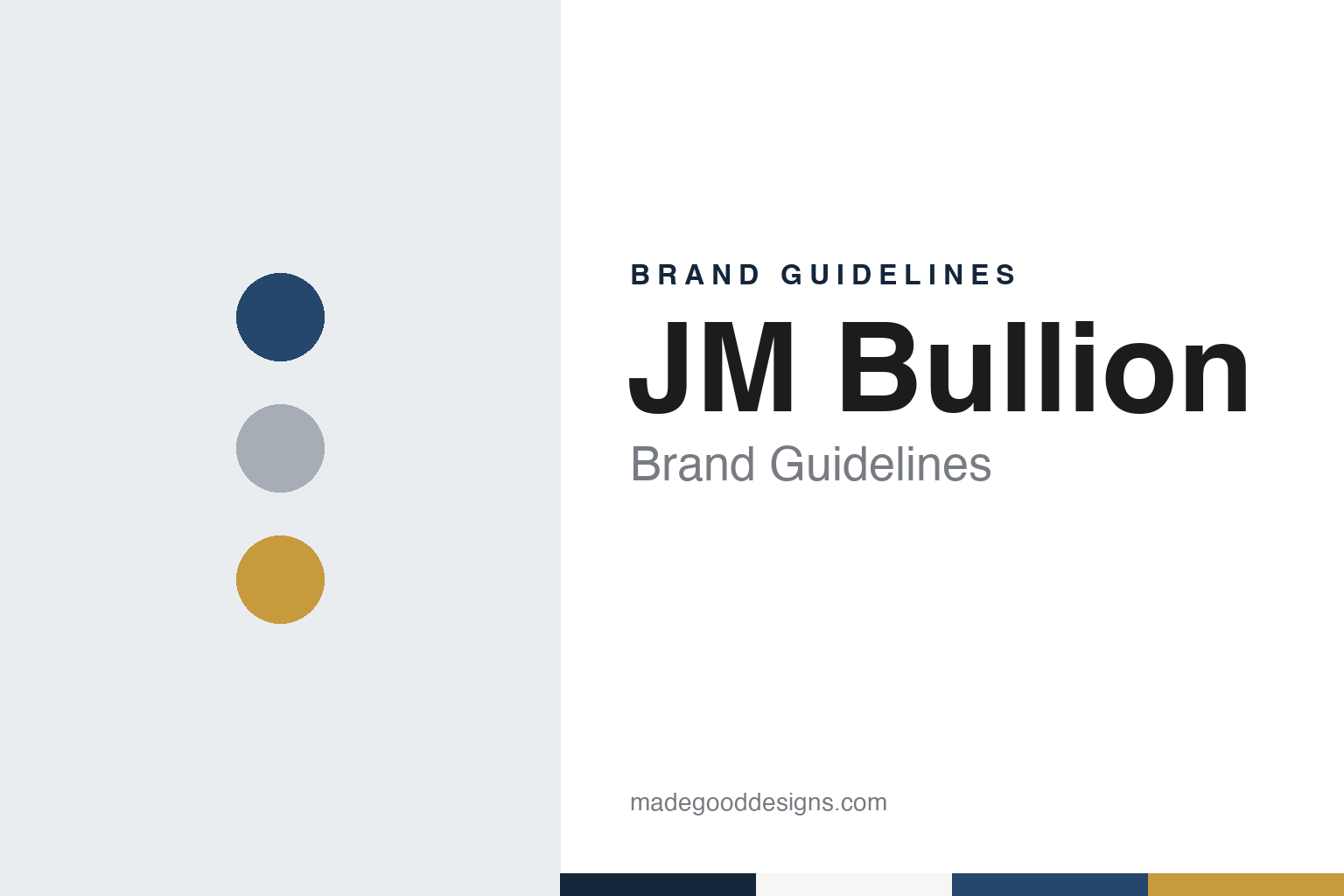
Two constants: a JM Bullion blue, silver and brass palette and a retail grotesque register. Abstract homage — not a JM Bullion product or mark; no coin, bar, logo or packaging is reproduced.
Dallas, 2011
An online shop with a wholesale partner.
JM Bullion is an online retailer of gold, silver, platinum and palladium based in Dallas, Texas. Its owner, Gold.com, Inc. — the company called A-Mark Precious Metals until December 2025 — gives JM Bullion’s founding year as 2011 and Dallas as its headquarters, and describes it as a business that sells metal directly to retail investors and collectors. When A-Mark announced its takeover in February 2021, it named Michael Wittmeyer as JM Bullion’s chief executive and co-founder.
The business grew up next to a wholesaler. A-Mark said in that February 2021 announcement that its relationship with JM Bullion dated back to its initial minority investment in the company in 2014, and that the two management teams had worked closely together since then. A-Mark itself is much older: its corporate history says it was established in 1965 as A-Mark Coin Company, and English Wikipedia gives the same founding name and year. Gold.com describes the A-Mark side of the business as a trading and wholesale platform with relationships with sovereign and private mints, and says it is an authorised purchaser of United States Mint bullion coins.
By the start of 2021, according to A-Mark, JM Bullion sold gold, silver, copper, platinum and palladium products through company-owned websites and online marketplaces, including eBay. It ran five separately branded sites, each aimed at a particular part of the market: three shops — JMBullion.com, ProvidentMetals.com and Silver.com — and two sites named for metal prices, GoldPrice.org and SilverPrice.org. A-Mark added that the deal would bring it a centrally placed distribution hub in Dallas.
The multi-site approach is the starting point for understanding the brand. Rather than putting every customer through one storefront, the company kept several names alive, each with its own address and audience, and treated plain, descriptive domain names as assets in their own right. That habit returns later in its history, in the most visible way possible.
Colour
From partner to subsidiary.
On 9 February 2021, A-Mark announced a definitive agreement to buy the 79.5% of JM Bullion’s shares that it did not already own. It said the deal would make JM Bullion the anchor of its direct-to-consumer strategy. The acquisition closed on 19 March 2021, A-Mark announced that day; Wittmeyer and JM Bullion’s chairman, Kendall Saville, joined A-Mark’s board, and Wittmeyer also became executive vice president of A-Mark’s Direct Sales segment, which included the older Goldline business. Gold.com now states that JM Bullion has been its wholly owned subsidiary since 2021.
Inside the group, JM Bullion became the base for new consumer products and further purchases. In November 2021, A-Mark and JM Bullion announced CyberMetals, an online platform that divides large gold, silver and platinum bars into fractional shares that customers can buy and sell, with the option of converting holdings into physical coins and bars through JM Bullion. In October 2022, A-Mark said JM Bullion had acquired the assets of BGASC, a California online precious-metals dealer, including its website, domain name, trademarks and logos, and would run it as a standalone brand. In June 2023, it said JM Bullion had acquired the assets of BullionMax, another California online dealer, to run as a standalone brand too; the same announcement described Rob Pacelli as JM Bullion’s president and incoming chief executive.
Each of those deals followed the pattern set by the original five sites: buy a name that already has an audience, keep it running under its own identity. Provident Metals, one of the brands A-Mark listed in 2021, shows the same thinking on the product side. English Wikipedia’s table of Royal Canadian Mint Silver Maple Leaf issues with special privy marks lists a 2016 reverse-proof edition with a Bigfoot privy as released by Provident Metals.
Typography
How bullion firms present themselves.
Bullion dealers, refiners and mints sell goods that are deliberately standardised: a one-ounce coin or a kilo bar is defined by its metal, weight and purity before any design choice is made. So their identities live in a narrow set of places — the way products are photographed, the marks struck into the metal, the shop interface and the pages that explain who owns whom.
Product photography in this category is usually plain and repetitive by design. Companies tend to show each coin or bar on its own against a light or neutral background, often obverse and reverse side by side, sometimes still in a sealed card or capsule, so that the buyer can read the design, the weight and the fineness at a glance. Special editions are told apart by small details, such as the privy marks that mints add to coins for a particular dealer or occasion.
On the metal itself, the hallmark does the branding. A refiner’s bar typically carries its maker’s mark, its weight, its fineness and a serial number, and minted bars are often sold in an assay card that repeats those details. Accreditation is part of the same language: English Wikipedia, for example, lists the Swiss refiner MKS PAMP on the London Bullion Market Association and London Platinum and Palladium Market Good Delivery lists.
Online, the price chart sits close to the logo. Gold.com, the owner of JM Bullion, runs a strip of gold, silver, platinum and palladium prices across the top of its corporate site, and JM Bullion has kept separate sites named for gold and silver prices. Corporate pages carry the rest of the story: Gold.com publishes a year-by-year timeline of its acquisitions, and Bullion International Group, the owner of APMEX, signs its site “An MKS PAMP GROUP Company,” linking a retail name to a refinery.
Aa
A retail grotesque — the voice of a price ticker and a checkout. (Specimen set in Archivo, a sans STAND-IN; NOT the JM Bullion logo.)
JM Bullion
The domain that renamed its parent.
The most striking moment in JM Bullion’s brand history came in 2024. On 11 March 2024, the trade site DomainInvesting.com reported that JM Bullion, then a subsidiary of A-Mark Precious Metals, had acquired the Gold.com domain name, and that with it the company now owned both Gold.com and Silver.com. Traffic to Gold.com was being redirected to the JM Bullion website, the report said, and it quoted Pacelli describing the address as “an extremely versatile asset” that would be part of the company’s long-term strategy. The price was not disclosed.
Less than two years later the parent company adopted the name. Gold.com’s corporate history says that in 2025 A-Mark rebranded as Gold.com, Inc., set up a new headquarters in Costa Mesa, California, and moved its listing to the New York Stock Exchange under the ticker GOLD; English Wikipedia dates the change to 2 December 2025. A domain bought by the retail subsidiary had become the corporate identity of the whole group, while JM Bullion kept its own name.
Today Gold.com describes JM Bullion as one of the largest online retailers of physical precious metals, and names JMBullion.com at the head of the direct-to-consumer brands of its marketplace, alongside Stack’s Bowers Galleries, GovMint.com and Goldline. The group says its products are supported by its own minting and refining operations, which include Sunshine Minting and Silver Towne Mint, so the retailer now sits inside a business that makes, trades, stores and sells metal.
For a design guide, JM Bullion shows how an online dealer can treat names and addresses as its main design material — several shop brands, sites named for metal prices, and a single domain strong enough to rename its parent. Compare APMEX, another large American online dealer, and Kitco, whose name is closely tied to published metal prices. For this guide we use a deep blue, an ink blue, a silver grey and a warm brass with a sans, an unofficial interpretation; no product or logo is reproduced.
Explore & save
Keep JM Bullion’s identity on hand — save it to a board in the Made Good inspiration library.
JM Bullion identity set
Pin the JM Bullion blue, silver and brass palette and the retail grotesque register to your own board.