CIR food Brand Guidelines
A worker cooperative from Reggio Emilia that grew out of a factory canteen.
Aa
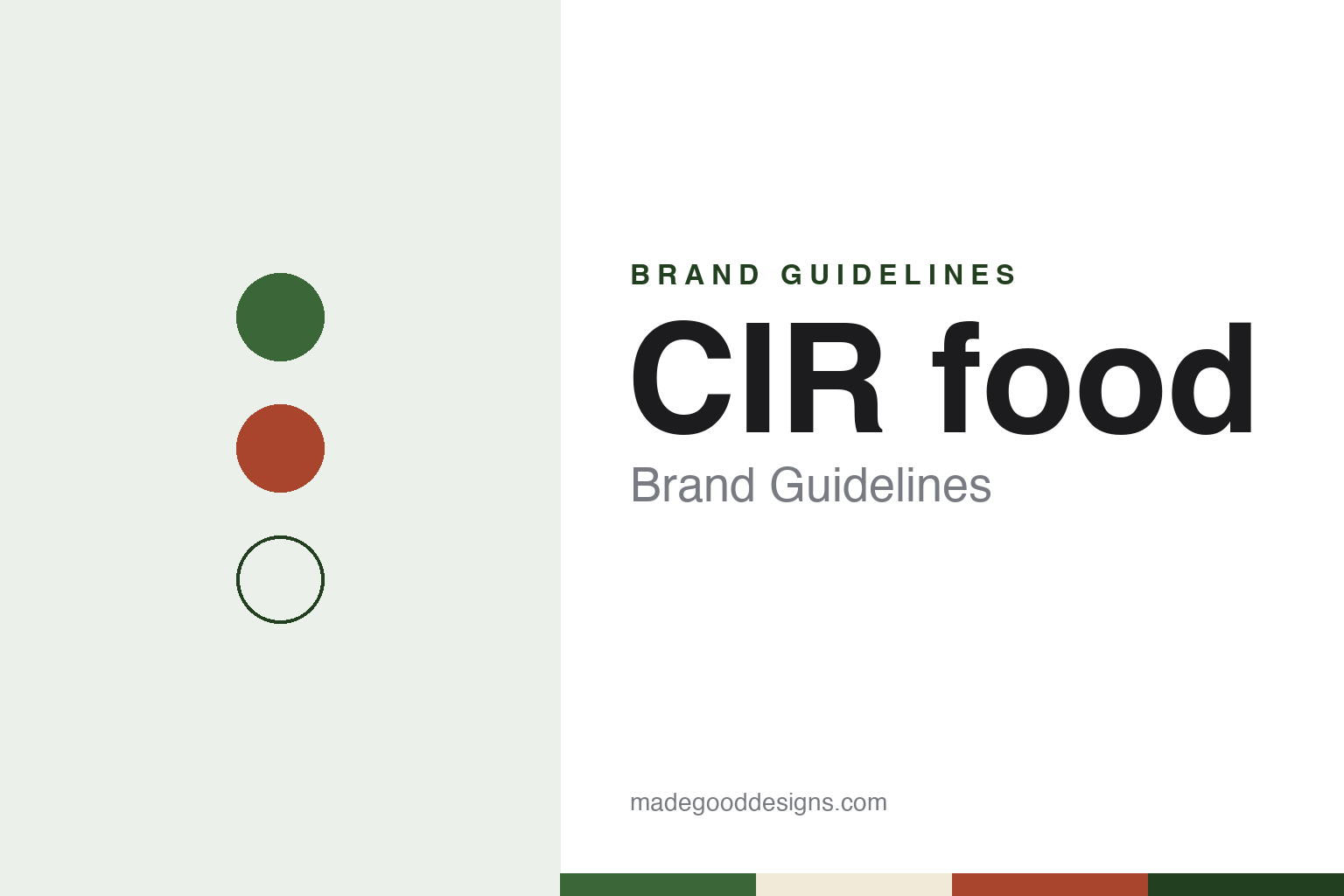
Two constants: a CIRFOOD basil, brick and cream palette and a Cooperative sans register. Abstract homage — not a CIRFOOD asset or mark; no logo, menu or restaurant sign is reproduced.
From a factory canteen
A cooperative that stayed in Reggio Emilia.
CIR food is a cooperative from Reggio Emilia, in Emilia-Romagna. On its website it writes its name as one word in capitals, CIRFOOD, and Italian Wikipedia expands the name as Cooperativa Italiana di Ristorazione, the Italian Catering Cooperative. The company traces its origins to the late 1950s, when an inter-company canteen in Reggio Emilia began serving meals to workers from the city’s factories; Il Resto del Carlino calls it the city’s first.
Il Resto del Carlino, the Bologna daily, told the longer story in September 2025. It describes CIRFOOD as a cooperative “officially born in 1977” with roots in that late-1950s canteen, and quotes its president, Chiara Nasi, saying the business began in the 1950s by serving the Officine Reggiane works and its workers, before the founding deed of 1977. In the 1970s, the paper says, a group of people pooled their capital to found three cooperatives, in Reggio Emilia, Modena and Ferrara; in 1992 the three merged into Cirfood. Italian Wikipedia names them as Crr of Reggio Emilia, Coris of Modena and Coferi of Ferrara.
It is a worker cooperative. The company calls itself a “cooperativa di produzione e lavoro a mutualità prevalente” — a production and labour cooperative that relies mainly on the work of its own members — and quotes its statute: members join to secure “continuity of employment” and sound economic, social and professional conditions. Il Resto del Carlino reported in June 2026 that the cooperative had more than 5,600 employee members, and that it was paying them a share of its 2025 result as a cooperative rebate.
The cooperative has kept its head office in its home city. Nasi told the paper in 2025 that it had received offers to move elsewhere and had chosen to stay in Reggio Emilia, a province she placed in Italy’s “Food Valley.”
Colour
Schools, workplaces, hospitals and high streets.
CIRFOOD works in what Italians call ristorazione collettiva — catering for schools, workplaces, hospitals and care homes — and in commercial catering. Il Resto del Carlino says it took the national lead in school catering in the second half of the 1990s, began expanding into health and care catering in 2007, and by 2024 was the top operator in that sector in Italy.
The same 2025 article gave the cooperative’s 2024 figures: more than 98 million meals, served through the work of 12,897 people, in 75 Italian provinces, with offices in Genoa, Milan, Padua, Modena, Florence and Rome and activity in Belgium and the Netherlands. It counted 175 company restaurants, 211 hospital and care facilities, 43 meal centres, 70 commercial outlets and school catering for 588 municipalities, and said that 87% of staff were women and 90% of contracts were permanent.
The figures keep moving. In June 2026 the same paper reported that, in 2025, more than 13,000 people prepared and served almost 100 million meals in 18 Italian regions, Belgium and the Netherlands, and that CIRFOOD won 67% of the new tenders it took part in and renewed 92% of its existing clients. Its own website gives a rounder figure of 12,000 people, in 18 regions and 75 provinces.
Commercial catering carries its own names. Italian Wikipedia lists brands including the RITA self-service restaurants, Tracce, the Antica Focacceria S. Francesco and Poormanger, and Il Resto del Carlino dates the commercial division, Cirfood Retail, to 2019. Corporate welfare services, first sold under the BluBe name, the company says, now run through Valyouness, a company set up in 2021, according to the paper.
Typography
Design and documentation.
Contract caterers sell a service that happens inside someone else’s building, so their brands have to work in two places at once: on the corporate pages where owners and clients read about them, and on the counters, menus and uniforms that guests see. Most of their public material shows food and venues rather than the company itself. Delaware North’s history page, for example, tells its story as a slide show of dated photographs, and Levy’s press room is a run of venue announcements.
Large groups split that work into sectors. Compass Group says it organises its business by market, a model it calls “sectorisation,” delivered through a portfolio of brands; its sectors include business and industry, healthcare and senior living, education, and sports and leisure. In that model a workplace canteen, a school kitchen and a stadium concourse can each carry a different name, even when one parent owns them all.
Some companies go the other way. In November 2014 Delaware North announced one global identity, dropped “Companies” and the DNC initials from its logo, and folded most of its operating units into a single name, keeping Sportservice as a named exception. Levy, owned by Compass since 2006, has instead added named units of its own, from E15 to Rank + Rally, each with its own launch year.
For a reader trying to understand these brands, the most useful sources are the companies’ own history and ownership pages, read alongside dated reporting. This guide gives founding dates, owners and contracts only as those sources state them, attributes each claim, and treats the visual identity described here as an unofficial interpretation rather than a reproduction of any company’s mark.
Aa
A plain cooperative sans — the name set as one word. (Specimen set in Figtree, a sans STAND-IN; NOT the CIRFOOD logo.)
CIRFOOD
A district for research.
In 2022 CIRFOOD opened the Cirfood District in Reggio Emilia, which Il Resto del Carlino describes as a research and innovation centre where the cooperative designs and tests new solutions for nutrition and catering. The District has its own observatory. In September 2025 Il Sole 24 Ore reported on two studies made for it: a white paper on demographic change and collective catering, edited by Alessandra De Rose, a demography lecturer at Rome’s La Sapienza university, and an Ipsos survey of how university students spend their lunch break, both previewed ahead of the cooperative’s third Canteen Summit.
That research role shapes how the cooperative talks about itself. Daniela Fabbi, its communication and marketing director, told Il Sole 24 Ore that catering in schools and universities was, for CIRFOOD, “nutrition, education, sociality” and also an observatory for understanding social, cultural and economic change. On its about page the company says that, beyond running catering, it sets out to nourish the future “with visions, ideas and perspectives.” The voice is collective: the website speaks of members, of the cooperative and of its regions far more than of any single leader.
The cooperative also plans in public. Il Resto del Carlino reported in June 2026 that Nasi, now president and chief executive, presented the 2025 results alongside a strategic plan for 2026 to 2030, and described the sector as complex and low-margin.
For a design guide, CIRFOOD shows how a contract caterer can build its identity on members, a home city and a research programme rather than on a founder’s name. Compare Pellegrini, the Milan family company founded in 1965, and Elior, the French contract caterer. For this guide we use a basil green, a brick red and a warm cream with a sans, an unofficial interpretation; no product or logo is reproduced.
Explore & save
Keep CIR food’s identity on hand — save it to a board in the Made Good inspiration library.
CIRFOOD identity set
Pin the CIRFOOD basil, brick and cream palette and the Cooperative sans register to your own board.