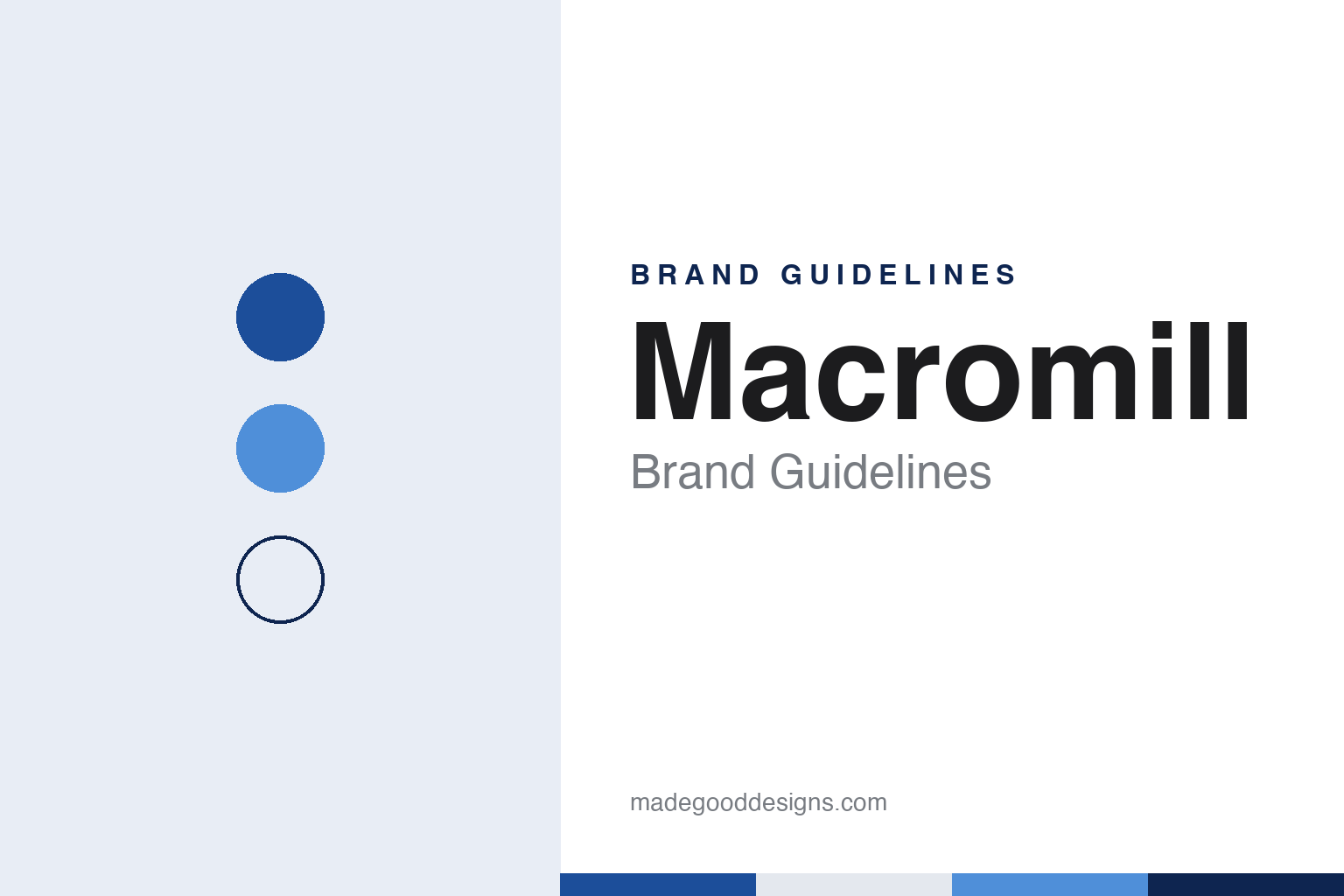
Macromill Brand Guidelines
A Tokyo research panel whose name means seeing the world at large.
Aa
Two constants: a clear blue, deep blue and soft grey palette and a Japanese gothic sans register. Abstract homage — not a Macromill product or mark; no logo, arrow mark or survey screen is reproduced.
Macromill.com
An internet research start-up in Tokyo.
Macromill began in Tokyo on 31 January 2000, when Tetsuya Sugimoto founded it as Macromill.com, Japanese Wikipedia says; the company’s own profile gives the same founding date. By August of that year it had switched on AIRs, an automated internet research system, and launched services called QuickMill and OpenMill, the company says. In December 2001 it dropped the “.com” and took the name Macromill.
The name is a compound. Japanese Wikipedia explains it as “macro,” standing for the world at large, joined to “mill,” with a play on miru, the Japanese verb meaning “to see.” The business was internet research from the start: questionnaires sent to a panel of registered consumers online, with the answers tabulated for clients in marketing.
Growth was quick. Macromill listed on Mothers, the Tokyo Stock Exchange market for young companies, in January 2004 and moved to the exchange’s First Section in April 2005, the company’s history records; in January 2004 it also obtained the Privacy Mark, a Japanese certification for handling personal information, the same history says. It joined the Japan Marketing Research Association in December 2002. In August 2010 it took over the marketing research business of Yahoo Value Insight, and in February 2012 it bought 51 percent of the Korean research firm Embrain, which it combined with its own Korean unit as Macromill Embrain that August. Macromill Embrain later listed on Korea’s KOSDAQ market in July 2020, the history adds.
Colour
Panels, plain product names and a new mark.
Its products carry plain, functional names. QPR, a purchase-history data service, began in December 2007; Questant, a do-it-yourself survey tool, in October 2013; and AccessMill, which pairs online behaviour logs with questionnaire answers, in September 2014, the company’s history says. A user-interview service called MilTalk followed in February 2015, and a household panel survey called MHS that April. In October 2015 it began joint research with the data science institute of Waseda University, and in January 2019 it began offering an AI analysis service together with NEC, the history adds.
Japanese Wikipedia describes the core as a large consumer panel from which Macromill gathers questionnaire answers alongside behavioural data such as purchase records, advertising exposure, web-access logs and location data, all linked to respondents’ basic attributes such as sex, age and place of residence. Offline methods sit beside the online work: the company profile lists group and depth interviews, central-location tests and home-use tests, along with survey design, tabulation and analysis, and a separate life science business.
The identity has changed with the company. Japanese Wikipedia says the earlier logo was a lowercase “m” with an eye-like bump on its left side, meant to feel organic, warm and playful, above a lowercase wordmark shaded from blue at the bottom to a darker blue at the top. In April 2016 the group unified the corporate logo design of its companies, the history page records. The current mark, in use since 2017 according to Japanese Wikipedia, combines four right-angled arrows in the corporate blue with an uppercase wordmark; the encyclopedia says the arrows are meant to express creating the direction clients should take and growing across a wide area.
Typography
How research firms present themselves.
Market research and data firms sell something that is hard to picture: answers drawn from surveys, panels and statistics. Their public identity is therefore carried less by products than by publications and screens. Euromonitor International, for example, presents an annual Top Global Consumer Trends report as a headline release, issued from London in November 2026 in English, Japanese, Korean, Chinese, Arabic and Portuguese, while its newsroom lists press coverage that quotes its analysts.
The platform has become the main showcase. Euromonitor describes Passport as a single hub for market, industry and consumer data, and in June 2026 the trade news service MrWeb reported a rebuilt version with a conversational, AI-based interface. In the same month Dynata launched Dynata+, which it describes as a self-service platform where users check feasibility, see pricing and launch survey projects themselves. Firms that run panels also publish panel books and quality pages, and some name a standard such as ISO 20252 on their sites.
Numbers carry much of the visual weight. Euromonitor’s 2027 trends release gives each trend a short coined name followed by a few headline survey percentages, and Dynata says its new platform shows feasibility, pricing and project progress in real time. In a category like this, a brand is read through headings, figures and the screens that hold them.
Ownership is often part of the story told on corporate pages. Dynata’s press room keeps its 2017 merger release, its 2019 rename and its 2024 restructuring announcements; Euromonitor’s site describes it as independent and privately owned, and the UK company register shows its holding structure. This guide sets out what can be checked about each firm — who founded it, who owns it, and what it says about its own reach — and marks clearly what rests on the company’s word.
Aa
A Japanese gothic sans for an uppercase, arrow-led identity. (Specimen set in Zen Kaku Gothic New, a sans STAND-IN; NOT the Macromill logo.)
Macromill
Two buyouts and a stake in Toluna.
Ownership has turned over more than once. In November 2013 Bain Capital set up two companies, BCJ-11 and BCJ-12, Japanese Wikipedia says; Macromill left the Tokyo Stock Exchange in April 2014, and in July 2014 BCJ-12 absorbed the original Macromill and took its name. In the same period it took 51 percent of Dentsu Marketing Insight, renamed Dentsu Macromill Insight, and in October 2014 it bought all of MetrixLab, a research firm based in the Netherlands. After mergers among its holding companies, Macromill returned to the First Section in March 2017, and in July 2018 it bought 51 percent of Tokyo Survey Research from Hakuhodo, Japanese Wikipedia and the company’s history record.
The MetrixLab chapter closed in 2023. In May 2023 Toluna agreed to acquire MetrixLab from Macromill, with Macromill taking a minority equity stake in Toluna and the two firms planning to work together, Research Live and Daily Research News Online reported on 15 May 2023, giving a closing date of 1 June. Macromill’s history records the transfer of the MetrixLab group to Toluna in June 2023 and lists Toluna as an equity-method affiliate.
A second take-private followed. In March 2025 TJ1, a company under funds of CVC, acquired 66.19 percent of the shares through a tender offer, Japanese Wikipedia says; Macromill left the Prime market in June 2025 and, after a share consolidation, became a wholly owned subsidiary of TJ1. The company marked its 25th anniversary on 31 January 2025 under the theme “ReSTART,” and in June 2026 it folded its separate English group website into its corporate site, it says. The group kept reorganising: in January 2026 Macromill absorbed two subsidiaries, Acrimate and Sentan, and in July 2026 its subsidiary Monitas absorbed Macromill South East Asia, the company says. Toru Sasaki is president and chief executive.
For a design guide, Macromill shows how a research firm can tie its name to the act of seeing and rebuild its mark around direction. Compare Toluna, which bought MetrixLab and in which Macromill took a stake in 2023, and Ipsos, another panel-based research group. For this guide we use a clear blue, a deep blue and a soft grey with a sans, an unofficial interpretation; no product or logo is reproduced.
Explore & save
Keep Macromill’s identity on hand — save it to a board in the Made Good inspiration library.
Macromill identity set
Pin the Macromill clear blue, deep blue and soft grey palette and the Japanese gothic sans register to your own board.