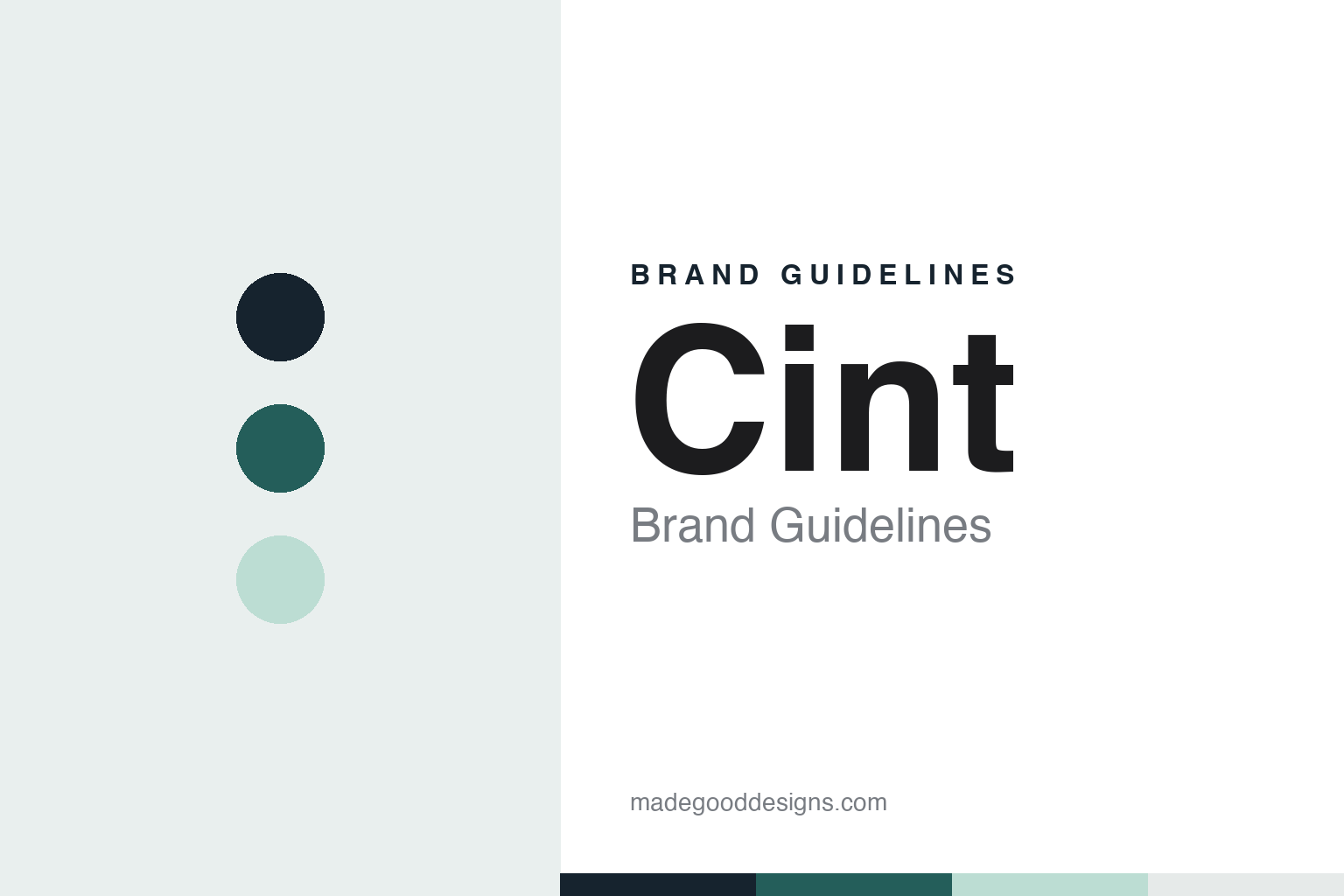
Cint Brand Guidelines
The Stockholm exchange that connects people who ask questions with panels that answer them.
Aa
Two constants: an ink, teal and mint palette and a geometric sans register. Abstract homage — not a Cint product or mark; no interface, logo or wordmark is reproduced.
Consumer Intelligence
A Swedish consumer site that turned into a research marketplace.
Cint is a Stockholm research-technology company, and its name is a contraction. Swedish Wikipedia says Cint is short for Consumer Intelligence, and that the business began on the consumer side: from 1999 to 2010 Cint Sverige AB ran a Swedish website, cint.se, where shoppers could rate products and services. In 2010 that consumer site moved to a new address, knyt.se, and the Cint name stayed with the commercial business that had grown up beside it.
That commercial side came second. Swedish Wikipedia says the English-language marketplace at cint.com was started in the autumn of 2001, with the original aim of paying for the consumer network. Its engine was a system called CPX, the Cint Panel Exchange. Members of the Swedish consumer site formed one of several panels inside it, next to panels owned by media companies and research firms, and the customers who bought access were research institutes in Sweden and abroad. The model that would define the company was already in place: Cint ran the exchange, and the respondents came from many panels, its own among them.
The business-to-business side became the whole company. On 18 January 2012 the trade newsletter Daily Research News Online, published by mrweb, reported a rebrand: Cint gave its products new names and adopted a new logo. Its sample-access and automated-tracking services were folded into Cint Access, its panel-management and revenue services into Cint Engage, and the Panel Exchange itself was renamed OpinionHUB. At that point, mrweb reported, the hub held about 7 million people from more than 600 panels in 60 countries. Cint’s marketing director told the newsletter that the hub name reflected the firm’s focus on connecting people who have questions with real people who can answer them.
Colour
A listing, Lucid and two businesses.
Cint’s growth in the 2020s came through the stock market and one large purchase. Swedish Wikipedia says Cint Group became a public company on Nasdaq Stockholm in 2021. In October of that year it announced a deal to buy Lucid, a research technology business founded by Patrick Comer, and Research Live, the news site of the UK’s Market Research Society, reported on 4 January 2022 that the acquisition had been completed. Cint said at the time that Lucid would bring audience-tracking technology and strengthen its position in the United States and globally. Part of the payment was made in new Cint shares, so Lucid’s former shareholders became shareholders in the Swedish group, Research Live reported.
Leadership followed the merger. Daily Research News Online reported on 3 September 2024 that Comer, then Cint’s chairman, was moving into the chief executive’s role. In the same report mrweb described Cint’s sample exchange as reaching more than 300 million opted-in respondents in over 130 countries, with the company still listed in Stockholm.
By 2026 the company described itself as two businesses. In a release dated 18 August 2026, Triton Partners said Cint works through a Panel Exchange, where customers survey respondents drawn from third-party panels, and Media Measurement, which helps customers judge how well their advertising works. The same release put Cint’s reach at hundreds of millions of consumers in more than 130 countries and its customer base at more than 4,300 business clients. Research Live listed Cint’s offices in Stockholm, London and New York, among other cities.
Typography
How research firms present themselves.
Market research and data firms sell something that is hard to picture: answers drawn from surveys, panels and statistics. Their public identity is therefore carried less by products than by publications and screens. Euromonitor International, for example, presents an annual Top Global Consumer Trends report as a headline release, issued from London in November 2026 in English, Japanese, Korean, Chinese, Arabic and Portuguese, while its newsroom lists press coverage that quotes its analysts.
The platform has become the main showcase. Euromonitor describes Passport as a single hub for market, industry and consumer data, and in June 2026 the trade news service MrWeb reported a rebuilt version with a conversational, AI-based interface. In the same month Dynata launched Dynata+, which it describes as a self-service platform where users check feasibility, see pricing and launch survey projects themselves. Firms that run panels also publish panel books and quality pages, and some name a standard such as ISO 20252 on their sites.
Numbers carry much of the visual weight. Euromonitor’s 2027 trends release gives each trend a short coined name followed by a few headline survey percentages, and Dynata says its new platform shows feasibility, pricing and project progress in real time. In a category like this, a brand is read through headings, figures and the screens that hold them.
Ownership is often part of the story told on corporate pages. Dynata’s press room keeps its 2017 merger release, its 2019 rename and its 2024 restructuring announcements; Euromonitor’s site describes it as independent and privately owned, and the UK company register shows its holding structure. This guide sets out what can be checked about each firm — who founded it, who owns it, and what it says about its own reach — and marks clearly what rests on the company’s word.
Aa
A geometric sans for a data company. (Specimen set in Manrope, a sans STAND-IN; NOT the Cint logo.)
Cint
Private again, under a Triton-led consortium.
Cint’s years as a listed company ended in 2026. Triton Partners says that on 29 April 2026 a consortium it led, acting through a company called TriCarbs Bidco AB that it formed with Bolero Holdings, announced a voluntary public cash offer for the shares in Cint Group. The acceptance period ran until 29 July 2026. Cint’s shares were delisted from Nasdaq Stockholm on 7 August 2026, and on 18 August 2026 Triton announced that its sixth fund had completed the offer, with the consortium holding about 97.8 per cent of the shares and votes. Triton called Cint the eighth investment of that fund.
Research Live reported on 18 August 2026 that Cint had become privately owned. Cint told the site it would keep all of its operations running and continue working with customers and partners across its research and measurement businesses “without interruption.” It said the new ownership would let it invest faster in its research and media-measurement platforms, with priorities that included AI-native tools and workflows, insight that is easier to reach and plug into other systems, and new ways of measuring media. Comer, chief executive since 2024, said the company now had a chance to invest more decisively in its products, people and partnerships. The site also noted that Triton had owned the research company Norstat from 2019 to 2024.
Across these changes Cint’s public story has been told through platform names rather than consumer products: CPX, OpinionHUB, Cint Access, Cint Engage, and later the Panel Exchange and Media Measurement. The company name itself has stayed the same four letters since the Swedish consumer site of 1999.
For a design guide, Cint shows how a research company can rename its products many times while keeping a short master name that began as an abbreviation. Compare Toluna, another company built on online survey panels, and Dynata. For this guide we use an ink blue, a deep teal, a soft mint and a pale grey with a sans, an unofficial interpretation; no product or logo is reproduced.
Explore & save
Keep Cint’s identity on hand — save it to a board in the Made Good inspiration library.
Cint identity set
Pin the Cint ink, teal and mint palette and the geometric sans register to your own board.