Infomaniak Brand Guidelines
A computer shop in Geneva that became a cloud company owned by a foundation.
Aa
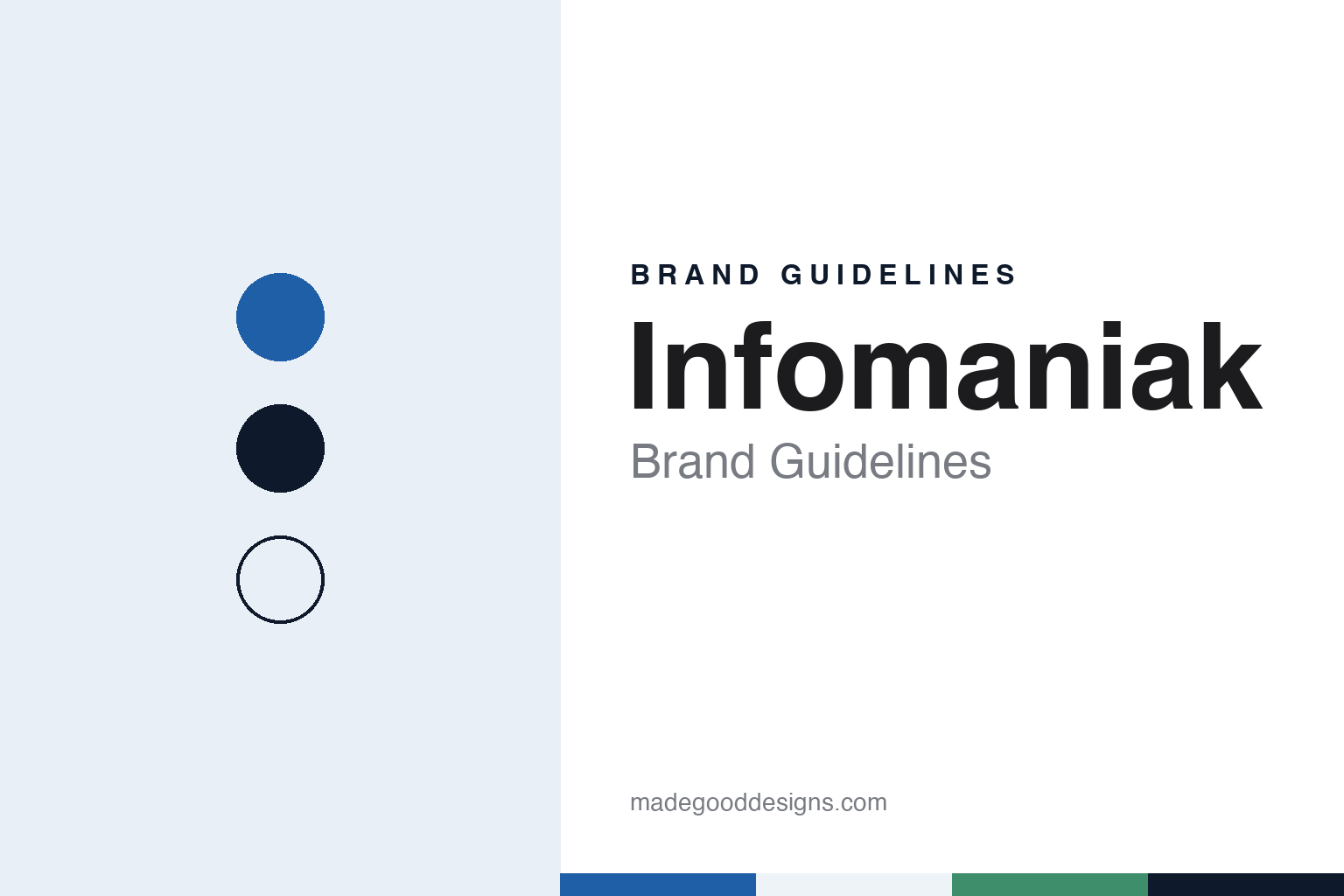
Two constants: a Swiss blue, ink and snow white palette and a neo-grotesque sans register. Abstract homage — not an Infomaniak product or mark; no logo, interface or building is reproduced.
A Geneva computer shop
From a club bulletin board to a hosting company.
Infomaniak traces its roots to a computer club. In 1990, English and French Wikipedia say, Boris Siegenthaler set up a user group in the canton of Geneva that offered its members a bulletin board system. In 1994 he and a fellow club member, Fabian Lucchi, opened the Siegenthaler & Lucchi computer shop in Châtelaine, a district of Vernier, selling custom-built personal computers for less than the large retailers charged. English Wikipedia says the pair bought a modem and a 64-kilobit line the same year and began offering internet access. The company itself counts from that year, writing in May 2026 that “since 1994” it has followed the same path of privacy, environmental responsibility and local roots.
The shop took the Infomaniak name in the mid-1990s. French Wikipedia says it became TWS Infomaniak SA in 1996, while English Wikipedia dates the creation of TWS Infomaniak SA to May 1997, when it became a full internet service provider selling access, web hosting and computer equipment. After the Swiss telecom monopoly ended on 1 January 1998 and free internet access arrived, English Wikipedia says, the firm changed course: in 1999 it was reincorporated as Infomaniak Network and concentrated on web hosting for private users and small and medium-sized businesses, including online radio.
Growth came step by step. English Wikipedia says the company adopted a sustainability charter in 2007, set up the ticketing subsidiary Infomaniak Entertainment in 2010 and managed more than 100,000 domain names by 2011. It opened its third data centre in 2014; French Wikipedia says that one, like the two before it, was cooled without air conditioning. Siegenthaler led the company until 2020, when Marc Oehler became chief executive, according to French Wikipedia.
Colour
Hosting, kSuite and a data centre that heats homes.
Infomaniak’s core business is still hosting and domains. French Wikipedia describes it as an ICANN-accredited domain registrar offering shared hosting, virtual private servers and a website builder, alongside cloud services built on the open-source OpenStack platform: a platform-as-a-service launched in 2018, the Swiss Backup service from the same year, and an infrastructure “Public Cloud” launched in 2021. On its website the company sums up its mission as promoting “technological independence in Europe without compromising on ecology, privacy or human values.”
Its everyday products carry short names. French Wikipedia lists the free file-transfer service SwissTransfer, launched in February 2019; the collaborative storage service kDrive, from February 2020; the video-meeting tool kMeet, from April 2020; and kSuite, launched in October 2022, which bundles kDrive, kMeet, the kChat messaging service, the OnlyOffice editors and email. The company also sells ticketing software, developed since 2007, and streaming for online radio and video, and markets an AI assistant called Euria that it says is hosted in Switzerland.
The data centres are part of the brand story. In a post dated 28 January 2025, Infomaniak said it had inaugurated a new data centre in Geneva the previous day, built in the basement of a cooperative building, and that since 11 November 2024 all of the electricity the site consumes has been passed as heat into the canton’s district heating network. The company says that at full capacity the site can supply heat equal to the needs of about 6,000 homes a year, that its main components are made in Europe, and that since 2013 it has cooled its data centres with filtered outside air. English Wikipedia says the 2014 data centre won the company a Geneva sustainability prize.
Typography
Hosting and cloud identities.
Web hosting and cloud companies sell something their customers rarely see: machines in buildings far away. Their identities therefore lean on what can be shown — the customer interface, the data-centre building, the names on the order page and the corporate page that says who owns the business.
The control panel is often the part of the brand customers use most. Providers give these interfaces names of their own and place them in the main menu beside the product lines: Hetzner’s website links to customer interfaces called Robot, Console and konsoleH, and OVHcloud’s to a customer account and webmail. Documentation, status pages and programming interfaces sit in the same menus, so the brand reaches into technical writing as much as into advertising.
Data-centre photography carries the physical side of the business: rows of racks, cabling and building exteriors. Hetzner’s company pages include a 360° tour of a data centre, and its press kit sets out logos and colours for journalists. Plan names do similar work in text. Some providers use letter codes for server lines, as Hetzner does with its AX and EX lines; others use words, as OVHcloud does with ranges named Kimsufi, Advance, Game and Scale. A mascot is a further option for a host’s brand.
Corporate pages answer the questions that buyers of infrastructure ask: who owns the company, and where its machines stand. Hetzner lists data-centre parks in Germany and Finland and further sites in the United States and Singapore; OVHcloud’s corporate site gives counts of data centres, customers and countries. This guide sets out what can be checked about each brand — founding, ownership and locations — and marks clearly what rests on the company’s own word.
Aa
A neo-grotesque sans in the Swiss tradition. (Specimen set in Inter Tight, a sans STAND-IN; NOT the Infomaniak logo.)
Infomaniak
A foundation, a listing and a Geneva head office.
For most of its history Infomaniak was owned by its founder and staff. In a post dated 20 May 2026 the company said Siegenthaler had handed shares to employees year by year, so that 36 of them held a quarter of the capital, and that on 13 May 2026 he transferred the majority of the voting rights to the Infomaniak Foundation, a Swiss public-interest foundation, through special shares that cannot be transferred. The company says the foundation is supervised by the cantonal authorities of Geneva, makes no operational decisions and is bound by a charter of nine principles covering independence, control of customer data, environmental impact and local jobs. Siegenthaler, now described as founder and chief strategy officer, chairs its board for an initial three-year phase.
A stock-market listing followed. The Swiss trade title Netzwoche reported in August 2026 that Infomaniak planned to list through a reverse takeover of Perrot Duval, a Geneva holding company already on the Swiss exchange, which would sell its industrial businesses to their management and take the name Infomaniak SA. Perrot Duval’s shareholders approved the deal, and in an update of 6 October 2026 Netzwoche reported that Infomaniak had made its debut on the SIX Swiss Exchange on 1 October 2026. Only the B shares trade; the A shares, with preferential voting rights, stay with the foundation, which keeps the majority of votes. French Wikipedia puts the head office in Les Acacias, a district of Geneva, and the staff at about 340 in 2026.
For a design guide, Infomaniak shows how a hosting company can make its ownership and its buildings part of its message: a founder’s foundation, a nine-point charter and a data centre that heats homes. Compare Scaleway, another European cloud company with its own history of data centres, and IONOS, a European hosting brand. For this guide we use a Swiss blue, a deep ink and a snow white with a neo-grotesque sans, an unofficial interpretation; no product or logo is reproduced.
Explore & save
Keep Infomaniak’s identity on hand — save it to a board in the Made Good inspiration library.
Infomaniak identity set
Pin the Infomaniak Swiss blue, ink and snow white palette and the neo-grotesque sans register to your own board.