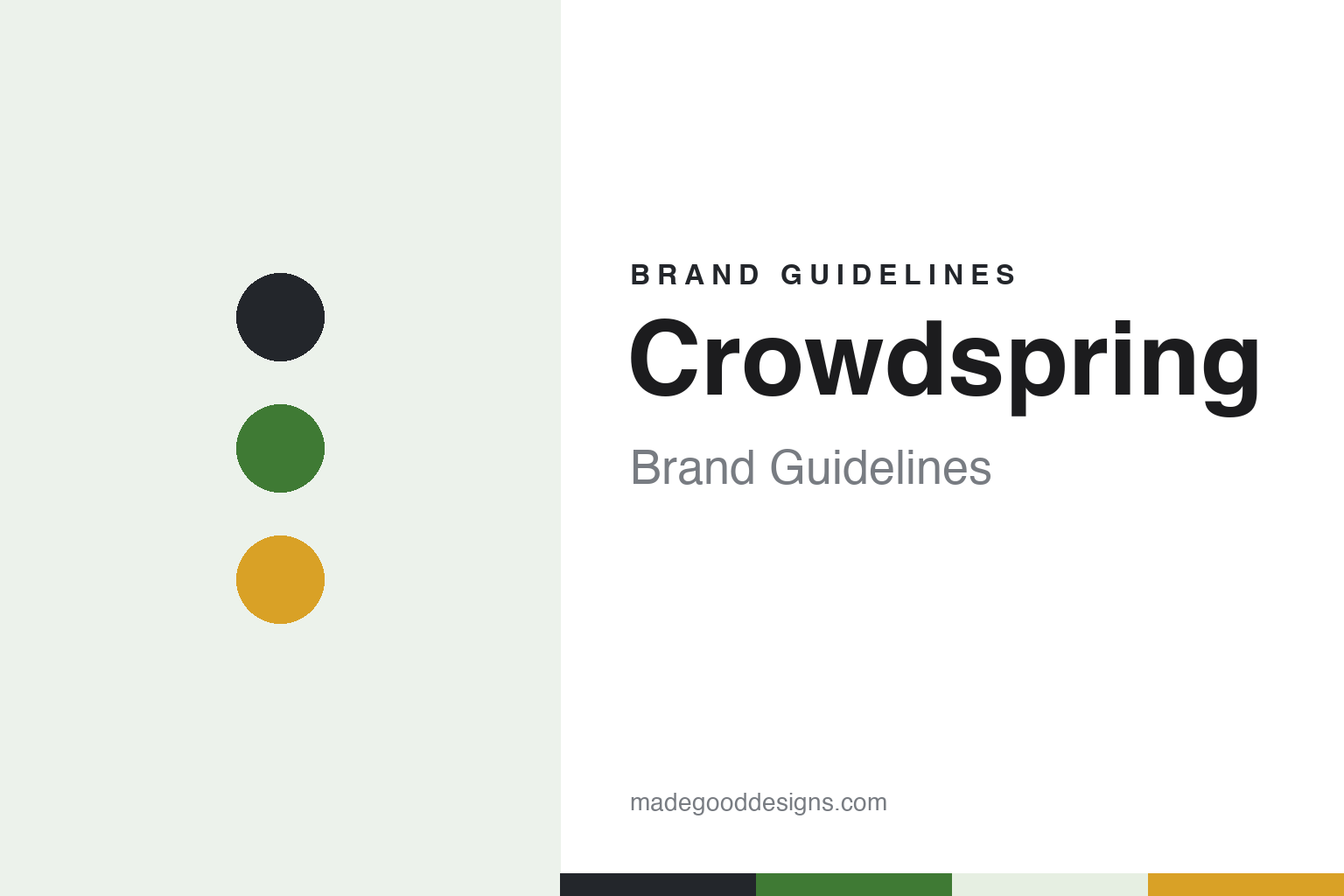
Crowdspring Brand Guidelines
A Chicago contest marketplace built on the creative brief.
Aa
Two constants: a charcoal, green and amber palette and a rounded sans register. Abstract homage — not a Crowdspring asset; no logo, design or contest entry is reproduced.
Two Chicagoans and a contest
A matchmaking idea narrowed to design.
Crowdspring — written “crowdSPRING” and legally crowdSPRING, LLC, according to English Wikipedia — is a Chicago marketplace for crowdsourced creative services. English Wikipedia says it was co-founded in May 2007 by Ross Kimbarovsky and Michael Samson, and that the marketplace opened to the public in May 2008. A Built In Chicago post of September 2012 likewise dated the co-founding to 2007.
Forbes told the founding story in January 2009, opening with a Chicago precedent: the 1922 competition for the Chicago Tribune’s tower, which drew 263 entries and which the magazine said the founders wanted to bring to graphic design. Kimbarovsky, an intellectual-property lawyer, and Samson, a film producer, had both run into trouble buying creative work in 2006: Samson while outsourcing post-production, Kimbarovsky with a design shop working on his law firm’s website. The two first imagined a matchmaking service for buyers and sellers of almost anything, from wedding planning to landscaping, Forbes reported, and settled on graphic design because the work could be made and delivered digitally with little overhead. The magazine said they raised their early money from 16 business associates around Chicago.
Forbes also counted the early scale. Since the May 2008 launch, it reported in January 2009, the site had registered nearly 2,400 buyers from 35 countries and 12,200 designers from more than 130, with a staff of nine. By September 2012, Built In Chicago wrote, Crowdspring covered graphic design, industrial design and writing, and gave clients access to some 122,000 designers and writers, with buyers from more than 100 countries.
Colour
A creative brief, a reward and a five-star scale.
The Crowdspring model is a competition. Forbes described buyers running contests for company logos, websites, T-shirts and similar work: a buyer loads rough specifications into the site, designers post entries, and the buyer gives feedback as the entries arrive. A premium Pro option, the magazine reported, let larger buyers hide submissions from public view so that competitors could not see them. Kimbarovsky put the pitch plainly to the magazine: “We have clients chasing good designers rather than desperate designers chasing work.”
A Slate columnist tested the service in May 2011 with a small logo project and described the interface step by step. Registration took a minute or two; anyone could browse other people’s projects and, in many cases, their submissions. To post a job he filled in Crowdspring’s “creative brief” form, answering its set questions about what the logo should communicate. The site called the fee paid to the winning designer a “reward,” and only the winning design was paid. As entries came in, Crowdspring prompted him to rate them on a five-star scale and to send feedback to the designers; after a week he had 32 submissions from 22 designers, fewer than the average of more than 110 entries the site advertised at the time. Slate noted that contest sites of this kind had long been debated in the design trade, and Forbes had reported in 2009 on a NoSpec campaign in the design community urging designers not to work before being paid.
The company’s own mark came out of that system. Forbes reported in 2009 that Crowdspring “eats its own cooking”: both its website design and its logo were sourced through its own marketplace, and the logo — a silhouette of a figure leaping with the force of a spring beneath it — came from a designer in Toronto who had no formal design training.
Typography
Marketplaces and their interfaces.
Freelance and creative-talent marketplaces describe themselves in a small set of words. DesignCrowd’s about page calls it an online creative marketplace that connects businesses with a global network of designers; English Wikipedia describes Crowdspring as a marketplace for crowdsourced creative services. Category names on these sites are practical rather than poetic: logo and identity, web, print, product and merchandise, art and illustration, with designer directories sorted by type, country and city.
The client’s first screen is usually a brief. When Slate tested Crowdspring in May 2011, posting a job meant filling in a “creative brief” form with set questions about what a logo should communicate. Contest sites then add their own rules on top of the brief. DesignCrowd’s how-it-works page lets a client choose a three-, five- or ten-day deadline, keeps designers from seeing one another’s entries and passes full copyright in the winning files to the client.
Showcase work is presented plainly, as entries and finished projects rather than as campaigns. Slate found that anyone could browse other people’s projects and, in many cases, their submissions, and that the site prompted clients to rate entries on a five-star scale and send feedback. Forbes reported in 2009 that Crowdspring offered larger buyers a Pro option that hid submissions from public view, and that its own logo came through its marketplace.
Corporate pages fill in the rest. DesignCrowd’s about section names its founder and chief executive and has a separate board and investors page listing its venture backers, while dated press releases record new country sites and new brands. This guide sets out what can be checked about each marketplace — who founded it, who owns it and how its interface works — and marks clearly what rests only on the company’s own word.
Aa
A friendly rounded sans for a marketplace of briefs and entries. (Specimen set in Nunito Sans, a sans STAND-IN; NOT the Crowdspring logo.)
Crowdspring
A spring, a leap and a Chicago base.
English Wikipedia describes Crowdspring as an online marketplace for crowdsourced creative services, based in Chicago, and notes a company blog launched in mid-2008. Built In Chicago used that “crowdSPRING” form in 2012, while Forbes printed “CrowdSpring” in 2009 and the Wikipedia article itself is titled “Crowdspring”. Forbes described the logo in 2009 as a silhouette of a figure leaping with the force of a spring below it.
Forbes placed the business in a wider field of freelance sites in 2009, setting it beside Guru.com and Elance, which offered a large pool of freelancers for everything from legal to design work. The difference, as the magazine put it, was the first step: on those sites vendors answered a posted project by advertising existing portfolios, while on Crowdspring designers took a first attempt at the work itself. Slate’s 2011 test showed the same structure from the client’s side, from the creative-brief form to the star ratings. English Wikipedia also records that the speculative nature of the model — designers submitting finished work with no guarantee of being chosen — has drawn ongoing criticism, and that Crowdspring has answered that it gives creatives a global platform to reach businesses and build portfolios.
For a design guide, Crowdspring shows how a contest marketplace can source its own mark through the process it sells. Compare DesignCrowd, a Sydney contest marketplace launched in 2008, and 99designs. For this guide we use a studio charcoal, a leaf green and an amber with a sans, an unofficial interpretation; no product or logo is reproduced.
Explore & save
Keep Crowdspring’s identity on hand — save it to a board in the Made Good inspiration library.
Crowdspring identity set
Pin the Crowdspring charcoal, green and amber palette and the rounded sans register to your own board.