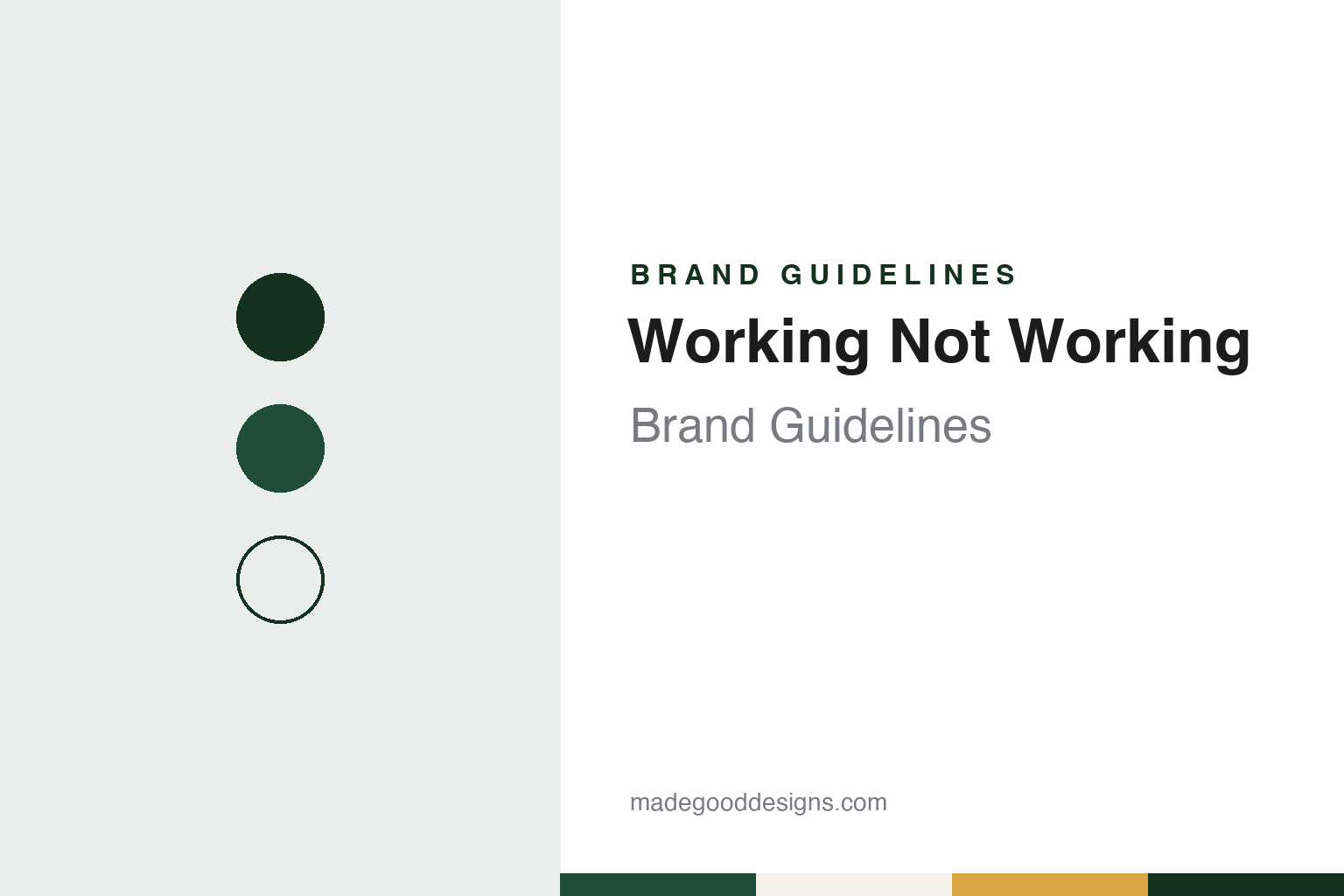
Working Not Working Brand Guidelines
Two art directors turned a blinking vacancy sign into a creative network.
Aa
Two constants: a green, cream and amber palette and a soft editorial serif register. Abstract homage — not a Working Not Working asset; no logo, wordmark or interface is reproduced.
Justin’s available
Two former Ogilvy art directors and a sign on a portfolio site.
Working Not Working was started by two art directors. In a December 2021 interview with The Creative Factor, Justin Gignac and Adam Tompkins said they had met as art directors in the same group at Ogilvy in 2002, had then left for separate freelance careers and had stayed friends. Eye on Design, the publication of the design association AIGA, reported in May 2021 that the pair founded Working Not Working a year after Fiverr launched in 2010, which places the start in 2011.
The idea came from freelancing itself. Gignac told The Creative Factor that work arrived unevenly: weeks with no bookings, then several offers at once. So he put a large blinking sign on his portfolio website, styled like a motel “Vacancy” sign, saying that he was available or soon would be. Recruiters began following it, and offers came in whenever he switched it to “Available.” Jobs he was too busy to take he passed on to art director friends. He and Tompkins agreed that the sign could work for everybody, sketched rough wireframes and hired a design and development studio in Brooklyn to build the first version of the site.
Membership was selective from the start. According to the same interview, a new member had to be referred by an existing one and then approved by the founders, who said they accepted only about 15 percent of applicants because they knew what their agency customers expected. Within a couple of years the network had about 2,500 creatives. The two founders said they ran everything themselves for the first three years while still taking freelance work, before raising an angel round.
Colour
A curated community, then an open one.
The founders described the platform as a showcase for when creative people were free to work. Members built a profile around their portfolio, gathered followers and could be hired for contract work, while companies browsed a curated pool of talent. Eye on Design wrote in 2021 that the platform was “geared toward connecting ‘elite’ freelance creatives” with companies that could afford them, and described a membership board of about 350 members who could propose and vote on a “vetted” badge for talented newcomers.
The network then opened up. Gignac told The Creative Factor that after the angel round the talent base grew to about 7,500 creatives, and that in 2017 the site was relaunched so that anyone could create a profile. By the end of 2021, the founders said, it had more than 100,000 creatives. Its talent had been concentrated in New York, Los Angeles and San Francisco, and the founders described plans to widen that to the whole world.
The brand defined itself against cheaper, open marketplaces. Eye on Design reported that Gignac had described Working Not Working as the antithesis of platforms like Fiverr, and that in 2020 the site was a finalist in the Webby Awards in the employment website category, where Fiverr was also in contention. A member quoted in the same article said most of her work through the platform came from people who had seen her profile and contacted her, rather than from jobs she applied for.
A later industry piece in PRINT, from September 2025, singled out the same mix: manual curation, peer-review badges, an availability status and in-person networking, which it argued agencies read as a sign that talent had already been screened by peers.
Typography
How the category presents itself.
Freelance and creative-talent marketplaces describe themselves in a small set of words. DesignCrowd’s about page calls it an online creative marketplace that connects businesses with a global network of designers; English Wikipedia describes Crowdspring as a marketplace for crowdsourced creative services. Category names on these sites are practical rather than poetic: logo and identity, web, print, product and merchandise, art and illustration, with designer directories sorted by type, country and city.
The client’s first screen is usually a brief. When Slate tested Crowdspring in May 2011, posting a job meant filling in a “creative brief” form with set questions about what a logo should communicate. Contest sites then add their own rules on top of the brief. DesignCrowd’s how-it-works page lets a client choose a three-, five- or ten-day deadline, keeps designers from seeing one another’s entries and passes full copyright in the winning files to the client.
Showcase work is presented plainly, as entries and finished projects rather than as campaigns. Slate found that anyone could browse other people’s projects and, in many cases, their submissions, and that the site prompted clients to rate entries on a five-star scale and send feedback. Forbes reported in 2009 that Crowdspring offered larger buyers a Pro option that hid submissions from public view, and that its own logo came through its marketplace.
Corporate pages fill in the rest. DesignCrowd’s about section names its founder and chief executive and has a separate board and investors page listing its venture backers, while dated press releases record new country sites and new brands. This guide sets out what can be checked about each marketplace — who founded it, who owns it and how its interface works — and marks clearly what rests only on the company’s own word.
Aa
A soft editorial serif, chosen for a network built by two art directors around portfolios. (Specimen set in Fraunces, a serif STAND-IN; NOT the Working Not Working logo.)
Working Not Working
Sold to Fiverr in 2021, closed in 2025.
In February 2021 Fiverr bought Working Not Working. Eye on Design reported in May 2021 that thousands of members learned of the sale by email that February, and that the news drew a strong reaction online from members who saw Fiverr as the opposite of what the network stood for; some said they would close their accounts. The founders told the publication that a light-hearted response they had tried at the time was a misstep, and that they would have to prove the decision was right for the community. Fiverr’s marketing chief told the same article that the company wanted to reach more top-level vertical markets.
For a time the founders stayed on. In the December 2021 Creative Factor interview they described the acquisition as a step that would take the network beyond its three American cities to talent around the world.
The network did not last as a separate service. In September 2025 PRINT wrote that the announcement that Working Not Working would close at the end of June had marked a shift for the creative industry, and that its members had been pushed toward larger gig platforms. Coverage of the closure on the freelance site SideHusl said the service closed at the end of June 2025, and that its creatives could join Fiverr or a Fiverr talent pool from which the company would contact them about matching work. Working Not Working no longer trades, and the old web address now carries an unrelated blog.
For a design guide, Working Not Working shows how a brand built by art directors can turn a simple signal of availability into a whole identity. Compare Fiverr, which bought it, and Contra, another network for independent creatives. For this guide we use a deep green, a warm cream and an amber with a serif, an unofficial interpretation; no product or logo is reproduced.
Explore & save
Keep Working Not Working’s identity on hand — save it to a board in the Made Good inspiration library.
Working Not Working identity set
Pin the Working Not Working green, cream and amber palette and the soft editorial serif register to your own board.