Escape Campervans Brand Guidelines
The van rental brand that turned its fleet into a rolling art show.
Aa
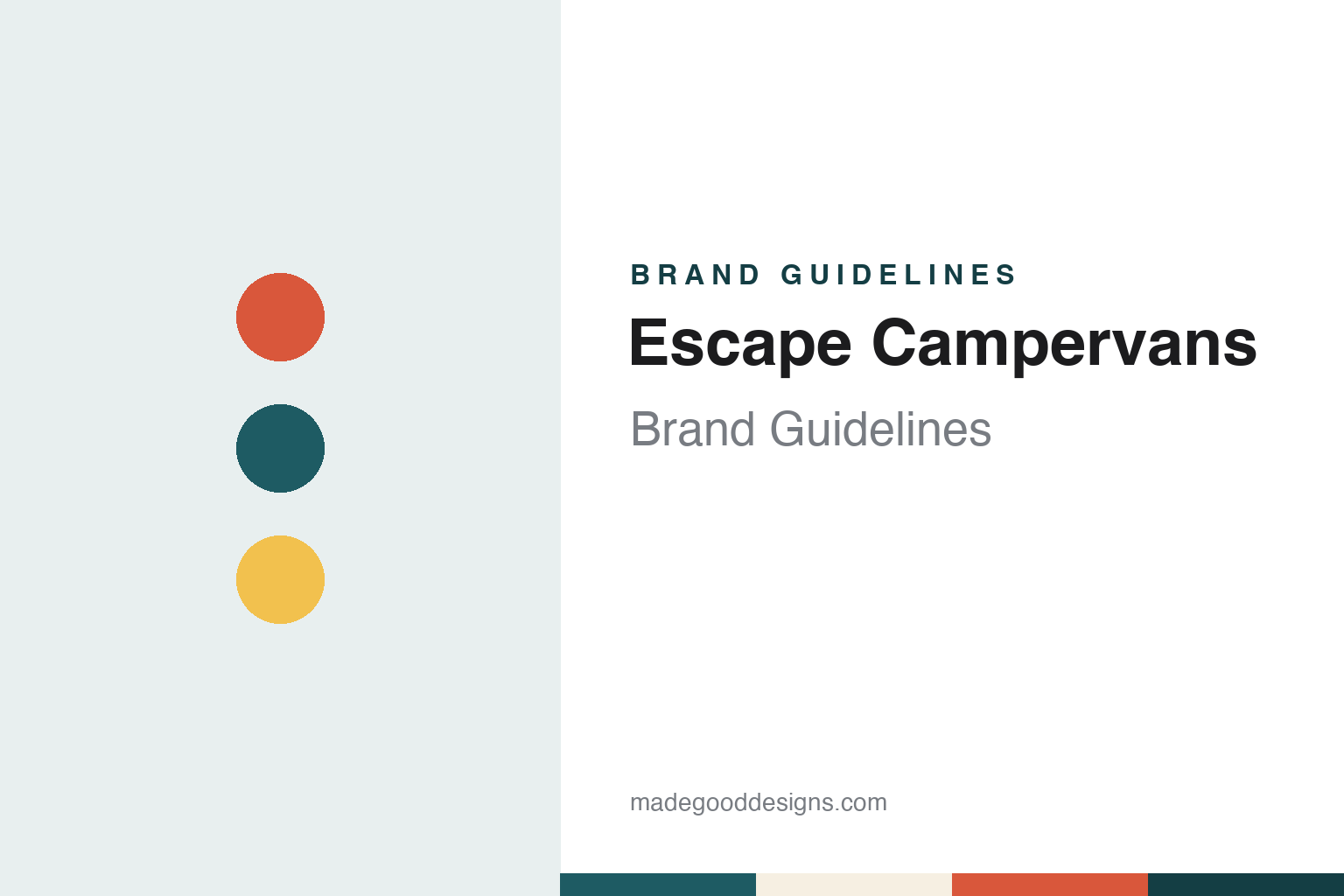
Two constants: a teal, coral and marigold palette and a painted grotesque register. Abstract homage — not an Escape Campervans van, artwork or mark; no logo or painted design is reproduced.
Vans as canvases
A rental fleet painted by independent artists.
Escape Campervans was founded in 2009, according to the company’s own boilerplate in a November 2025 release, and it rented campervans across North America for about sixteen years. Hilco described it as a provider of “affordable, adventure-focused campervan rentals,” and the brand’s current owner says the original Escape spent those years “turning first-time renters into lifelong road-trippers.”
What set the brand apart was the fleet’s look. The original Escape vans carried bold, hand-painted artwork commissioned from independent artists, the trade magazine RV PRO reported in October 2026, “providing a signature look that became inseparable from the brand’s identity.” A November 2025 release from the auction firm Hilco Global described “more than 600 brightly-painted vans on the road” over the company’s life, and said many of the vans carried Escape’s hand-painted artwork, some of it on removable vinyl wraps. The company’s current owner sums it up on its website: if you rented with the original Escape, “you probably remember the vans before you remember the name.”
The van names were part of the system. The Hilco release lists the models offered at the end: the Maverick, the Mesa, the Del Mar, an all-wheel-drive van, and the Santa Cruz, alongside Jeep rentals, many with optional rooftop sleepers. The Drive reported in November 2025 that buyers could sort the auction listings by the underlying chassis, and that spare roof tents were on sale too.
Colour
November 2025: the doors close.
The original company did not last. In November 2025 Escape posted a notice saying it had made “the difficult decision to officially close our doors,” The Drive reported on 17 November 2025. The company cited an increasingly challenging economic environment, declines in international travel, inflationary pressures and shifts in the consumer market. On 24 November 2025 Hilco Global announced that Escape Campervans had officially ceased operations after nearly two decades, and that about 400 vans from the remaining fleet were being sold through weekly online auctions and “Buy It Now” listings on bidadoo, an online auction house selling on eBay, in partnership with Hilco Global Capital Solutions. RV PRO carried the same announcement on 3 December 2025.
The painted vans went with that sale. The vehicles “belonged to the original company and were sold along with the rest of its fleet when it closed,” the brand’s current website says, and they are not part of the business that uses the Escape name today. The old company itself, Escape Campervans Inc., is described on that website as having ceased operations in November 2025, and the current owner states plainly that it is not a successor to it.
The auction was open to the public. Hilco said the vans were late-model vehicles with low to moderate mileage, each with an inspection report, and that new stock would be added every week, with most lots offered at no reserve, until the fleet was gone.
Typography
How hire brands present themselves.
Campervan and motorhome rental is sold with pictures of the open road, but two different kinds of business sit behind those pictures. Some companies own and run fleets of their own vehicles from depots; others are marketplaces, on which private owners list their own caravans, campervans and motorhomes and the platform handles the booking and the cover. Camplify, launched in Newcastle, New South Wales, in 2015, and PaulCamper, launched in Berlin in 2013, are marketplaces of the second kind, and since December 2022 both have belonged to the same group listed in Australia.
This guide looks first at the vehicle as each company publishes it: in a company livery or paint scheme, photographed against a landscape, or listed as an owner’s own van in that owner’s own photographs. Where a company describes its vans, its colours or its paintwork, the guide gives that as the company’s own account, with the date of the source.
Names come next. Rental firms give names to their vehicle ranges and models, and marketplaces give names to their memberships and cover products: Camplify sells a premium membership called Club Camplify and member cover under the name MyWay, while PaulCamper says it built its rental cover together with Allianz. Bookings are made online, and some companies also offer an app, as Camplify does on its website; this guide describes such apps plainly, from what the companies say about them.
Finally, there are the owners. Some names in this category belong to larger groups, and corporate pages, annual reports and stock-exchange filings show who owns what and since when. This guide follows those documents and dated press reports, gives fleet, depot and country counts only as a dated source states them, and treats the colours and typefaces shown here as an unofficial interpretation rather than official brand values.
Aa
A lively grotesque for a brand that once let artists dress its vans. (Specimen set in Bricolage Grotesque, a sans STAND-IN; NOT the Escape Campervans logo.)
Escape Campervans
Same name, new company.
The name came back in 2026. Avanti Campervans, which RV PRO describes as a family-owned campervan rental operator and outfitter, acquired the Escape Campervans name and trademark and relaunched Escape as a new company with a new fleet, the magazine reported on 23 October 2026. “This isn’t a comeback of the original business,” the release said; Avanti’s owner said the company had spent twelve years in campervan rental and was “not trying to recreate what came before.”
The new fleet reverses the old look. Instead of painted vans, the relaunched Escape rents clean, unmarked minivan campers “designed to blend in rather than stand out,” RV PRO reported. The two models, the Voyager and the Caravan, seat four and sleep two, with a bed, a kitchen setup and storage; the company describes a pull-out kitchen design that it says is patented. Its own pages present the plain vans as an advantage, saying they fit anywhere a normal car does, from a campground to a city street. In October 2026 the magazine counted 14 locations across the US, with Vancouver and Calgary planned for 2027; the website lists cities from Anchorage to Miami, including Boston, Denver, Seattle and a New York-area base in Jersey City.
The new owner kept the mission line, “making campervan adventures easily accessible, affordable and fun throughout North America,” and the itinerary library, while dropping the artwork. Those itineraries run from Route 66 between Los Angeles and Chicago to a drive from Seattle to Anchorage, and from a Utah loop through its five national parks to a crossing from New York to Seattle that links the network’s hubs. It is open about the change: “The van may look different,” the website says, and it notes that pictures of old painted vans may still appear on some pages but are not connected with the new company.
For a design guide, Escape Campervans shows how much of a brand can live in its vehicles, and what remains when the vehicles go: a name, a mission line and a set of road-trip routes. Compare Cruise America, a US motorhome renter founded in 1972, and Outdoorsy, a US peer-to-peer RV rental platform. For this guide we use a canyon teal, a desert coral and a marigold with a sans, an unofficial interpretation; no product or logo is reproduced.
Explore & save
Keep Escape Campervans’s identity on hand — save it to a board in the Made Good inspiration library.
Escape Campervans identity set
Pin the Escape Campervans teal, coral and marigold palette and the painted grotesque register to your own board.