Olive Young Brand Guidelines
CJ’s 1999 Sinsa-dong beauty chain, in olive green and coral.
Aa
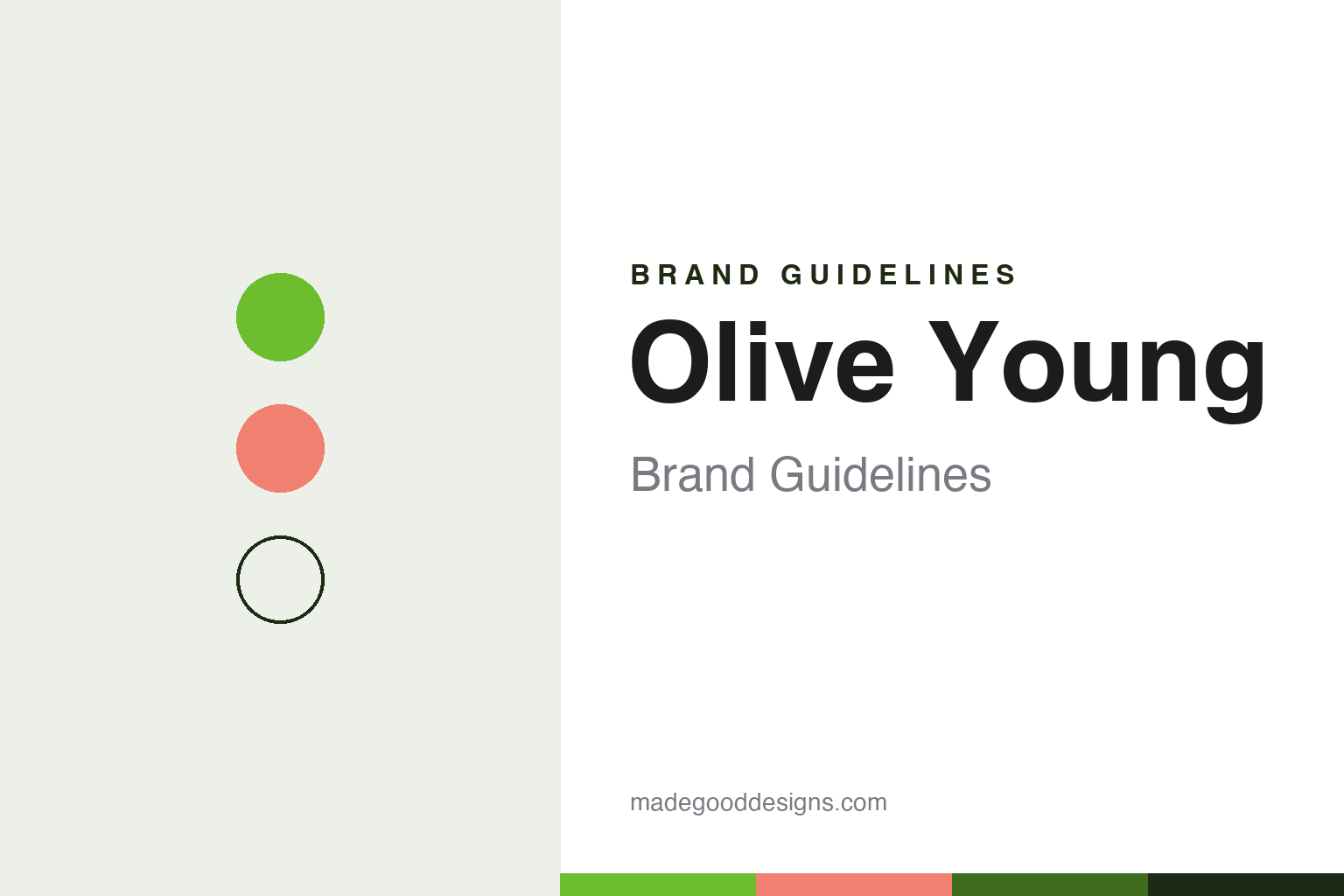
Two constants: an olive green and coral palette and a rounded geometric sans register. Abstract homage — not an Olive Young product or mark; no logo, shelf or pack is reproduced.
Sinsa-dong, 1999
A CJ division, a Gangnam shop and a long run of name changes.
Olive Young opened its first store in Sinsa-dong, in Seoul’s Gangnam district, in December 1999, under the management of CJ Group, English Wikipedia says. The company’s own history page describes its start as the Health & Beauty Convenience business division of CJ CheilJedang, the group’s food company, which was later separated and set up as a company of its own. Korean Wikipedia gives the name in Korean as 올리브영 and calls the chain a drugstore chain run by CJ Olive Young.
The early years brought a foreign partner. In 2002 the business formed a joint venture with Dairy Farm International, the Hong Kong retailer within the Jardine Matheson group, according to Korean Wikipedia; the joint venture ended in 2008, when CJ completed its purchase of Dairy Farm’s stake, English Wikipedia says. In 2009 Olive Young began importing the organic cosmetics of the American brand Juice Beauty, and in 2010 CJ launched CJ ONE, a membership scheme shared across its companies.
The corporate shape then changed twice. In December 2014 Olive Young merged with CJ Systems and the combined business took the name CJ Olive Networks, English Wikipedia says. In 2019 the retail business was split off again as CJ Olive Young, according to Korean Wikipedia. Its corporate website now gives its head office in Yongsan-gu, Seoul, and lists it among CJ Group’s affiliates under logistics and new distribution.
Growth came store by store. The company says it opened its first store outside Seoul, in Busan, in the late 2000s, passed 1,000 stores in South Korea in 2017 and passed 1,350 in 2024. In August 2026 The Korea Herald put the count at 1,367 stores, in an article on the newer beauty chains, discount outlets and pharmacies competing for the same shoppers, many of them foreign visitors.
Colour
Own labels, flagships and a wellness spin-off.
An Olive Young store mixes outside brands with its own. Korean Wikipedia lists categories running from skin care, make-up, perfume and men’s grooming to hair and body care, oral care, drinks and snacks. It also dates the chain’s own labels: Bioheal Boh in 2013, Wakemake and Round A’Round in 2015, and Bring Green and Fillimilli in 2018. The company’s history page says it launched its first private brand between 2007 and 2011 and began selling those labels through Amazon in the United States in 2017.
The shops have grown into a set of formats. The company says it opened a flagship store in Gangnam in 2017 and an “Innovative Store,” OLIVE YOUNG N Seongsu, in 2024, in Seoul’s Seongsu area, followed in 2026 by OLIVE YOUNG Beauty Mansion Seongsu. English Wikipedia says the chain introduced electronic shelf labels in 2018 and launched its Global Mall, an online shop for overseas customers, in 2019; the company adds a same-day delivery service from 2018 and an annual OLIVE YOUNG Awards & Festa event from 2019.
In 2026 a wellness spin-off appeared. The Korea Times reported in November 2026 that Olive Better, a chain for wellness products, had grown to five locations nine months after its first store opened in the Gwanghwamun area of Seoul in January. Its newer branches include one at Starfield Coex Mall, aimed at office workers, and a larger store in Seongsu with a drinks bar, a low-sugar snack section and a sauna-themed corner.
Typography
Design and documentation.
South Korea’s large retailers tend to present themselves through formats before slogans. A single group may run hypermarkets, warehouse stores, supermarkets, convenience stores and online malls side by side, each with its own name on the fascia, and corporate pages usually open with a timeline: the first branch, the district it stood in, the year it opened, and then each new format as it was added.
The big-box stores carry much of their identity on the shelf. Hypermarkets sell groceries alongside clothing, household goods and electronics under one roof, and own labels give them names to point to in the aisle, from value ranges to premium ready meals. Warehouse formats lean on large packs and goods shown in boxes or on pallets, so that the display itself signals the way the store sells.
Department stores and convenience chains work at opposite scales. Department-store groups put their weight into the building, the façade and the flagship in a city centre, while convenience chains rely on a short name and a bright fascia that has to read from a street corner and repeat across a large network of small shops. Beauty and lifestyle chains, and the apps that sit alongside all of these stores, carry the same names into a much smaller frame.
Behind the shop fronts sit corporate structures that the companies set out in plain terms: founding groups, spin-offs, joint ventures with foreign retailers, private-equity owners and listings on the Korea Exchange. Names have changed as partners arrived or left, and some chains have gone through court-supervised rehabilitation. For a designer, that history explains why a fascia, a logotype or an own-label pack looks the way it does today.
Aa
A rounded geometric sans, friendly and upright. (Specimen set in Plus Jakarta Sans, a sans STAND-IN; NOT the Olive Young logo or wordmark.)
Olive Young
A symbol, a wordmark, a green and a coral.
Olive Young publishes a short account of its own identity. On its brand resources page the company says the logo combines an OLIVE YOUNG symbol with a wordmark, in two named colours: Olive Green, which it links with vitality, and Coral, which it links with natural beauty. It explains the first word of the name as a play on the phrase “all live young,” and says “young” refers to a mindset rather than to age. The company’s timeline records a new brand identity announced for its 20th anniversary in 2019 and a further update to the identity in 2020.
Since 2026 the brand has also been a store name in the United States. In March 2026 the company appointed its first US chief executive and set up its first North American logistics centre, in Bloomington, California, Cosmetics Business reported. On 29 May 2026 it opened its first US store, on Colorado Boulevard in Pasadena, an 8,000-square-foot shop that the company said carried products from some 400 brands, NBC Los Angeles reported; a second store followed in Century City on 13 June 2026, according to Cosmetics Business.
Olive Young also works through another retailer’s shelves. In January 2026 Sephora, the LVMH-owned beauty chain, announced an omnichannel partnership under which Olive Young would curate Korean beauty sections in Sephora stores and online, Cosmetics Business reported. In August 2026 the two companies named 19 Olive Young-curated Korean brands for more than 500 Sephora stores in the US and for sephora.com, along with a dedicated Olive Young space at Sephora’s Times Square store in New York, the same magazine reported.
For a design guide, Olive Young shows how a store chain can turn a green and a coral, a short name and a run of own labels into a recognisable shopfront at home and abroad. Compare Lotte Duty Free, another Seoul retailer built around beauty shoppers, and Daiso, whose Korean stores also sell low-cost beauty goods. For this guide we use a leaf green, a soft coral and a deep olive with a sans, an unofficial interpretation; no product or logo is reproduced.
Explore & save
Keep Olive Young’s identity on hand — save it to a board in the Made Good inspiration library.
Olive Young identity set
Pin the Olive Young green and coral palette and the rounded geometric sans register to your own board.