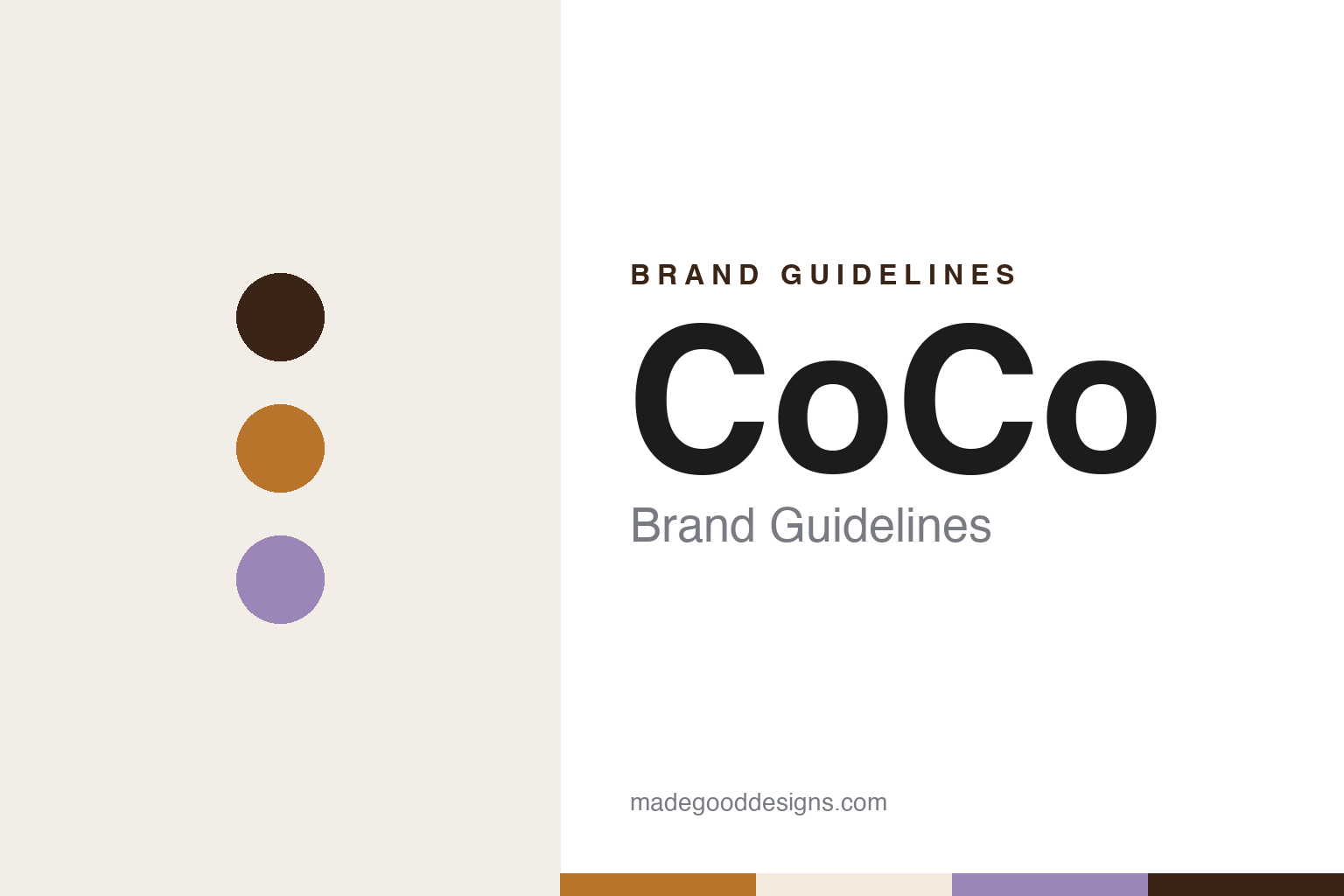
CoCo Brand Guidelines
The Tamsui tea shop that became a global bubble tea franchise.
Aa
Two constants: a tea amber, milk cream and taro lilac palette and a rounded friendly sans register. Abstract homage — not a CoCo product or mark; no cup, logo or menu board is reproduced.
Tamsui, 1997
A riverside tea shop and three partners.
CoCo began in Tamsui, the river-mouth town north of Taipei, in 1997. Chinese Wikipedia says that in May 1997 Tommy Hung (洪肇水) and two partners opened a foam-tea shop there under the name 都可流行生活飲食, the forerunner of the brand that became 都可茶飲 and, in English, CoCo Fresh Tea & Juice. English Wikipedia renders the Chinese name, CoCo都可茶飲, as “CoCo You Can Drink Tea,” and names Hung as founder and current chairman. Tamsui was then part of Taipei County, today New Taipei City. English Wikipedia describes the business as a global bubble tea, or boba, drink franchise based in Taiwan.
The company’s own account is brief. Its website, which now calls the business CoCo Bubble Tea, says it was “founded in 1997 by Chairman, Tommy Hung,” around a core mission it sums up as “Consistency and Continuity,” and that it built its name on new drinks, store design, fresh fruit and its own recipes. It lists three brand values, Dedicate, Fun and Care, and closes with the line “Embrace Tradition, Unleash Innovation, and Seize the World.”
Chinese Wikipedia gives the operating company as 億可國際飲食股份有限公司, while the trade magazine Foodservice Equipment Reports named the operator as OCOCO Int’l. Co. Ltd. in January 2015.
Colour
From Suzhou to Mong Kok and New York.
CoCo grew first at home and then abroad. Chinese Wikipedia says the brand opened its first store in Suzhou, in Jiangsu province, in 2007, and from there began expanding into overseas markets. A press release issued by Invest Hong Kong, the Hong Kong government’s investment agency, on 5 July 2011 said CoCo had opened its first Hong Kong teahouse in Wan Chai in January that year and was adding a second in Mong Kok, selling “signature Taiwanese tapioca milk tea” alongside fresh teas and juices. The same release put the company at more than 600 teahouses in Taiwan, the United States and Hong Kong. The company’s website dates its first New York store to 2011.
The Hong Kong release also set out how the company described itself at the time. It said CoCo had been founded on its founders’ wish to serve drinks made with the freshest ingredients, and credited its growth to a commitment to “QSC,” which it spelled out as quality, service and cleanliness. Its general manager in Hong Kong said the teahouses were placed on busy streets for maximum visibility, and the release presented the move as part of a wider push into northeast and southeast Asia, the Middle East and Australasia.
The numbers rose quickly. In January 2015 Foodservice Equipment Reports said the operator ran more than 1,800 CoCo Fresh Tea & Juice outlets worldwide, with operations in Asia, North America and Africa. Chinese Wikipedia now gives about 4,500 stores worldwide and calls CoCo the Taiwanese hand-shaken drink brand with the most branches, and English Wikipedia gives more than 5,000 locations, listing markets from South Korea, Japan and the Philippines to Canada, Mexico, Peru, Mauritius and New Zealand, and in Europe France, Spain, the United Kingdom, Sweden, the Netherlands, Belgium, Italy and Germany. Chinese Wikipedia adds that in 2024 the company opened franchising in Taiwan south of Taichung.
The menu is broad rather than built on a single drink. The company’s website groups it into ranges including Fresh Tea, Milk Tea, Fruit Tea and Slush & Smoothie, with further lines of macchiato, fresh milk, chocolate, Yakult and a popping series. English Wikipedia notes that its taro milk tea was recommended by Eater.
Typography
How tea-drink chains present themselves.
Bubble tea and tea-drink chains sell a drink that is made in front of the customer, so most of their public image is built around the cup. On their own websites, Taiwanese brands such as Chatime and Gong Cha lead with pictures of individual drinks and group them into named ranges and short lists: Gong Cha calls its top five drinks worldwide the “Famous Five,” and Chatime’s US website sorts its menu into ranges such as Signatures, Milk Tea Classics and Fruity.
Drink and staff names do much of the brand work. Chatime’s US website builds its copy on tea puns, calling its counter staff “T-Ristas,” while Gong Cha names drinks by their tea, fruit and toppings, from milk foam to “QQ” jelly. Store fronts and menu boards appear in the companies’ franchise pages and news posts, where a new store design or a first store in a new country is presented as an event.
Ordering apps and online shops are now part of the picture. In 2020 the Taipei Times reported that Chatime’s parent, La Kaffa International, had begun taking orders through an app with a software partner, and in 2026 Nation’s Restaurant News reported that Gong Cha was rolling out a “digital kitchen.” For a designer, these tools are part of the brand as much as the cup or the counter.
Behind the cups are corporate histories that are often more complicated than the store fronts suggest. Many chains grew through franchising, with regional partners running whole countries, and some have changed owners several times. This guide sets out what can be checked about each brand — who founded it, who owns it now, and how it is sold — and marks clearly what rests only on the company’s own word.
Aa
A rounded friendly sans — chosen for a cheerful counter register. (Specimen set in Nunito, a sans STAND-IN; NOT the CoCo logo.)
CoCo
A short name, a long menu.
CoCo’s public face pairs a short Latin-letter name with a descriptor that has changed over time. In Chinese the brand is CoCo都可, as Chinese Wikipedia titles it. In English it was “CoCo Fresh Tea & Juice” in the 2011 Hong Kong release and in 2015 trade coverage, and it is “CoCo Bubble Tea” on the current website, which asks customers to tag their photographs #CoCoBubbleTea.
Much of the brand’s recent visibility in Taiwan comes from tie-ins. Chinese Wikipedia lists a 2023 collaboration with the mobile game Fullmetal Alchemist M, joint drinks with Uni-President’s papaya milk in 2023 and 2024, ice lollies made with Poki in 2024 and 2025 based on CoCo drinks such as its passion-fruit 百香雙響炮 and its 奶茶三兄弟 milk tea, and a 2024 carton drink with Taisun. The same article says the company holds regular promotions each year, among them a CoCo Day marking the brand’s birthday. The company also says it has won the World Branding Awards in the bubble tea category three years in a row; that is its own statement of the award.
The reported store counts trace the growth: more than 600 in the July 2011 Invest Hong Kong release, more than 1,800 in Foodservice Equipment Reports in January 2015, and between about 4,500 and more than 5,000 in the Chinese and English Wikipedia articles today. Tommy Hung, who opened the first shop in 1997, is still named as chairman on the company’s website.
For a design guide, CoCo shows how a tea-drink franchise can scale on a compact name and a clearly grouped menu rather than on one signature drink. Compare Chatime, another Taiwanese bubble tea franchise, and TWG Tea, a tea brand from Singapore. For this guide we use tea amber, milk cream and taro lilac with a rounded sans, an unofficial interpretation; no product or logo is reproduced.
Explore & save
Keep CoCo’s identity on hand — save it to a board in the Made Good inspiration library.
CoCo identity set
Pin the CoCo tea amber, milk cream and taro lilac palette and the rounded friendly sans register to your own board.