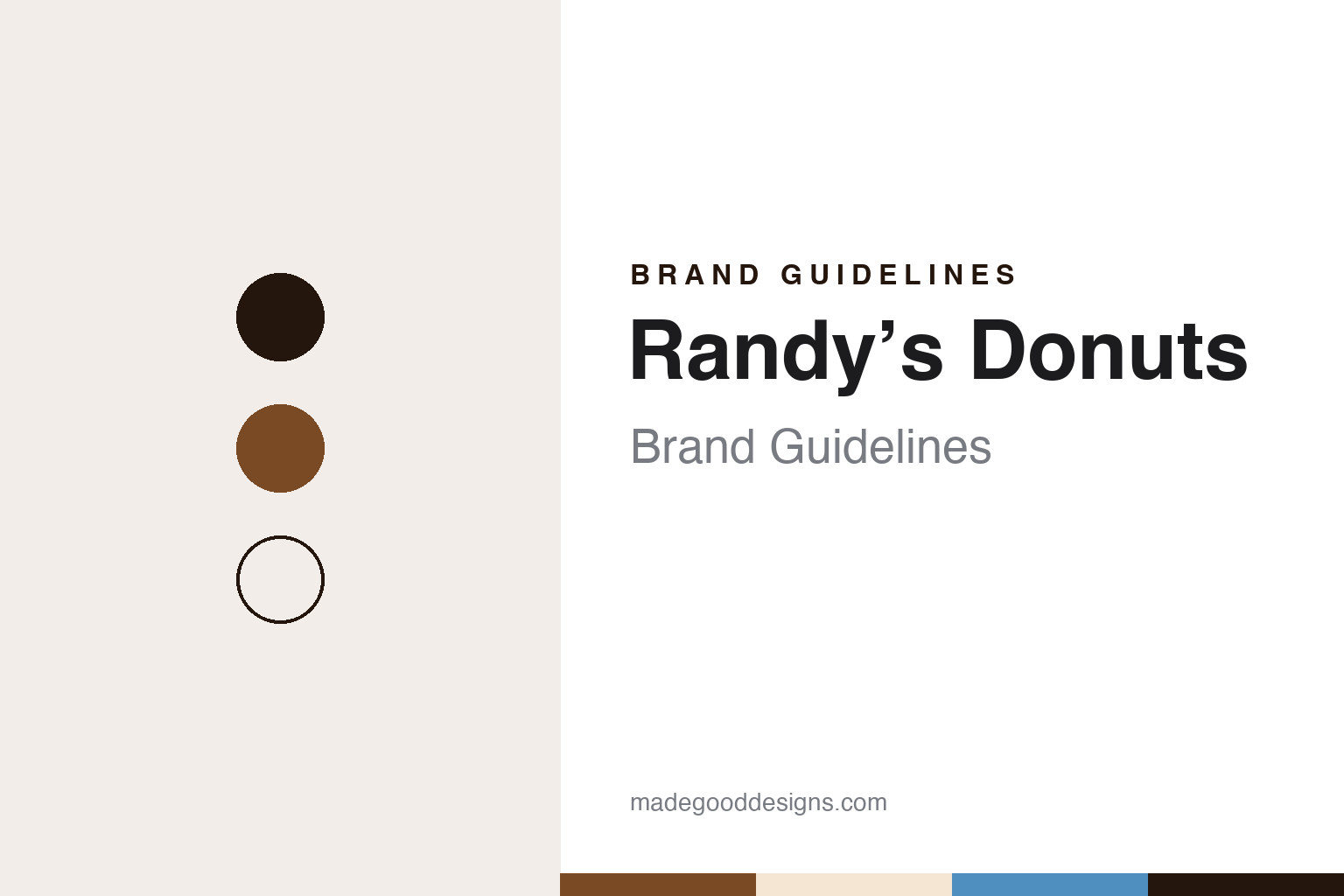
Randy’s Donuts Brand Guidelines
The Inglewood drive-in under a giant rooftop doughnut.
Aa
Two constants: a Randy’s fryer brown and sky blue palette and a Retro display sans register. Abstract homage — not a Randy’s Donuts product or mark; no sign, logo or packaging is reproduced.
Big Donut Drive-In
A doughnut-machine salesman’s chain.
Randy’s Donuts started under another name. Its original shop, a drive-up stand on West Manchester Boulevard in Inglewood, California, near Los Angeles International Airport, was built for the Big Donut Drive-In, a chain started by the doughnut-machine salesman Russell C. Wendell. The Los Angeles Conservancy, in its page on the building, says the shop was the second of ten Big Donut locations and was completed in 1953. English Wikipedia says the chain’s first shop opened in 1951 in Westmont and its second, now Randy’s, in 1952, and the company itself says it started in 1952. The Los Angeles Business Journal, citing the Conservancy in 2017, dated the start of Wendell’s chain to 1950.
The name came later. English Wikipedia says Wendell sold the Inglewood shop in 1976, after turning his attention to his Pup ’N’ Taco chain, to Robert Eskow, who renamed it after his son, Randy; the Conservancy dates the renaming to the mid-1970s. In 1978 the brothers Ron and Larry Weintraub bought the shop and kept the name. For almost four decades after that it stayed a single shop. The brothers received frequent requests to franchise, the Los Angeles Business Journal reported in April 2017, but kept to one location, open 24 hours a day.
Colour
The giant doughnut.
What made Randy’s famous is on its roof. The building beneath is, in the Conservancy’s words, “a fairly unremarkable if admirably intact Mid-Century Modern drive-up food stand,” reportedly designed by Henry J. Goodwin. Above it sits a giant doughnut. The structural engineer Richard Bradshaw, who worked on the Theme Building at Los Angeles International Airport, is said to have designed this and other giant doughnuts, the Conservancy says, out of rolled steel bars covered with gunite, a sprayed concrete. English Wikipedia gives the usual rooftop doughnut a diameter of about 32 feet 6 inches, or 9.9 metres, a figure the Weintraubs checked with a tape measure for the authors Brian and Sarah Butko, who wrote about roadside giants. Not every copy matches: the Bellflower shop, English Wikipedia says, has a smaller doughnut mounted on a pole in front of the building, widely reported as 23 feet across.
The Conservancy notes that the shop may not technically count as programmatic architecture, the Southern California tradition of buildings shaped like the things they sell, because only the sign takes the doughnut form. It chooses to treat it as one anyway, since the doughnut is “so large, so uncompromising, so demanding of our attention,” and it calls Randy’s “one of Los Angeles’ most iconic landmarks.”
The doughnut has also had a long screen career. English Wikipedia lists its appearances: Tony Stark eats from a box of Randy’s doughnuts while sitting inside the sign in the 2010 film Iron Man 2, and the building appears in films including Earth Girls Are Easy and Get Shorty, in Justin Timberlake’s video for “Can’t Stop the Feeling!” and, by reference, on the vinyl cover of J Dilla’s album Donuts.
Typography
Design and documentation.
Doughnut, cookie and cupcake chains sell small things that are eaten quickly, so much of their identity has to work at the counter and in the hand. The box, the bag and the cup travel further than any shop sign in a takeaway trade. Crumbl is a clear case: its own history page calls its long pink box a signature, and Restaurant Business wrote in 2026 that the box makes the cookies look almost as if they are on display.
The product itself is often the second carrier. Glazed rings seen through a window, warm cookies on a counter and cupcakes stacked into towers are the images these companies choose to publish on their own sites and social channels. Some chains add a time or a temperature to the promise: Insomnia Cookies built its name around warm cookies sold late into the night, with shops near college campuses open until 3 a.m., as Restaurant Business reported in 2018.
Flavour naming tends to be plain and descriptive. A cookie or doughnut is usually named after the dessert or ingredient it borrows from, as with the Blueberry Muffin and Dubai Chocolate Brownie that Restaurant Business reported on Crumbl’s menu in 2026, and rotating or seasonal flavours are announced week by week so that the menu itself becomes news. Shops are generally identified by their town, street or campus rather than given names of their own.
Behind the shopfront, corporate pages tell a founder story and, more rarely, an ownership story. Several of the chains in this group began with one person or one family and one shop, then passed through franchising, a larger food company or a private-equity investor. Those changes are dated in trade and business press, and each guide here gives them as dated facts.
Aa
A retro display sans — a doughnut on the roof. (Specimen set in Righteous, a sans STAND-IN; NOT the Randy’s Donuts logo.)
Randy’s Donuts
From one shop to a franchise.
The shop changed hands again in 2015. It was bought by Mark Kelegian, a former lawyer, who told the Los Angeles Business Journal in April 2017 that he had found it by chance on a website listing businesses for sale, and that he kept the staff and changed little for a year while he watched how it ran. Seeing customers give up on the queue, he opened an extra window and hired more staff, bringing the total to 25, the paper reported. He then set out to grow the brand beyond Inglewood, beginning with a small outlet in the renovated Westfield Century City mall. He told the paper at the time that city permitting made it unlikely that new shops could carry a rooftop doughnut like the original’s, though they would use the same recipes and ingredients.
Franchising followed. The Orange County Business Journal reported in July 2022 that Randy’s had opened its first Orange County shop, in Costa Mesa, the year before, and a second in Santa Ana, as part of a franchising push under Kelegian; it said the menu ran to more than 60 varieties across classic, deluxe, fancy and premium doughnuts. English Wikipedia adds franchises in Las Vegas and Phoenix, shops abroad in South Korea, Saudi Arabia, the Philippines and Japan, a shop at Los Angeles International Airport from 2023 and another in the NoHo Arts District in 2024. The company’s own locations page, in November 2026, lists shops across California, Arizona, Nevada and Georgia and in New York City, and abroad in South Korea, Mexico, the Philippines and Japan, including Shibuya in Tokyo, where, English Wikipedia says, a ground-level doughnut sign about four metres across stands in front of the shop.
For a design guide, Randy’s Donuts shows how a single sign can outlast owners and even the name it was built for: the doughnut made for Big Donut became the mark of Randy’s, and English Wikipedia says versions of it now stand at other Randy’s shops. Compare Krispy Kreme, a doughnut chain with its own long American history, and Duck Donuts, a much younger chain named after its first beach town. For this guide we use a fryer brown, a glaze tan and an Inglewood sky blue with a rounded retro display sans, an unofficial interpretation; no product or logo is reproduced.
Explore & save
Keep Randy’s Donuts’s identity on hand — save it to a board in the Made Good inspiration library.
Randy’s Donuts identity set
Pin the Randy’s fryer brown and sky blue palette and the Retro display sans register to your own board.