Blomsterlandet Brand Guidelines
A Gothenburg flower supplier that became a national plant chain.
Aa
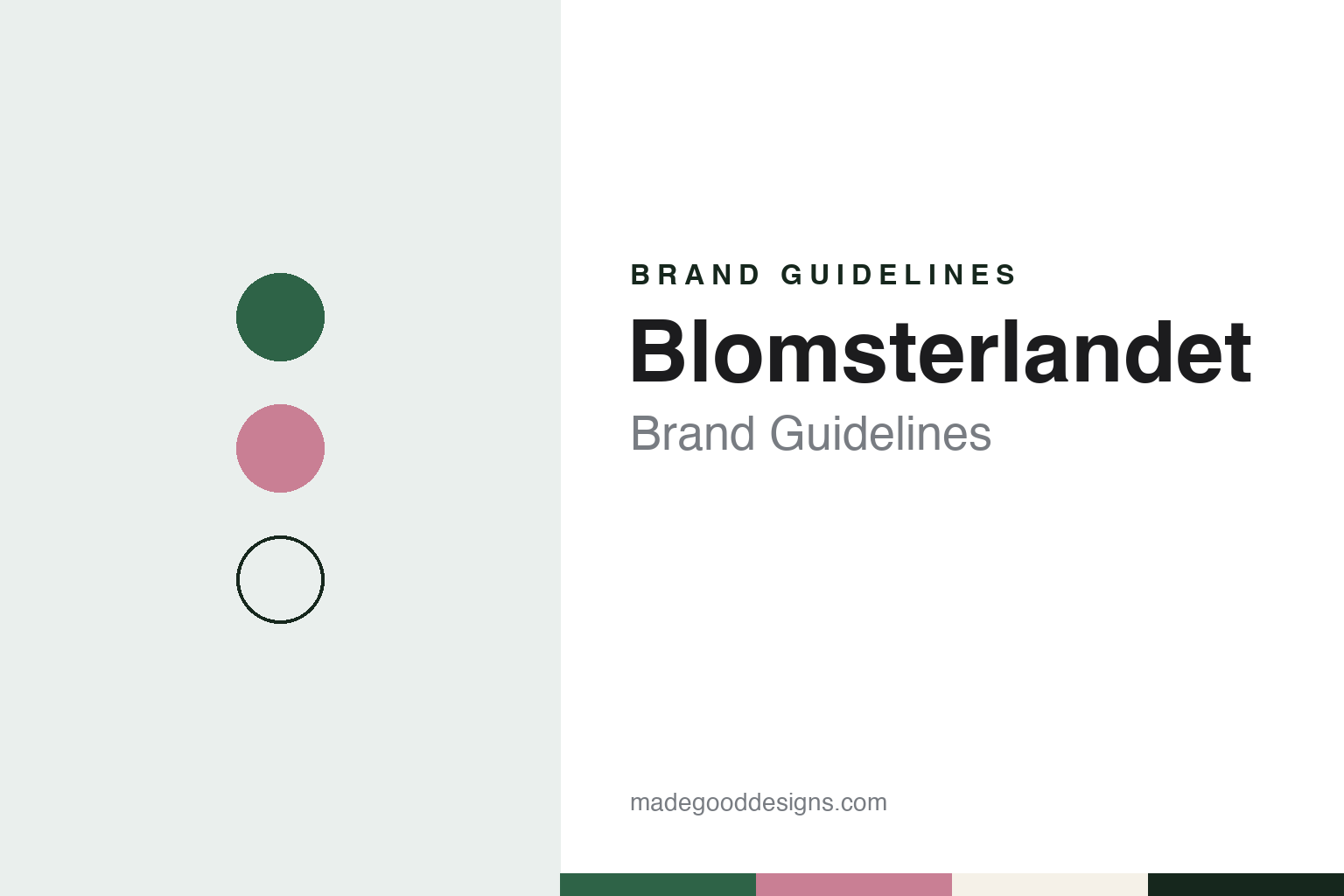
Two constants: a glasshouse green, petal pink and linen palette and a soft serif register. Abstract homage — not a Blomsterlandet product or mark; no store, logo or sign is reproduced.
From S-Blommor
Cut flowers for grocers, then shops of its own.
Blomsterlandet is a Swedish chain of plant and garden shops, selling indoor plants, outdoor plants and garden accessories, according to Swedish Wikipedia. The company says it has 61 stores in Sweden, from Malmö in the south to Luleå in the north, alongside an online shop, and around 700 employees. Beyond the shops, it says, it shares growing advice on its website, on social media and through live-shopping broadcasts, and several stores run their own social accounts. Its head office is in Mölnlycke, just outside Gothenburg, the company says.
The business began in Gothenburg. Swedish Wikipedia gives the founding year as 1986, under the name S-Blommor; the company’s own history places the start in the mid-1980s, when S-Blommor delivered cut flowers and plants to grocery stores. Seeing the value of a sales channel of its own, the company says, it chose the name Blomsterlandet, Swedish for “the land of flowers,” and opened its first store with plants and garden accessories in Jönköping in 1989, a store it says still trades on the same site.
For many years, the company says, the business stood on two legs: its own stores, and supplying cut flowers and pot plants to grocery chains such as Ica and Willys. In 2018 it spun off the S-Blommor grocery-supply arm to concentrate on Blomsterlandet as a national store chain and web shop. Its timeline also lists the Green Room customer club, launched in 2012, and an e-commerce platform introduced in 2015, and it marked its 35th anniversary in 2024.
Colour
A Stena company with a plant-name database.
Blomsterlandet has had the same owner for more than two decades. The company’s timeline says Stena Adactum acquired it in 2004, and its governance page says the chain is run by Nordic Garden Group AB, which is wholly owned by Stena Adactum, part of the wider Stena group.
Its range, as the company sets it out, runs from plants for the home and garden to cut flowers for everyday life and celebrations such as weddings, growing supplies and garden accessories, and decorative items such as candle holders and gifts.
Plant names are part of that offer. In December 2023 the company announced that it would take over hosting of SKUD, the Swedish cultivated-plant name database, from 2024, as the Swedish University of Agricultural Sciences (SLU), its previous host, wished to step back; Blomsterlandet said it had sponsored the database for several years. The company described SKUD as the garden trade’s reference work for naming cultivated plants in Sweden, online since April 2005 and kept up to date by botanists from the Gothenburg Botanical Garden and Uppsala University. The database now runs on a Blomsterlandet web address, and Swedish Wikipedia dates the takeover to October 2024.
According to the same announcement, SKUD records the plant names in use in Sweden, with more than 150,000 scientific and horticultural names and thousands of Swedish vernacular names; parts of it were printed as a book in 2009, and it has otherwise been free to search online, down to the level of individual cultivars. At the time of that announcement the company counted 64 stores.
Typography
How garden-centre chains present themselves.
Garden-centre chains present themselves through the places they run rather than through a single product. Their own pages lead with the centres: glasshouse aisles and outdoor plant tables, indoor plants, garden furniture, gifts and homewares, and seasonal ranges that change through the year. Court papers filed by Dobbies in 2024 describe that mix plainly, listing horticultural, food, homewares and seasonal products alongside restaurants, cafés and concessions let to other retailers.
Food is part of the format. Many centres run restaurants or cafés, and some add food halls; Dobbies has stocked supermarket-branded ranges and later launched food halls under its own name, according to Retail Gazette and English Wikipedia. Notcutts says each of its centres has a permanent display garden, and it runs a loyalty scheme, the Privilege Club, that ties its centres to a customer list.
Naming is usually plain. Notcutts’s website lists most of its centres by town, alongside a few with names of their own, such as Wheatcroft and Garden Pride. Smaller formats can carry a variant of the main name, as Dobbies did with its Little Dobbies urban shops, which had all ceased trading by December 2024, according to the Court of Session.
Corporate history pages carry much of the brand story. Family-owned groups such as Notcutts set out founders, nurseries, show medals and successive generations of the family, while chains that have changed hands have their owners and deals recorded in the trade and business press. The guides in this series follow those published records: founding dates, owners and centre counts as dated sources give them, and colours and typefaces treated as unofficial interpretations rather than official brand assets.
Aa
A soft serif for a flower-and-plant chain. (Specimen set in Fraunces, a serif STAND-IN; NOT the Blomsterlandet logo.)
A new look in Mora
A fresh identity and new sites.
The chain has refreshed its look. On 27 March 2026, the trade magazine Market reported, Blomsterlandet opened its 62nd store, in the Noret retail area of Mora, and launched a new visual identity with it; the company’s sales and marketing chief told the magazine the change was meant to make the chain more modern and draw a younger audience. Market later described the Mora store as the first with the new visual identity and an updated store concept.
New sites have followed. In July 2026 Market reported that Blomsterlandet had signed agreements for seven store sites at established retail locations where the Norwegian-founded chain Plantagen was then trading, in Barkarby, Halmstad, Kungsbacka, Malmö Svågertorp, Norrköping, Uppsala and Värmdö, in properties owned by Erla Eiendom. The chief executive, Susanne Holmström, told the magazine that Blomsterlandet was not taking over Plantagen’s business, operations, staff or existing leases, and that the company had been interested in the locations for a long time. She said Blomsterlandet picks sites on its own criteria, naming the customer base, the catchment area and how well a location suits its store concept, and that the places chosen had strong customer traffic and a clear interest in plants, flowers and gardens. In August 2026 Dagens PS reported that Blomsterlandet had already moved into a former Plantagen site in Motala.
The chain has also turned to an older business. In August 2026 Market reported that Blomsterlandet was taking over Växthuset Linds, a family-owned greenhouse business in Visby founded in 1879, which is to keep the Linds name and its own identity (agreed in August 2026; not completed at the time of writing).
For a design guide, Blomsterlandet shows how a flower supplier to grocery stores built a shop brand of its own around a single, descriptive name. Compare Plantasjen, the Norwegian chain known as Plantagen in Sweden, and Intratuin, a Dutch garden-centre chain. For this guide we use a glasshouse green and a petal pink on linen with a serif, an unofficial interpretation; no product or logo is reproduced.
Explore & save
Keep Blomsterlandet’s identity on hand — save it to a board in the Made Good inspiration library.
Blomsterlandet identity set
Pin the Blomsterlandet glasshouse green, petal pink and linen palette and the soft serif register to your own board.