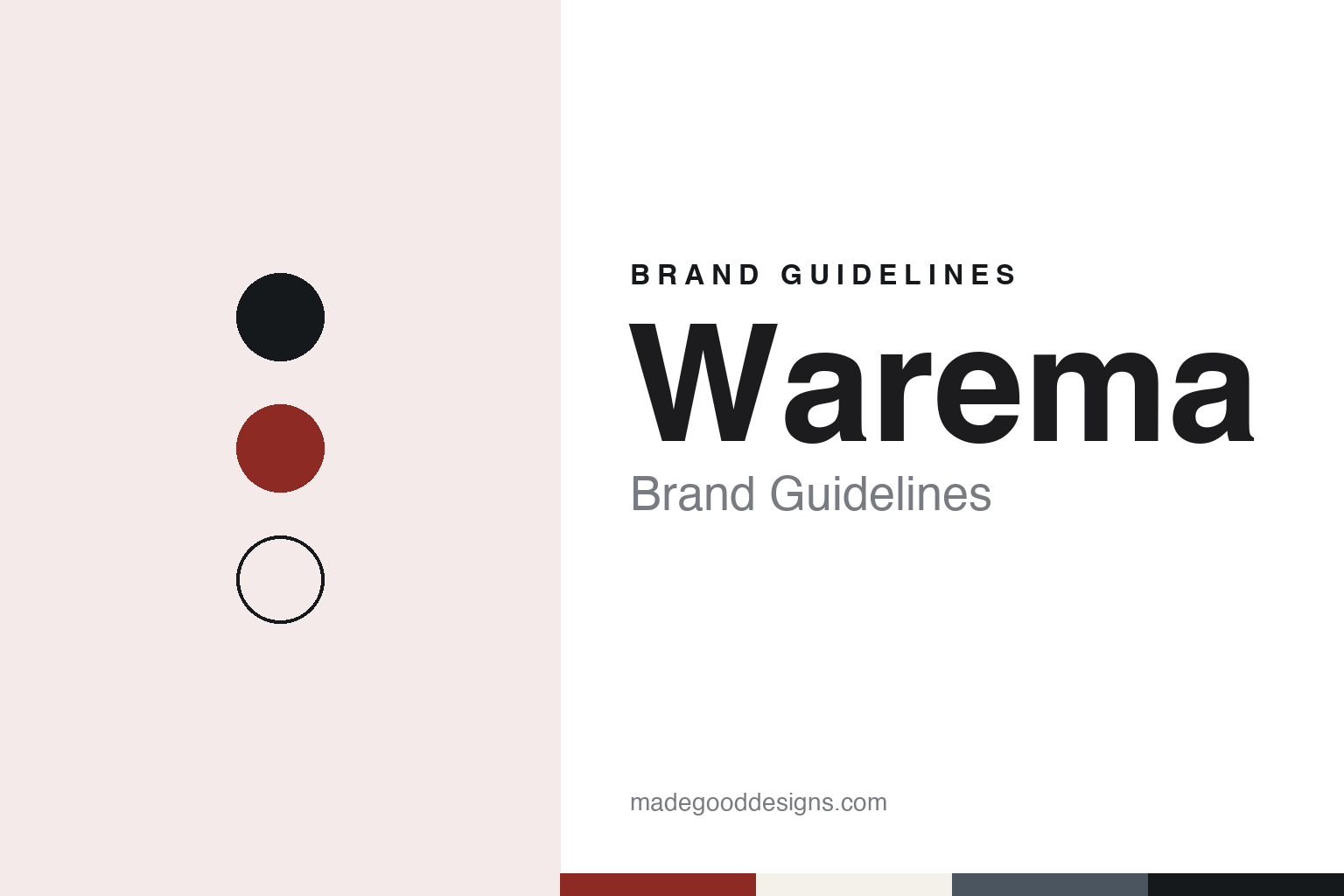
Warema Brand Guidelines
Marktheidenfeld’s family-owned sun-shading maker since 1955.
Aa
Two constants: an awning red, slat grey and ink palette and a technical sans register. Abstract homage — not a Warema product or mark; no blind, logo or nameplate is reproduced.
Wagner, Renkhoff, Marktheidenfeld
A name built from two founders and a town.
Warema began in 1955 in Marktheidenfeld, in Lower Franconia in northern Bavaria. The company’s own history names its founders as Hans-Wilhelm Renkhoff and Karl-Friedrich Wagner; German Wikipedia lists a third, Hans-Wilhelm Bach. The name is an acronym: German Wikipedia says it stands for WAgner REnkhoff MArktheidenfeld, joining the two partners’ surnames to the town where the business started.
The beginning was small. The company says its starting capital was a single product, light-metal venetian blinds, made by five employees. German Wikipedia says Renkhoff ran the business on his own from 1958, when it counted 45 staff. In 1959, the company says, it added roller blinds, and soon after that aluminium roller shutters, a prefabricated design.
The early workshops were spread across several buildings in the centre of Marktheidenfeld. In 1960 construction began on the earliest part of what is still the headquarters, and in 1961 the company moved there; German Wikipedia gives the same year for the move to the present site.
Trade fairs became part of the story early. In 1965, the company says, it exhibited at the roller-shutter fair then called R’65, which has since become R+T in Stuttgart, and it says it has returned to that fair ever since. Two years later, in 1967, it brought out the “Super 80” external venetian blind, the kind of outside slatted blind that remains at the centre of its range.
Through the 1970s the range widened again, according to the company, with awnings, vertical louvre blinds and black-out systems. Because some of the components for these were not available to buy, it says it began making its own plastic parts, control components, special machines and tools. German Wikipedia records awnings joining the range in 1997. That in-house plastics work later became a separate business, Warema Kunststofftechnik und Maschinenbau, which German Wikipedia says supplies the car industry as well as Warema’s own production.
Colour
A holding company, a second generation and a European legal form.
The group took its modern shape in the 1990s. In 1991, the company says, it set up a production company in Limbach-Oberfrohna in Saxony, Warema Sonnenschutztechnik GmbH; German Wikipedia dates that company to 1992 and says it employed more than 500 people in mid-2018, making interior and exterior sun shading. In 1992, German Wikipedia says, the group was turned into a holding company, the Renkhoff AG, over four businesses: Warema Renkhoff GmbH, Warema Sonnenschutz GmbH, Reko Kunststofftechnik und Maschinenbau GmbH and Reko electronic GmbH.
Leadership passed to the founder’s daughter. Angelique Renkhoff-Mücke joined the executive board in 1998 after ten years in management at a retail company, the company says, and has chaired it since 2001. German Wikipedia says her father chaired the supervisory board from 1999 to 2006. The company describes itself as family-owned.
International growth followed. In 2004 the group founded Warema International GmbH as an intermediate holding company for its foreign subsidiaries; the company says it now serves customers from 53 countries. German Wikipedia adds a subsidiary near Shanghai in 2005 and says the group runs eight production sites, in Germany, Austria, France, the Netherlands, Hungary, Slovakia and China, along with 13 sales companies.
In September 2009 the holding company became a European company, Warema Renkhoff SE, merging with Warema Renkhoff GmbH; the “SE” stands for Societas Europaea. German Wikipedia traces the workforce from 780 people in 1980 to 2,746 in 2010 and around 5,300 across the group by February 2022.
The founder also left a charitable body. German Wikipedia says the Hans-Wilhelm Renkhoff Stiftung, set up by him in 1995, supports research and teaching at universities, social projects and youth work, and sits close to the group.
Typography
Design and documentation.
Blinds, shutters and awnings are sold on how a room looks once they are up, so the companies that make and sell them lean heavily on room-set photography. A typical product page shows a finished window in a kitchen, bedroom or conservatory, often in several light conditions, before it shows the mechanism. Ranges are usually grouped by blind type, such as roller, Roman, Venetian, pleated or vertical, and then again by room, feature and colour, so the menu itself becomes a kind of style guide.
Fabric is the second language of the category. Retailers publish swatches and sample cards, and many offer free samples by post so that customers can hold a fabric against their own walls and daylight. In the UK, the Competition and Markets Authority noted in 2017 that most made-to-measure blind and shutter sales involve a visit to the customer’s home, where an adviser brings product books and samples; online sellers instead rely on posted samples and measuring guides.
Shutters and awnings bring their own imagery. Shutter pages tend to dwell on louvres, frames and finishes in painted or natural wood, shown open, half-tilted and closed. Awning makers photograph patio canopies extended over terraces and gardens, with the fabric, frame and arm in view, and often show the same canopy retracted against the wall.
Behind the product pages, most of these companies keep a corporate side: a short history of a founder and a first workshop, a list of the brands a group owns, and notes on where things are made. Ownership in the category often runs through larger groups, so a brand page may sit inside a family of sister names that share factories, suppliers or a parent company.
Aa
A technical sans for a maker of slats, rails and controls. (Specimen set in Barlow, a sans STAND-IN; NOT the Warema logo.)
Warema
The SunLight Manager and its sister brands.
Since 2011 Warema has grown mostly by buying specialists. That year, the company says, its plastics business acquired a plant in Gyál, near Budapest. German Wikipedia says Wings Professional Project of Lübeck, which develops and makes large-slat systems, joined in July 2012, and that Caravita of Gaimersheim, near Ingolstadt, a maker of parasols and shade sails since 1993, joined in April 2017. In June 2019 the Main-Post reported that Warema had bought Anwis, a Polish maker of exterior and interior sun shading founded in 1979, which would stay independent within the group; German Wikipedia dates Anwis’s membership from 1 January 2019. In February 2024 investmap.pl reported that Anwis, based in Włocławek, had announced a new production hall and warehouse in the Brześć Kujawski district. German Wikipedia adds ClipnShade, a start-up making sun shading for tenants, from 2021.
The group opened a logistics and production centre at Wertheim-Bettingen, about 15 kilometres from the headquarters, in 2021, the company says, alongside a showroom it calls the Sun Forum. It says it makes its products for the European market at Marktheidenfeld, Wertheim-Bettingen, Limbach-Oberfrohna and Pécs in Hungary, and sells through a network of specialist dealers backed by sales offices in Germany, Austria, Switzerland and France.
The current range, as Warema presents it, covers external venetian blinds, roller shutters, awnings, shade sails, slat-roof patio covers, insect screens and smart-home controls. Its awning names include Terrea for patios, Perea for pergolas and Climara for conservatories, and its patio roof is called Lamaxa. The brand signs itself as “the SunLight Manager”.
Not every part of the group is growing. In October 2026 the Main-Post reported that management had told a works meeting that 80 jobs would go at the plastics and machine-building subsidiary in Marktheidenfeld, and KunststoffWeb reported in November 2026 that the unit, which supplies automotive and industrial customers, employs about 450 people, around 260 of them at the home site, according to company figures.
For a design guide, Warema shows how a technical maker builds a brand from a place name and a product line, then gives each new outdoor product its own short name. Compare Somfy, whose motors drive many shading systems, and Weinor, another German awning maker. For this guide we use awning red, slat grey and ink with a sans, an unofficial interpretation; no product or logo is reproduced.
Explore & save
Keep Warema’s identity on hand — save it to a board in the Made Good inspiration library.
Warema identity set
Pin the Warema awning red, slat grey and ink palette and the technical sans register to your own board.