CroisiEurope Brand Guidelines
The Strasbourg family river line that grew from day trips on the Rhine.
Aa
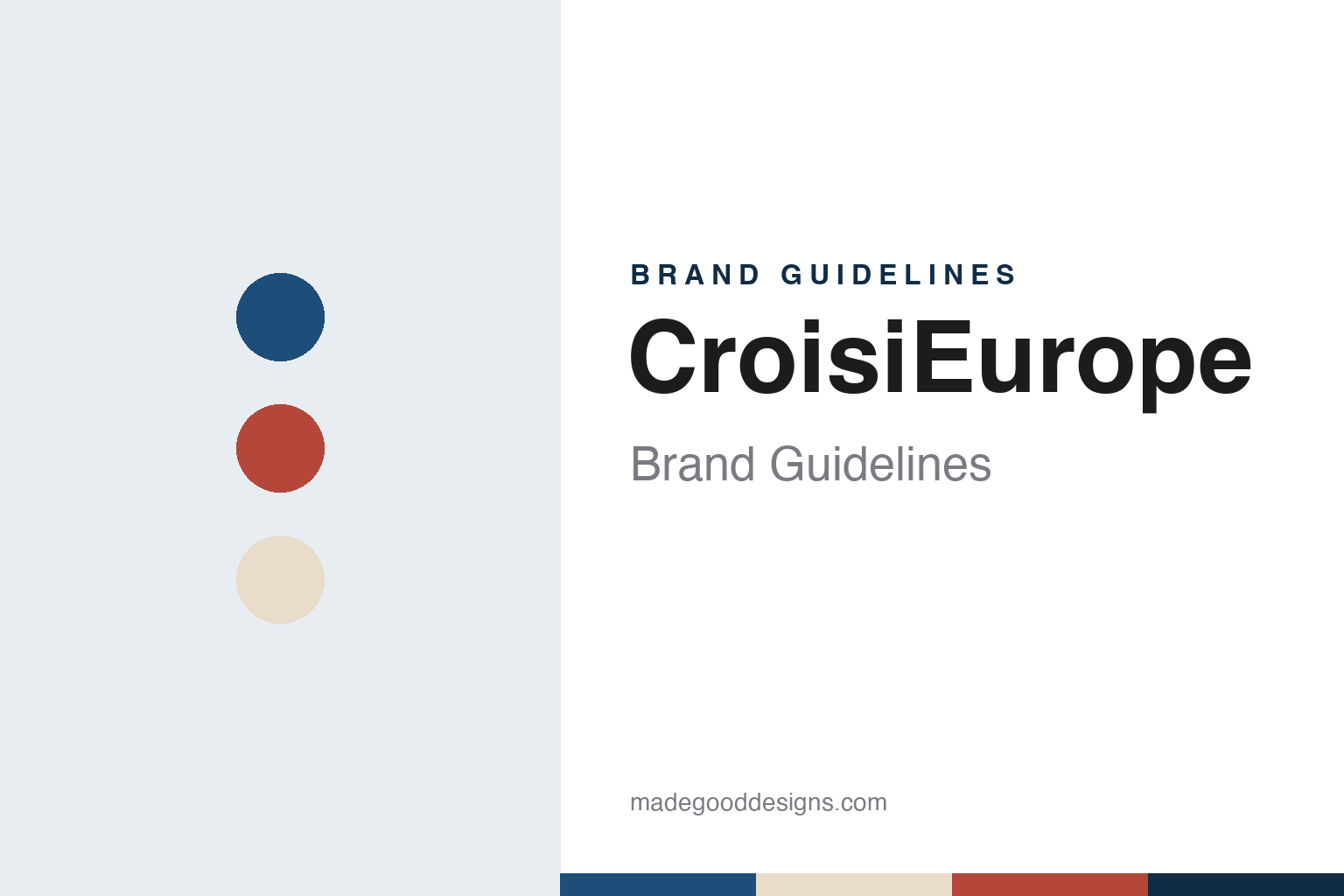
Two constants: a river blue, sandstone and Alsace red palette and a rounded sans register. Abstract homage — not a CroisiEurope ship, product or mark; no logo or livery is reproduced.
Alsace Croisières
Day trips on the water near Strasbourg.
CroisiEurope began in Alsace in 1976, when Gérard Schmitter founded Alsace Croisières, according to both English and French Wikipedia. French Wikipedia places the start in Strasbourg, with a chartered boat called the Strasbourg that belonged to the city’s port authority. The company’s own history sets the scene near Strasbourg, on the edge of the Plobsheim lake, and describes its founder as a potter’s son from Betschdorf who had opened a restaurant and then hit on the idea of hiring a boat by the day for visitors. Its timeline says the first outings offered lunches and afternoon dances around the port of Strasbourg.
The fleet grew one boat at a time. In 1982 the company bought its first boat, the Alsace I, and ran trips up the Rhine as far as Rüdesheim in Germany. In 1984 came its first boats with cabins, the Hansi, the Kléber and the Petite France, which, the company says, took passengers on longer cruises along the Rhine and its tributaries, among them the Neckar, the Moselle and the Main. The company dates its first boat in a higher “Prestige” category, the Kellermann, to 1986.
In 1990 the company became its own shipowner. French Wikipedia names the Liberté as the first boat built for it; the company says an in-house engineer designed the boat and that from then on it controlled its fleet “from A to Z,” from construction to marketing. A Paris office followed in 1991, Danube cruises in 1993 and cruises on the Rhône and the Saône in 1995. In 1997 the company dropped its regional name and became CroisiEurope, a change it says reflected a business that now reached well beyond France. Cruises on the Seine from Paris followed in 1998.
Colour
Four children, many rivers and a fleet built to fit them.
CroisiEurope has stayed in the family. In 1999, the company says, Gérard Schmitter and his wife Jeannine handed the business to their four children, Patrick, Philippe, Christian and Anne-Marie, each with a branch of their own: Christian general and commercial management, Patrick the building and fitting-out of the boats, Philippe catering and the hotel side, and Anne-Marie the finances on board. French Wikipedia gives the same year for the handover and puts the fleet at 14 boats in 2000. Writing in TourMaG in March 2026, Jean Da Luz described the company as entirely family-owned and led by Christian Schmitter of the second generation, with the third generation now involved, and quoted Lucas Schmitter: “We are craftsmen of cruising” (our translation).
The routes spread north and south. The company lists the Elbe in Bohemia and the Po in Italy from 2000, the Douro in Portugal from 2002, and a river-sea boat built in 2005 for the Guadalquivir in Spain that could also reach the Guadiana by sea. French Wikipedia records the CroisiMer brand from 2007, with a first sea cruise in Croatia aboard La Belle de l’Adriatique in 2008, and the CroisiYacht brand from 2010; the company says La Belle des Océans joined its sea fleet in 2019. In 2013, French Wikipedia says, CroisiEurope announced the purchase of the Compagnie Fluviale du Mékong, from which it had chartered boats. Further afield, the company lists the Irrawaddy, the Mekong through Vietnam and Cambodia, and safari cruises around Chobe National Park and Lake Kariba in southern Africa.
The boats are shaped by the rivers they sail. The company says its boats have been built in Namur in Belgium, Saint-Nazaire in France and Ho Chi Minh City in Vietnam. French Wikipedia says three boats in the company’s top “five-anchor” class were built at Saint-Nazaire by Neopolia, among them the Loire Princesse, a paddle-wheel boat designed to sail the Loire between Saint-Nazaire and Bouchemaine, and the Elbe Princesse, which ran between Berlin and Prague.
On 15 March 2026, at the quai de Grenelle in Paris, CroisiEurope marked its 50th anniversary by christening the MS R.E. Waydelich, a five-anchor paddle-wheel boat built at Saint-Nazaire that had sailed the Elbe as the Elbe Princesse II and was moving to the Seine, TourMaG reported. The same report gave a fleet of 50 to 54 boats including chartered vessels, 170 itineraries, and 205,000 passengers in 2025, 51% of them from France.
Typography
Rivers, ships and the people who sail them.
River cruise lines sell a particular kind of ship: long and low, sized for river locks, and built to moor at the edge of a town rather than at a port outside it. AmaWaterways’ co-founder Rudi Schreiner put the appeal plainly in a 2022 interview with Forbes: the ship arrives in town, passengers step off downtown, and they wake the next morning in another city. That idea runs through the way these companies present themselves, with the river and the town at its centre and the ship as the means of getting there.
The pictures follow the same order. Coverage of the lines often starts on deck: that Forbes interview opened with a picture of the sun deck of an AmaWaterways ship moored in Vienna, set with umbrellas, tables and chairs. Cabins are shown around the window. When Newsweek reported on the christening of an Avalon Waterways ship in Budapest in 2019, it singled out the panoramic balcony windows and generous cabins as the line’s signature.
Naming is the other constant, and it is usually systematic. AmaWaterways joins the prefix Ama to a word or a name, from the AmaDagio of 2006 to the double-width AmaMagna; Avalon pairs its own name with a single abstract word, such as Artistry, Panorama or Envision. Avalon names its new ships at public ceremonies led by a godmother, and English Wikipedia lists several of them.
Behind the ships sit corporate pages about founders and owners. Some lines tell a founder’s story — AmaWaterways traces its own to a raft on the Amazon in 1975 — while others present themselves through a parent group, as Avalon does through the Swiss Globus family of brands and its origins on Lake Lugano in 1928. This guide sets out what can be checked about each line: who founded it, who owns it, and how it names and pictures its fleet.
Aa
A rounded sans for a family river line. (Specimen set in Nunito Sans, a sans STAND-IN; NOT the CroisiEurope logo.)
CroisiEurope
A regional name that became a European one.
The name itself carries the company’s story. Croisière is the French word for cruise, and the 1997 rename joined it to Europe in a single word, replacing a name tied to one region. The ships carry French names and family ones: French Wikipedia lists the Lafayette, the Victor Hugo, the Symphonie, the La Bohème and the Cyrano de Bergerac, which sails the Gironde estuary with the Princesse d’Aquitaine, and records that one boat was named the Gérard Schmitter in honour of the founder. English Wikipedia says French is the main language on board, with announcements made in French and English.
The company still works from Strasbourg, where its timeline says a renovated river station was opened in 2002, and it lists offices that followed in Lyon in 2001 and in Nice and Brussels in 2002. French Wikipedia adds an office in Lausanne in 2008.
The company has also been ranked in a consumer survey. On 3 November 2026 TourMaG reported that CroisiEurope had received the Prix Capital 2027 for retail brands in the cruise-line category, for the second year running, a ranking based on a survey of 15,000 consumers that rewarded, among other things, the service of its staff on shore and on board.
For a design guide, CroisiEurope shows how a family business can keep a regional origin in its story while its name, fleet and routes grow far beyond it. Compare Viking Cruises, another river line with a name drawn from its home region, and Uniworld. For this guide we use a river blue, a sandstone and an Alsace red with a rounded sans, an unofficial interpretation; no product or logo is reproduced.
Explore & save
Keep CroisiEurope’s identity on hand — save it to a board in the Made Good inspiration library.
CroisiEurope identity set
Pin the CroisiEurope river blue, sandstone and Alsace red palette and the rounded sans register to your own board.