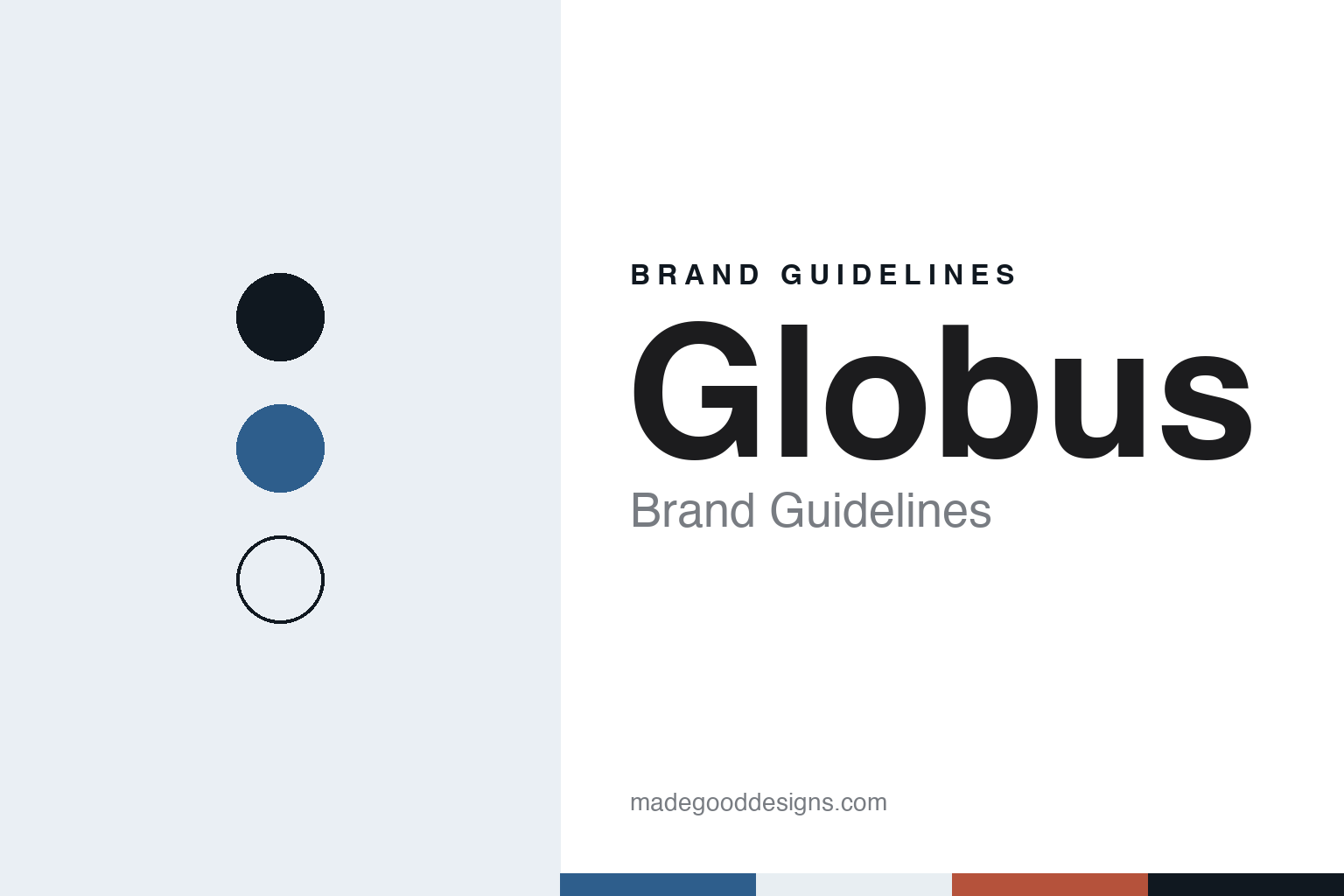
Globus Brand Guidelines
Antonio Mantegazza’s 1928 Lugano firm behind Cosmos and Avalon.
Aa
Two constants: a Globus lake blue and terracotta palette and a Grotesque sans register. Abstract homage — not a Globus product or mark; no logo, brochure or coach livery is reproduced.
Globus Viaggi
A Lugano business on the lake.
Globus began in Lugano, in southern Switzerland, in 1928. The Historical Dictionary of Switzerland (HLS), in its entry on Sergio Mantegazza last revised in March 2024, says the travel agency Globus was founded in Lugano that year by his father, Antonio Mantegazza.
English Wikipedia tells the early story in more detail. Its article on Group Voyagers says the group traces its history to a rowing boat that Antonio Mantegazza used to carry goods across Lake Lugano; its article on Sergio Mantegazza describes a single gondola carrying tourists and goods across and around the lake. Both say he went on to buy a fleet of 12 coaches to take tourists around the area, and the Group Voyagers article says he named the venture Globus Viaggi. By 1950, according to both articles, the company ran 33 coaches and had added overnight excursions to Rome, Venice and the French Riviera; the Group Voyagers article adds the Dolomites.
Those overnight trips became regular tours, English Wikipedia says, and grew longer to cover more ground. In the 1950s, according to the same article, Antonio Mantegazza’s business partner Werner Albek led a move into first-class European tours sold to travellers from the United States, under the name “Grand European Touring.”
The name is shared with unrelated businesses. The HLS has a separate entry on Globus the department store group of Zürich, founded in 1907 as Magazine zum Globus by the banker Heinrich Burkhardt and sold by Migros in 2020 in equal shares to Signa of Austria and Thailand’s Central Group; that retailer has nothing to do with the tour operator; nor does Globus Medical, the American maker of spine implants.
Colour
From Lugano to Britain and America.
The decisive change came in the 1950s. The HLS says Sergio Mantegazza, Antonio’s son, helped turn the Lugano travel agency into an international tour operator, active above all in Britain and the United States.
Britain got its own brand. In 1961, English Wikipedia says, the group launched Cosmos, first called Cosmos Holidays, in the United Kingdom, offering lower-priced European touring alongside air holiday packages to southern Europe; destinations such as Canada, Australia and New Zealand followed. Cosmos still sits beside Globus in the group today. English Wikipedia’s article on Sergio Mantegazza says Globus ran circular tours and also offered budget coach holidays in Europe, alongside the first-class “Grand European Touring” sold to Americans.
An airline came next. The HLS says that in 1968 the firm founded the charter airline Monarch Airlines, based at Luton; English Wikipedia instead says Monarch was started by two British businessmen and financed by Globus’s partners. English Wikipedia says the Mantegazza family sold Monarch in 2014 to the investment firm Greybull Capital, and the HLS records that the airline ceased operations in 2017. Around 2010, the HLS says, the Globus group employed 5,000 people worldwide and had a fleet of 34 medium- and long-haul aircraft.
Sergio Mantegazza became president of Globus in 1975, English Wikipedia says, and widened the business with packages to Africa, Australia and South America. The Group Voyagers article lists a broader spread for the group’s brands from that point: Africa, Australia, North and South America, Southeast Asia, Europe and the South Pacific. In the early 1970s the group set up Group Voyagers, Inc. to run its operations in the United States and sell the Globus and Cosmos brands in the American market, according to the same source, which calls Sergio Mantegazza the chairman and owner of Globus.
Typography
Escorted and adventure tour operators.
Escorted and adventure tour operators sell a trip rather than a single product: a fixed route, a group of strangers travelling together and a guide who stays with them. Some build that around coaches and hotels on long touring circuits; others around small groups on trails, local buses and homestays. The operators in this guide sit at different points along that range, and their brands are built to signal which kind of trip a traveller is booking.
Group size and the guide are central to how these companies describe themselves. Intrepid Travel says its groups are usually 12 to 14 people with a local leader, while G Adventures sorts its departures into named travel styles, from Classic to Local Living and trips for travellers aged 18 to 39. These style names do the work that a range name does for a manufacturer: they let a catalogue of hundreds of itineraries be read at a glance.
Brochure and website naming in this sector tends to be plain and descriptive. Trips are usually titled by region, route or length, and the brand voice lives in the surrounding copy and in the names of collections, partnerships and community programmes. Some operators also run foundations or work with non-profit partners whose names appear beside the trips; Intrepid has The Intrepid Foundation, and G Adventures works with the Planeterra Foundation.
The corporate pages tell a second story, about founders and owners. Intrepid Travel began in Melbourne in 1989 and G Adventures in Toronto in 1990; both have since passed through outside investors, and Intrepid through a joint venture and a series of acquisitions. This guide sets out who founded each brand, who owns it now and when that changed, as dated sources report it, and keeps each company’s own claims clearly marked as its own.
Aa
A grotesque sans for a business that grew from coaches on a Swiss lake. (Specimen set in Archivo, a sans STAND-IN; NOT the Globus logo.)
Globus
A family of brands.
Rivers joined roads in 2004. English Wikipedia’s article on Group Voyagers says Globus launched the river cruise company Avalon Waterways that year, together with Monograms, a line of independent travel packages now sold as Globus Independent Tours; its article on Sergio Mantegazza gives 2003. Avalon began operating in 2004 with one ship, the Avalon Artistry, and added the Avalon Poetry in 2005, according to English Wikipedia, which says Avalon joined the Cruise Lines International Association in August 2009. As of 2019, the same article says, its ships sailed the Danube, Rhine, Moselle, Rhône, Seine and Saône in Europe, as well as the Mekong, the Yangtze, the Ganges and the Amazon. English Wikipedia counts 23 new ships christened in Europe and three in Southeast Asia since the 2004 launch, and lists themed sailings built around food, beer and Christmas. Godmothers of its ships in Europe have included the television presenter Meredith Vieira and the authors Elizabeth Gilbert and Diana Gabaldon, the same article says.
Today the business presents itself as the Globus family of brands. Its landing site names Globus, Cosmos and Avalon, and describes guided tours, independent trips, small-group journeys and river cruises across six continents. Before sending visitors on, it asks them to pick a market: the United States, Canada, the United Kingdom, Australia, New Zealand, India or elsewhere. In North America its brands are sold through Group Voyagers, English Wikipedia says.
For a design guide, Globus shows how a single company can hold several travel brands, each aimed at a different traveller, under one family name. Compare Trafalgar, another European coach-touring name, and Collette, an escorted-tour company that also grew from one founder. For this guide we use a lake blue and a terracotta with a sans, an unofficial interpretation; no product or logo is reproduced.
Explore & save
Keep Globus’s identity on hand — save it to a board in the Made Good inspiration library.
Globus identity set
Pin the Globus lake blue and terracotta palette and the Grotesque sans register to your own board.