Dishoom Brand Guidelines
A 2010 Covent Garden café modelled on the Irani cafés of Bombay.
Aa
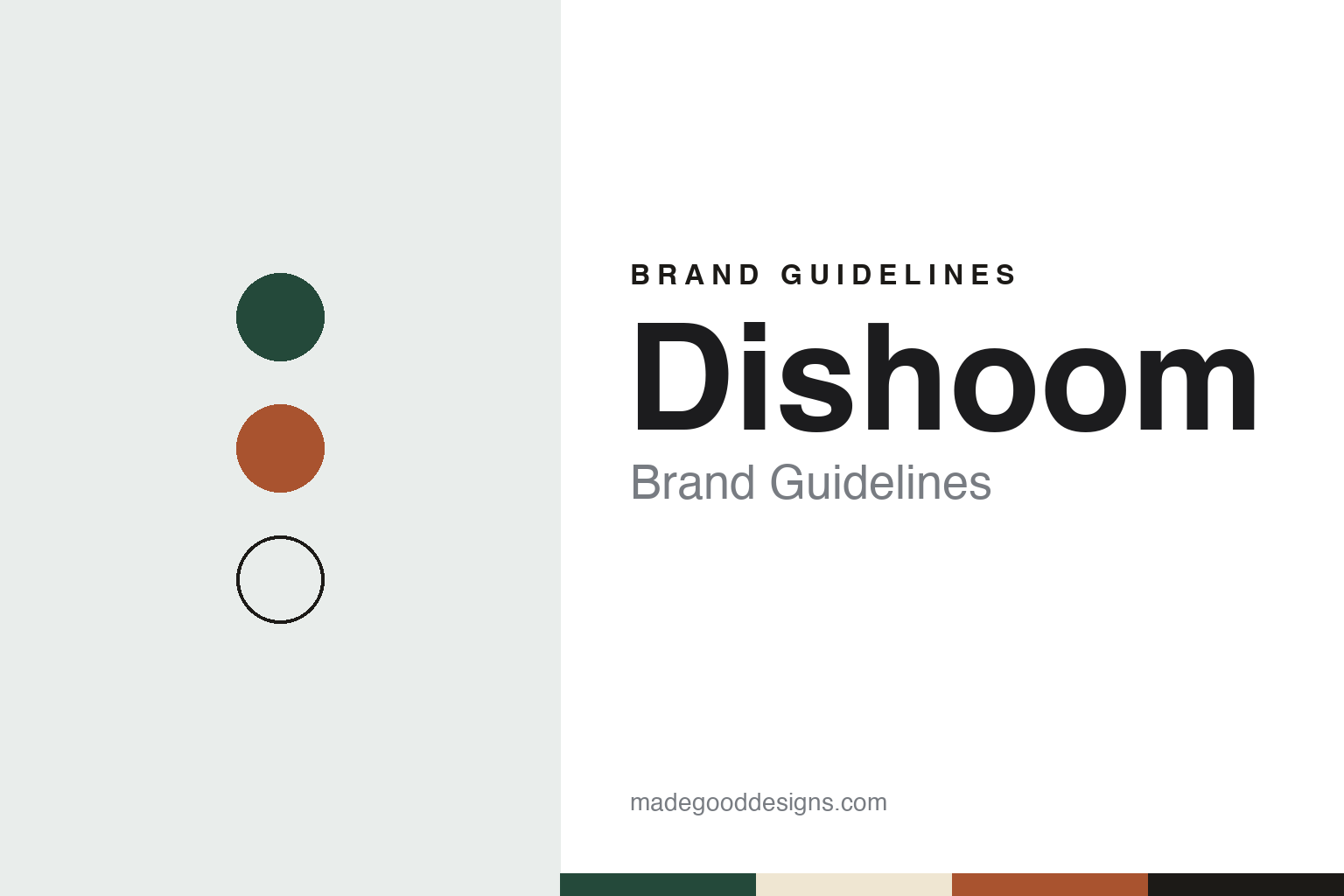
Two constants: a café green, cream and terracotta palette and an old-style display serif register. Abstract homage — not a Dishoom product or mark; no dish, sign or logo is reproduced.
Covent Garden, 2010
An Irani café, imagined in London.
Dishoom opened its first café in Covent Garden, London, in 2010, on Upper St Martin’s Lane. English Wikipedia names its founders as Shamil Thakrar and his cousin Kavi Thakrar, together with the brothers Amar and Adarsh Radia, and says the Radias left the business in 2017. A 2012 business profile by William Drew, published by Restaurant Online and its sister title Big Hospitality, gives a slightly different picture: it describes Shamil Thakrar and the Radia brothers as the founders and says Kavi Thakrar joined as a co-director shortly after the first site opened, taking charge of day-to-day operations while Shamil led design and marketing. By 2020 Claire Chambers, writing in Scroll, described the cousins as co-chief executives.
The founders came from outside the restaurant trade. The 2012 profile says Shamil Thakrar had worked for the consultancy Bain & Co and that his partners had backgrounds in banking, accountancy and technology; it quotes him saying that all of them were new to restaurants when they opened. The Thakrar family comes from Gujarat and the Radias have roots in Bombay, the profile says, and all of the founders grew up mainly in Britain while keeping close links to the city.
The idea came from Bombay’s Irani cafés, the all-day cafés that English Wikipedia says were popular in the city in the 1960s and that Dishoom was designed to match. Chambers wrote in September 2020 that the number of such cafés in Mumbai had fallen from around 350 in the 1960s to scarcely 30, and that interest in them among the British South Asian community had grown because of Dishoom. Shamil Thakrar told the 2012 profile that the aim was to move away from the British curry-house tradition, because Bombay food “is not about curry.”
The name is a sound effect. Scroll calls it an onomatopoeic word for a punch or smack, and the company says it is the sound used in old Hindi films when the hero lands a punch. Its head chef, Naved Nasir, who was introduced to the Thakrars in 2009, told Chambers that he and his friends laughed at the name at first, at a time when new Indian restaurants were often named after spices.
Colour
Station clocks, rattan and Devanagari.
Interiors are central to Dishoom’s identity. The company says the first café, in 2010, had bentwood chairs, marble-topped tables, slowly turning ceiling fans and sepia portraits of the founders’ family on the walls. Chambers described the later rooms in Scroll in 2020: tiled floors, an imposing station clock, vintage luggage scales, rattan chairs, references to Indian cinema, and signs written in deliberately broken English or in Devanagari script.
Each site gets its own story. Scroll reported that every Dishoom has its own style and imagined backstory, and the company says it invents a fictional owner for each one and expresses that character in the design: the history of Indian independence at King’s Cross, the Swadeshi movement in Birmingham, Bombay noir and espionage in Glasgow, and the 1970s Bombay rock scene at Carnaby. It says jokes connected with these stories are painted on the walls in Hindi and Gujarati. The King’s Cross café, which opened in 2014 in a large former railway building, is lined with dark wood and green walls, Scroll reported, calling the site Dishoom’s “godown.”
The second site showed that the look would change from room to room. Restaurant Online reported in October 2012 that the Shoreditch café, between Shoreditch High Street and Boundary Street, had been designed by the restaurant specialist Russell Sage Studio as a less polished, more eclectic space with many reclaimed elements, a covered courtyard and its own bakery; Thakrar said the team was not interested in “banging out a formula.” The year before, the founders had run a five-month summer pop-up on London’s South Bank, Dishoom Chowpatty Beach, modelled on the beach stalls of Bombay.
The menu is Bombay café food. The 2012 profile listed keema pau, dill salmon tikka, chicken berry biryani and a bacon naan roll, and noted that the kitchen served just one curry a day. Chambers singled out the house black daal, the restaurant’s name for dal makhani, and the East India Gimlet cocktail. In September 2019 the Thakrars and Nasir published a cookbook, Dishoom: From Bombay with Love, which Scroll described as both a recipe book and a love letter to the city.
Typography
The category.
Britain’s fast-casual and restaurant-group chains sit between the quick-service counter and the traditional sit-down restaurant. Many of them began as a single London room and grew into groups of dozens or hundreds of sites, and their identities are built as much from the room, the menu and the tone of voice as from a logo. Wagamama’s website, for example, describes its format through communal benches, open kitchens and food served in bowls as soon as it is ready.
The format often comes from somewhere else. Some chains borrow a setting from abroad — a Tokyo ramen bar, a Bombay Irani café, a street-food stall — and rebuild it for British high streets, shopping centres and railway stations. The restaurant guide Harden’s, writing in 2018, credited one such chain with popularising communal, canteen-style dining in Britain. Others are built around a single dish, such as a burger, a bowl of noodles or a plate of sushi, and keep the menu short enough to repeat across many sites.
Naming is usually plain and descriptive. Dishes are listed by what they are, sometimes in the language of the food’s home country, and restaurants are named after their street or district. Some groups give each site its own story or decorative theme; others keep every branch close to a single template so that a guest knows what to expect anywhere in the estate.
Ownership is part of the story. Founders often appear on the companies’ own pages, while trade titles such as Restaurant Online record the private-equity owners, listed groups, takeovers and restructurings that follow. This guide sets out what can be checked about each brand — who founded it, who owns it, and where it trades — and marks clearly what rests only on the company’s own word.
Aa
An old-style display serif — a café-signboard register. (Specimen set in DM Serif Display, a serif STAND-IN; NOT the Dishoom logo.)
Dishoom
From one café to Glasgow and Permit Room.
Restaurant Online reported in 2012 that its directors had no venture-capital or private backers to answer to. After Covent Garden came Shoreditch in 2012 and King’s Cross in 2014; the group made its Scottish debut on St Andrew Square in Edinburgh in 2017, Restaurant Online reported in April 2025, and Manchester and Birmingham followed. The same report said the latest core opening before 2025 had been Battersea in 2023, and that the estate then counted 10 restaurants under the Dishoom name.
In 2023 the group also launched a bar-led spin-off, Permit Room. English Wikipedia says that as of July 2025 the company ran 11 Dishoom restaurants and four Permit Room bars, in Oxford, Cambridge, Brighton and Notting Hill. The Glasgow café opened on Friday 29 August 2025, STV News reported, in the Grade A listed former stock exchange on Nelson Mandela Place, with the bacon naan roll and house black daal among the dishes named. Restaurant Online reported that the group had agreed a 20-year lease on the building, spread over the ground and basement floors. In its own 15th-anniversary essay in 2025, the company said it had fifteen restaurants.
For a design guide, Dishoom shows how a restaurant brand can be built from one borrowed setting — the Irani café — and then retold room by room, with each site given its own invented history rather than a copied template. Compare Wagamama, whose identity lives in shared benches and bowls, and Wahaca, another London group built on the street food of one country. For this guide we use café green, teak, chai cream and terracotta with a serif, an unofficial interpretation; no product or logo is reproduced.
Explore & save
Keep Dishoom’s identity on hand — save it to a board in the Made Good inspiration library.
Dishoom identity set
Pin the Dishoom café green, cream and terracotta palette and the old-style display serif register to your own board.