Freedom Brand Guidelines
The Sydney furniture and homewares chain that put design at the centre of its brand.
Aa
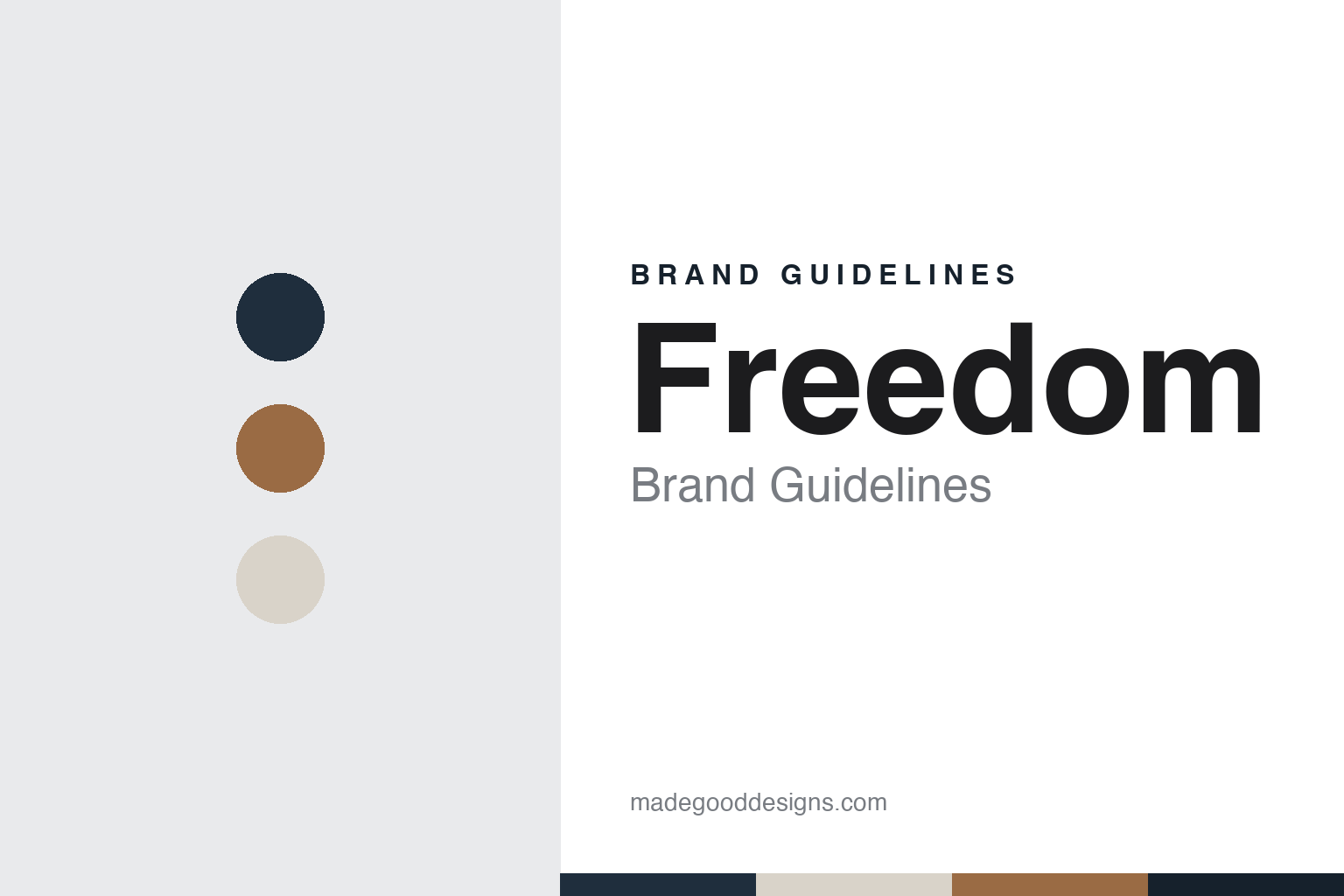
Two constants: an ink blue, timber and stone palette and a geometric uppercase sans register. Abstract homage — not a Freedom product or mark; no furniture, logo or store sign is reproduced.
Freedom
A Sydney chain that bought its rivals.
Freedom was founded in Sydney in 1981. English Wikipedia names the founder as Warren Higgs and says the first Melbourne store opened in 1984; in April 2011 the marketing title Mumbrella described the business as a “30-year old mid-market furniture retailer,” in line with that date. English Wikipedia says the investment company Jamison Equity bought the chain in July 1991.
The company went to the stock market in 1996. ABC News reported in 2003 that it had first listed on the Australian Stock Exchange that year as Freedom Furniture Limited. English Wikipedia says the same year it entered New Zealand through a local franchisee, Farmers Deka, and that the New Zealand arm had 13 stores by 2008.
As a listed company Freedom grew by buying other chains. English Wikipedia says it acquired the Guests and Andersons furniture chains in April 1999 and the bedding business Capt’n Snooze in 2000; the Sydney Morning Herald reported in August 2003 that the Guest family had sold their furniture chain to Freedom in 1999. In August 2002 the Herald reported that Freedom Group was buying the Bayswiss homewares chain, then 10 stores in New South Wales, and that it planned to keep the Bayswiss format unchanged. By August 2003, ABC News put the group at around 170 stores under the Freedom, Guests, Bayswiss, Captain Snooze and Andersons names.
Colour
Steinhoff, Greenlit and a new wordmark.
The link with Steinhoff began on the supply side. The Sydney Morning Herald reported in August 2003 that in July 2001 Freedom had struck an alliance with Steinhoff, the South African furniture maker, under which both companies moved their Australian manufacturing assets into a new company. That month Freedom’s managing director and two executive directors proposed taking the company private through a scheme of arrangement, backed by Steinhoff, which ABC News described as the parent of a major supplier to Freedom. If the scheme went ahead, the Herald reported, management would control 75 per cent of the company and Steinhoff the rest. English Wikipedia says the buyout was completed in 2003, and that in 2004 Freedom took management control of the British furniture and homewares retailer Cargo Homeshop, then 36 stores, through a management and supply agreement.
Freedom later sat inside Steinhoff’s Australasian arm. In September 2018 Inside Retail reported that Steinhoff Asia Pacific Group, which owned Freedom, Fantastic Furniture, Snooze and other retail brands, had renamed itself Greenlit Brands and arranged new financing through Australian banks, after accounting irregularities at its parent, Steinhoff International, became public. The Greenlit name and logo were developed inside the group after a group-wide vote, Inside Retail said.
The Freedom identity has been revisited more than once. In April 2011 Mumbrella reported a revamp of the chain’s branding and advertising after changes in its management team. In October 2020 Mumbrella reported a change to Freedom’s logo and brand identity, which had last been updated in 2006, made with the agency The General Store, with 12 key stores rebranded by November and the rest in 2021. Freedom’s marketing head told B&T that the wordmark had moved from lowercase back to uppercase, and that fonts, colours and tone of voice had been aligned around it. In New Zealand, Inside Retail reported the same month, the revamp brought a streamlined logo and New Zealand-made sofas and dining suites.
Typography
Furniture retail in Australia.
Furniture retail is a category built around the showroom. The chains in this group, from the north-eastern United States and the American South to Canada, Australia and France, sell sofas, beds, tables and storage from large stores where pieces are set out as rooms, so a customer can see a bedroom or a living room as a whole before choosing its parts.
Print came early. The International Directory of Company Histories describes an Atlanta furniture partnership of the 1880s and 1890s selling through illustrated newspaper advertisements and through salesmen who carried photographs of furniture styles from door to door. Catalogues, flyers and weekend sale pages followed in the twentieth century, and today the same chains publish websites with room planners and online showrooms alongside the stores.
Naming tends to be plain. Many of these businesses carry a founder’s surname, sometimes joined to another name after a merger or purchase, and ranges are often sold under the retailer’s own label as well as under manufacturers’ brands. Store formats are named just as directly: showrooms, outlets, clearance centres and mattress departments.
Corporate pages fill in the rest. Listed companies publish founding dates, stock-exchange listings and leadership changes for investors, while family-owned chains tell the same story through founders and generations. Purchases of one chain by another, and changes of owner, are usually dated there too. For a designer, the useful material is this mix of a long-running name, a room-set showroom and a steady flow of printed and digital promotions; the tones and typefaces in each guide here are our own reading of that, not an official system.
Aa
A short wordmark set in capitals since 2020. (Specimen set in Jost, a geometric sans STAND-IN; NOT the Freedom logo.)
Freedom
A distinct identity inside the Amart group.
Greenlit spent the following years selling its brands one by one, and Freedom was among the last to go. Inside Retail reported on 15 June 2025 that Greenlit was selling the Freedom business to Amart Furniture, the Brisbane chain controlled by Quadrant Private Equity. The combined group would have around 120 stores across Australia and New Zealand, and Freedom was to keep a distinct identity within Amart; the transaction was then still to be completed. Inside Retail reported in May 2026, when Greenlit completed the sale of Fantastic Furniture, that the deal followed Greenlit’s divestment of Freedom, which places Freedom under Amart’s ownership by then.
The store network has changed shape over the years. English Wikipedia says two New Zealand stores, in Palmerston North and Taupō, closed in 2023, leaving 12 in New Zealand, five of them in Auckland. As of November 2026, Freedom’s Australian website lists 47 stores, with most of them in New South Wales, Victoria and Queensland, and promotes related services under the same name, such as Freedom Kitchens and Freedom Wardrobes. Those counts are the company’s own and are dated to that month.
Across four decades the name has stayed constant while the owners changed: a founder, an investment company, public shareholders, a management team backed by a supplier, a South African group’s Australian arm and, since 2025, a private-equity-backed rival from Brisbane. The 2020 rebrand set out how the company wanted to look, with its wordmark in capitals and its fonts, colours and voice set around it, according to its marketing head’s account to B&T.
For a design guide, Freedom shows how a retailer can keep one short name through many owners and use a single wordmark change to reset its look. Compare Amart Furniture, its owner since 2025, and Nick Scali, which bought the Plush sofa chain from Greenlit. For this guide we use ink blue, timber and stone with a geometric sans, an unofficial interpretation; no product or logo is reproduced.
Explore & save
Keep Freedom’s identity on hand — save it to a board in the Made Good inspiration library.
Freedom identity set
Pin the Freedom ink blue, timber and stone palette and the geometric uppercase sans register to your own board.