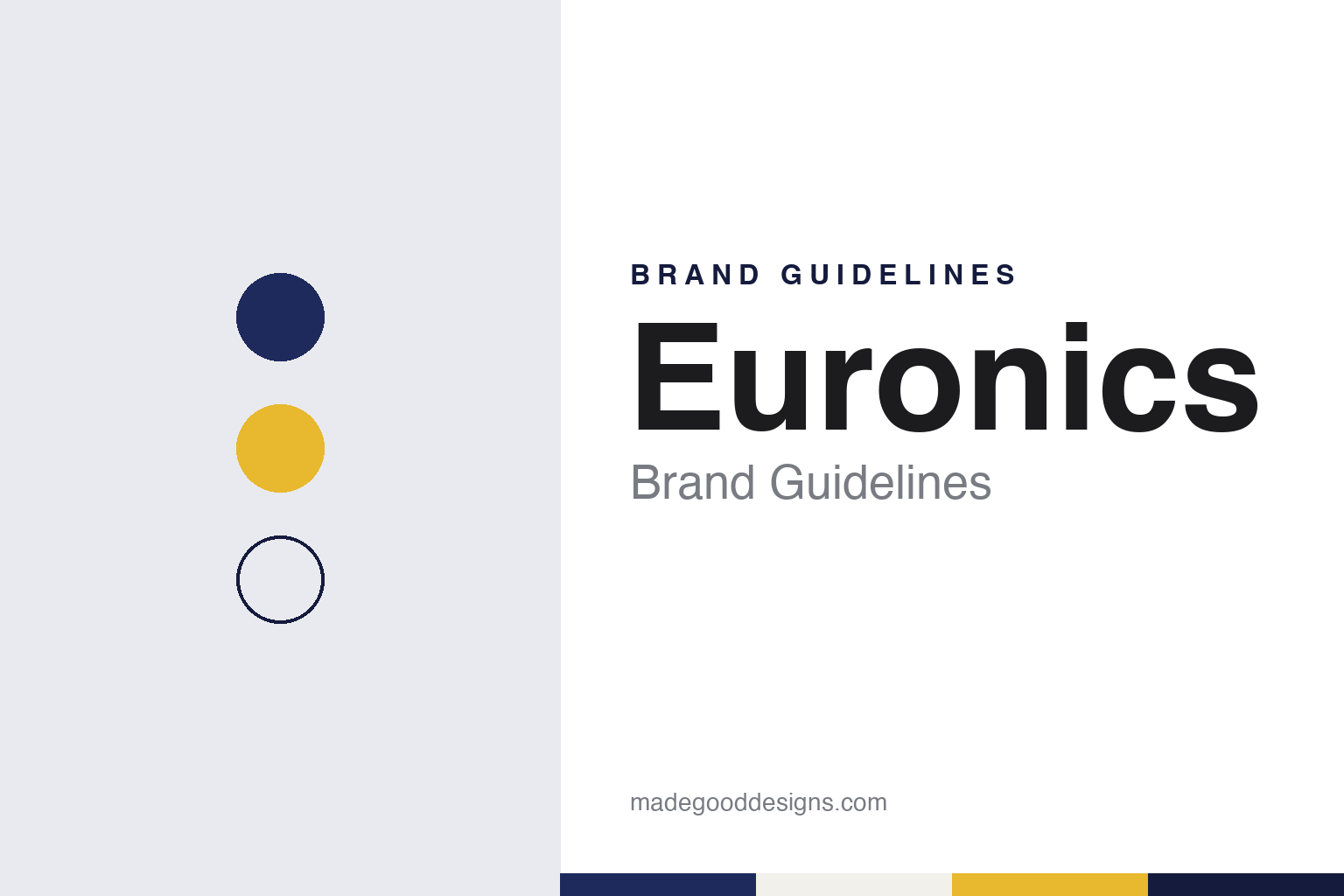
Euronics Brand Guidelines
A 1990 alliance of independent electrical retailers under one shared sign.
Aa
Two constants: an ink blue, deep blue and signal yellow palette and a shopfront sans register. Abstract homage — not a Euronics product or mark; no logo, fascia or livery is reproduced.
Five groups, one name
A grouping of independents, not a chain.
Euronics is not a single shop chain but a grouping of independent electrical retailers. English Wikipedia describes Euronics International as an association based in Amsterdam, founded in 1990 by five national buying groups from Germany, Italy, Spain, Belgium and the Netherlands; German Wikipedia gives the same founding story and notes that it rests on the group’s own account. The company’s website puts it slightly differently, saying the group was founded in 1990 by five entrepreneurs, and it names Marcel Vloemans as one of its founders.
The reason for the grouping, as English Wikipedia summarises it, was that specialist dealers needed the purchasing weight of a large organisation without giving up what made them specialists: trained staff, product knowledge and personal service. The answer was a legal form built for cross-border cooperation. Euronics is set up as a European Economic Interest Grouping (EEIG, or GEIE in its French initials), under which, the company says, its national retail organisations stay independent and keep their own liability while pooling resources across borders.
The company describes its governance in the same terms. A board of managing directors, it says, is made up of representatives of the four largest retailers in the group and four elected retailers, each serving three years, and a central office carries out international work in consultation with committees on which the national organisations sit. The members themselves take very different forms, from a German purchasing cooperative owned by its dealers to a Swiss chain owned by a larger retail group, and many of them trade under their own names as well as, or instead of, the Euronics sign.
That variety makes simple counting difficult, and the figures in print change with the year. German Wikipedia records that in 2015 the group had 28 cooperation partners in 36 countries, with about 6,400 member companies trading from more than 11,000 locations, and that by 2019 there were about 5,500 member companies at more than 8,800 locations. Reporting in February 2024 on a new Swiss partner, inside-it.ch said Euronics represented independent retailers in 35 countries with more than 8,500 outlets.
Colour
From Ditzingen and Milan to Tallinn and Zurich.
Germany is one of the founding countries, and Italian Wikipedia ranks the German partner first by turnover within the group, with Italy second. Euronics Deutschland eG, based in Ditzingen in the Ludwigsburg district of Baden-Württemberg, is a purchasing cooperative with more than 1,100 members, German Wikipedia says. It grew out of a joint venture formed in 2001 by two dealer cooperatives, Interfunk of Ditzingen, founded in 1969, and Ruefach of Ulm, founded in 1974. After a three-year transition, in which a jointly owned subsidiary ran the business of both, the members voted in 2004 to merge the three companies into Euronics Deutschland. Its member shops trade as Euronics or Euronics XXL, and a group of television and audio specialists trades as media@home.
In Italy the Euronics name dates from 1999. Italian Wikipedia says Euronics Italia grew out of the GET brand, set up in 1972 as demand for household appliances, colour televisions and hi-fi grew, and that in July 2022 it was made up of ten member companies with more than 450 outlets across the country, trading under three store names. Its membership has changed through court-supervised restructurings: English Wikipedia records that the retailer Galimberti joined in 2018 under measures agreed with the bankruptcy court in Milan, and that in November 2018 the Court of Monza admitted Castoldi to the group, with Euronics Italia taking over ten stores.
Further north, membership has followed changes of ownership. English Wikipedia says Euronics entered Estonia in 2003 and also trades in Latvia and Lithuania, and that in Finland the stores are run through the merchant cooperative Tekniset. In Norway, Euronics Norge of Fredrikstad became a subsidiary of the Swedish Elon Group on 1 January 2016 and changed its name to Elon in January 2019, English Wikipedia says; German Wikipedia records the Danish company El-Salg as a member since 2006.
The group also takes in partners that keep their own names. In February 2024, inside-it.ch reported that Interdiscount, the electronics retailer owned by the Swiss group Coop, had signed a strategic partnership with Euronics International. Interdiscount had more than 170 branches in Switzerland at the time, the report said, and was absorbing the online shop Microspot.ch, which Coop had decided to close in October 2023.
Typography
How the category presents itself.
Consumer-electronics retailers present themselves first through the store. Many trade from large units on the edge of towns, with long aisles divided into product areas such as computing, television, sound, phones and kitchen appliances. Trade reports describe how these floors are laid out for trying things: in 2017 Tweakers described Coolblue’s first XXL store in Amsterdam as six product areas, and in 2026 Républik Retail described a Boulanger store near Lille with a playable gaming area and a seated space for watching projectors.
Delivery is part of the public face. Some chains run their own vans for large appliances and installation, and Coolblue says it added its own bicycle delivery service in cities in 2018. Online shops, click-and-collect counters and services for repair, trade-in, rental and refurbished goods are presented beside the shelves, often under names of their own that sit next to the shop name on signs and websites.
Naming follows a similar pattern. A chain usually keeps one short shop name and adds own-label ranges with separate names, so a single store can carry the retailer’s brand, its house labels and many outside makers side by side. French Wikipedia, for example, dates Boulanger’s Listo and Essentiel B labels to 2005. When a chain buys a rival abroad, it may keep the local name, as Boulanger did with Krëfel in Belgium after 2019.
Behind the shop fronts sit corporate pages. These usually give a founding story, the current owner and any stock-market listing or plan for one, and some owners publish their own announcements of changing stakes. This guide sets out what dated sources say about each company’s founders, owners and listings, and treats the companies’ own descriptions as their claims.
Aa
A clear, wide shopfront sans for a shared sign. (Specimen set in Figtree, a sans STAND-IN; NOT the Euronics logo.)
Euronics
A sign the members choose to wear.
Because members are independent, Euronics works as a brand on two levels: an international name that a retailer can put over its door, and a national organisation that supports the dealers behind it. The UK shows how that is handled. There the group is represented by Combined Independents (Holdings), known as CIH, a buying group based in Andover, Hampshire.
In January 2019 the trade magazine kbbreview reported that CIH had announced a Europe-wide rebranding. It covered a new logo, marketing materials and website, the livery of delivery vehicles and members’ shop fascias. The magazine noted that members remained fully independent: those that chose to show the Euronics name on their shopfronts would be offered redesigned fascias, along with rebranded uniforms. The same report said CIH had partnered with the Kitchen Bathroom Buying Group and Der Kreis in January 2018 to give members access to kitchen furniture, and had refitted the reception of its Andover headquarters with a kitchen display to reflect that alliance.
The sign is therefore a shared asset rather than one company’s shopfront. In Germany, member shops trade under Euronics or Euronics XXL, German Wikipedia says; in Italy, Euronics Italia uses three store names, according to Italian Wikipedia; and in Switzerland Interdiscount kept its own name when it joined in 2024, inside-it.ch reported.
For a design guide, Euronics shows how a shared name can sit above independent businesses without replacing them. Compare MediaMarkt, the German electrical chain, and Currys, the UK electrical chain. For this guide we use an ink blue, a deep blue and a signal yellow with a sans, an unofficial interpretation; no product or logo is reproduced.
Explore & save
Keep Euronics’s identity on hand — save it to a board in the Made Good inspiration library.
Euronics identity set
Pin the ink blue, deep blue and signal yellow palette and the shopfront sans register to your own board.