Welcia Brand Guidelines
Three Saitama and Tokyo pharmacies, an AEON name and a full-size “E.”
Aa
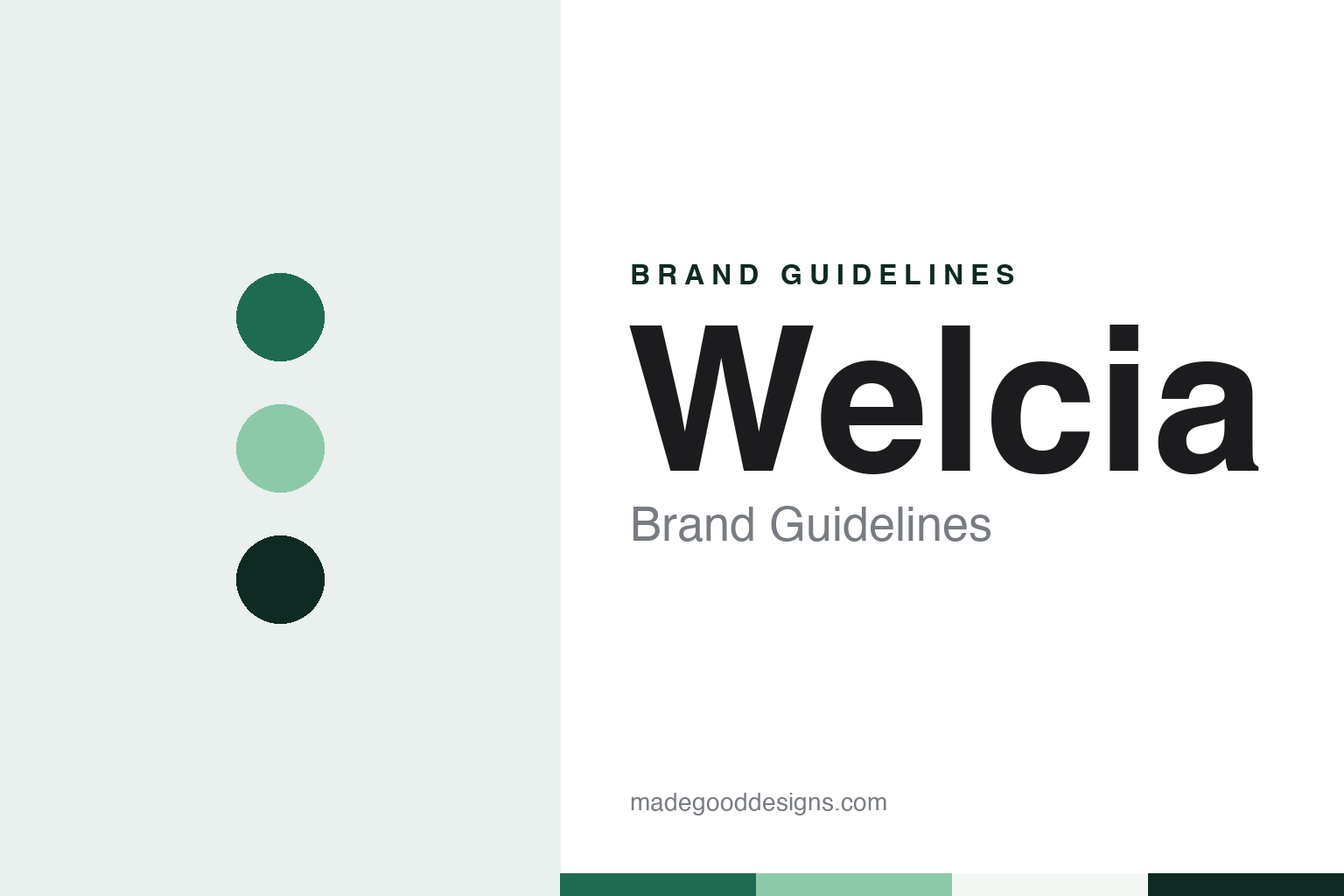
Two constants: a green, mint and white palette and a clean gothic sans register. Abstract homage — not a Welcia product or mark; no logo, mascot or shop sign is reproduced.
Green Cross and Coa
Three local pharmacies, one shop name.
Welcia is a merger story. Japanese Wikipedia traces the operating company, Welcia Yakkyoku, to three independent pharmacies: Juji Yakkyoku, opened in December 1959 in Fuchū, in western Tokyo; Ichinowari Yakkyoku, opened in 1965 in Kasukabe, Saitama, by Takayuki Suzuki; and Ikeno Drug, opened in 1971 in Sakado, Saitama, by Takamitsu Ikeno, whose shops traded as “Top.” Suzuki later became the first chairman of Welcia Holdings and Ikeno a later chairman, the same article says.
In the 1980s two of these businesses ran drugstores under the names Green Cross and Coa. In July 1997 they merged as Green Cross-Coa, with offices moving to Ōmiya, now part of Saitama city, in 1998. Japanese Wikipedia records a capital and business alliance with the Hokkaido chain Tsuruha in August 1999, and in February 2000 an alliance with JUSCO, the company now called AEON, which brought the business into the AEON group. Green Cross-Coa listed on JASDAQ in October 2001, absorbed Ikeno in March 2002, and in July 2002 unified its shop names as “Welcia.” It joined the second section of the Tokyo Stock Exchange in 2004 and renamed itself Welcia Kanto in December 2005.
The name itself came from AEON. Japanese Wikipedia says the “Welcia” shop name was taken from AEON Welcia Stores, the name at that time of AEON’s national alliance of drugstore chains, later renamed Hapicom; the alliance changed its name, but the shops kept Welcia.
Colour
A holding company, many shop names and one spelling.
The group’s present structure dates from 2008. On 1 September 2008 Welcia Kanto and Takada Yakkyoku, a Shizuoka chain formerly in the Matsumoto Kiyoshi group, formed a joint holding company, GLOWELL Holdings, which listed on the second section of the Tokyo Stock Exchange the same day, according to the company and Japanese Wikipedia. It moved to the first section in April 2012 and took the name Welcia Holdings on 1 September 2012.
Acquired chains were gradually brought under the one shop name. Japanese Wikipedia says the Kansai chain Eleven, bought in 2010 and renamed Welcia Kansai, switched its shops from “Super Drug Eleven” to “Welcia” between February and July 2014. In September 2014 Welcia Kanto absorbed Takada Yakkyoku, Welcia Kansai and Welcia Kyoto and became Welcia Yakkyoku. Not every name disappeared: after CFS Corporation of Yokohama joined in 2015, its Hac Drug shops carried on, and Japanese Wikipedia now lists four shop brands, Welcia, Hac Drug, Kanemitsu Yakuhin and Toshiya Yakkyoku.
The spelling matters to the company. Its profile page states that the “e” in the katakana name is written with a full-size character, not the small one many people use, and Japanese Wikipedia notes that the small-character form is incorrect. The group’s own goods carry the Welcia name too: Japanese Wikipedia lists the welmark household range and, since June 2021, the paired ranges “Karada Welcia” for food and items that touch the skin and “Kurashi Welcia” for household goods, alongside AEON’s Topvalu. Its mascot is a polar bear called Uetan, used on the group’s social accounts, the same article says.
Japanese Wikipedia records the group reaching Hokkaido through Kokumin in 2022 and Okinawa through Fuku Yakuhin that December, a joint venture with AEON Kyushu in September 2022 that runs a food-and-drug format called Welcia Plus, and an announcement in March 2023 that group drugstores would stop selling tobacco. Overseas, the company says it formed a joint venture in Singapore with BHG Holdings in 2017, opened its first store there that November, and took full ownership in February 2025 as Welcia Singapore.
Typography
Design and documentation.
Japan’s discount stores, value-apparel chains and drugstores tend to present themselves above all through the shop floor. At Don Quijote, Japanese Wikipedia describes a method called “compressed display,” with goods packed in so tightly that the store becomes half a maze, and price cards written by hand: each store employs its own POP writers, whose lettering the chain calls Donki moji. In these chains the sign on the shelf often does more identity work than the logo above the door.
Own-brand ranges are the second layer. Large groups sell their own lines under names that sit alongside the store name rather than replacing it; Pan Pacific International Holdings, the parent of Don Quijote, lists ranges such as Jonetsu Kakaku, launched in 2009, and EDRP, whose packs are printed in black and white to cut costs. Mascots work in the same way. Don Quijote’s penguin, Donpen, dates from 1998, and in 2021 the company set rules for how the character may appear in signs and illustrations.
Store names are usually plain. Some come from a founding family or an older family shop, others from a borrowed idea: the Don Quijote name comes from Cervantes’s novel, according to a company FAQ quoted by Unseen Japan in 2022. Many chains also run a second name for a format or a market, such as Don Don Donki for stores outside Japan.
Behind the stores sit corporate websites that set out founders, parent groups, timelines and stock-exchange listings, often in both Japanese and English. This guide uses those pages for dated company facts, adds encyclopaedia and press sources where they exist, and describes each chain only by what it sells, how its stores look and who owns it, with no claims about the products themselves.
Aa
A clean gothic sans — a plain register for a dispensing drugstore. (Specimen set in Zen Kaku Gothic New, a sans STAND-IN; NOT the Welcia logo.)
Welcia
From AEON subsidiary to part of Tsuruha.
AEON’s stake grew in stages. In November 2014 a tender offer made Welcia Holdings a consolidated subsidiary of AEON, the company’s history records. A decade later the group combined with Tsuruha. Japanese Wikipedia says Welcia and Tsuruha agreed on 28 February 2024, in talks led by AEON, to begin discussing a business integration. On 11 April 2025 AEON, Tsuruha Holdings and Welcia Holdings signed the definitive agreement, Impress Watch reported that day: a share exchange taking effect on 1 December 2025 would make Welcia a wholly owned subsidiary of Tsuruha.
The deal was completed on schedule. Nikkei Asia reported on 13 November 2025 that Welcia Holdings would be removed from the JPX-Nikkei Index 400 on 27 November because it was being delisted after its acquisition by Tsuruha Holdings. Welcia’s shares left the Tokyo Stock Exchange’s Prime market on 27 November 2025, Japanese Wikipedia says, and on 1 December 2025 the share exchange made it a wholly owned subsidiary of Tsuruha Holdings, as both the company’s own history and Ryutsuu News record. Ryutsuu News reported that day that the combined group had 5,659 stores in Japan, using figures as of the end of February 2025.
The integration closed a loop that began in 1999, when Green Cross-Coa first formed a capital alliance with Tsuruha. Welcia Holdings continues as a holding company in Sotokanda, Chiyoda, Tokyo, with subsidiaries including Welcia Yakkyoku, Shimizu Yakuhin, Yodoya, Kokumin and Fuku Yakuhin listed on its website, and Japanese Wikipedia describes it as part of the AEON group.
For a design guide, Welcia shows how a chain assembled from many local pharmacies can settle on one borrowed shop name, and how a company can care about a single character in its own spelling. Compare Tsuruha, its parent since December 2025, and Matsumoto Kiyoshi, another Japanese drugstore chain. For this guide we use a green, a mint and white with a clean gothic sans, an unofficial interpretation; no product or logo is reproduced.
Explore & save
Keep Welcia’s identity on hand — save it to a board in the Made Good inspiration library.
Welcia identity set
Save the Welcia green, mint and white palette and the clean gothic sans register to your own board.