Artbox Brand Guidelines
The Seoul stationery shop that grew into a lifestyle chain.
Aa
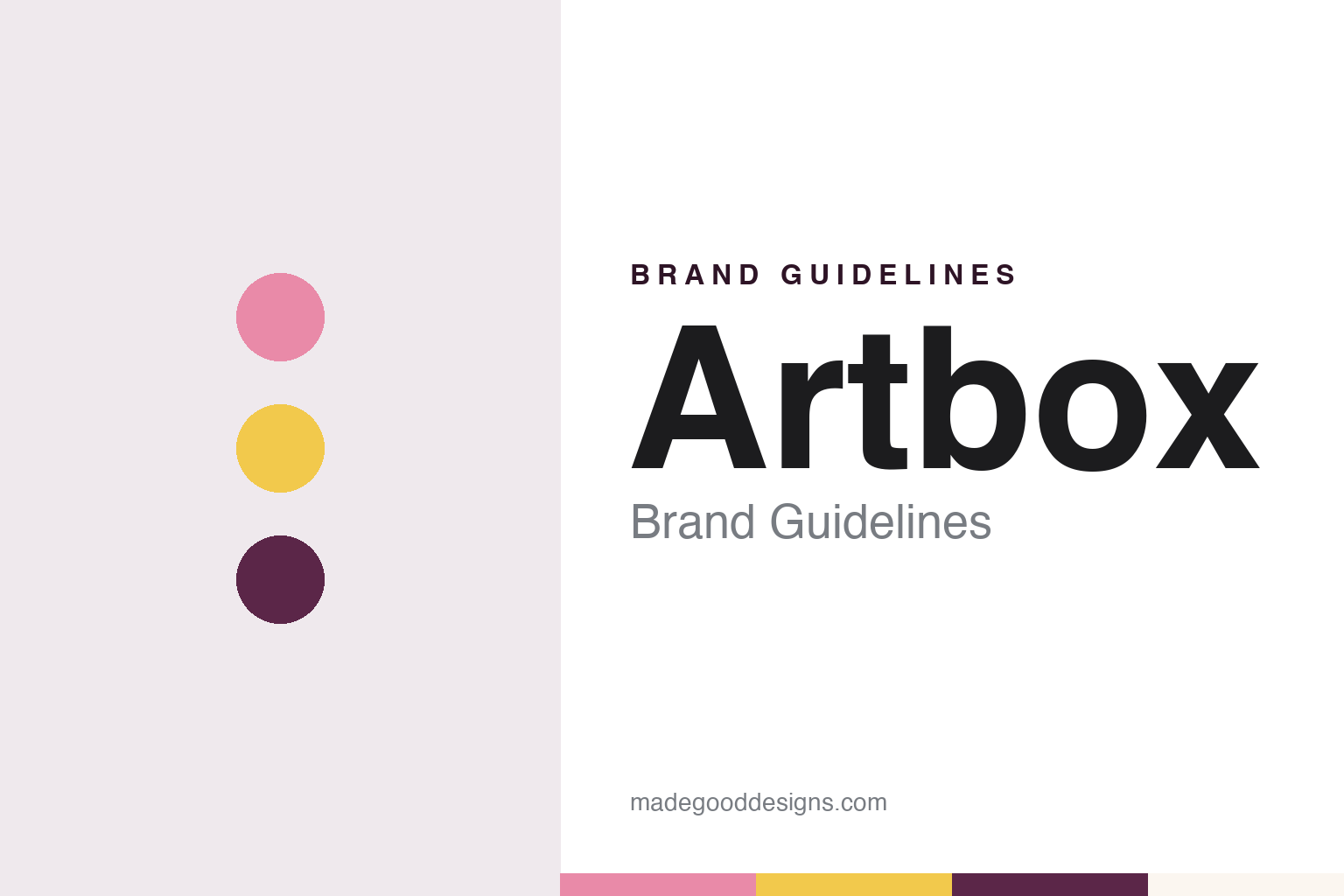
Two constants: an Artbox pink, yellow and plum palette and a rounded sans register. Abstract homage — not an Artbox asset; no logo, shopfront, character or product is reproduced.
Samsung Publishing, 1984
A stationery business inside a book publisher.
Artbox started inside a book publisher. The Korean weekly Sisaweek reported in November 2022 that the business began in 1984 as a division of Samsung Publishing and became a separate company in 1986; English Wikipedia gives the same two dates. Business Post, in a November 2023 profile of the publisher’s chairman, says Samsung Publishing was founded in 1964 and built its name on collected editions of literature sold door to door, and that the chairman himself had run Artbox before taking charge of the publisher in 1992.
For most of its life Artbox sat inside the publisher’s accounts. Until mid-2022 Samsung Publishing counted Artbox and its logistics subsidiary, AB Logis, as consolidated subsidiaries, Sisaweek reported, and the stationery chain made up a large part of the group’s results. That changed in August 2022, when the publisher sold 31,500 Artbox shares. Its stake fell from 46.45 percent to 35.26 percent, and from the third quarter of 2022 Artbox was no longer consolidated. Samsung Publishing gave the reasons as the separation of the two companies and raising operating funds.
Business Post reported that 30,000 of those shares went to Artbox’s chief executive, Cho Seok-hyun, whose holding rose from 25.46 percent to 36.12 percent, making him the biggest single shareholder. By September 2026 his stake stood at 39.20 percent against the publisher’s 35.26 percent, InsightKorea reported. The same report says that in November 2024 Artbox absorbed the business division of Litem L&C, a maker of plastic household goods, adding manufacturing to its own product planning and retail.
Colour
Ground-floor shops and a white frontage.
Artbox makes much of what it sells. In April 2024 Maeil Business Newspaper reported that the company runs an SPA model, handling product planning, design, production and sourcing, and sales itself, with its own production kept above half of the range. Its main customers, the paper said, are people in their teens and twenties, and its store strategy centres on ground-floor shops on busy streets, chosen to catch passing foot traffic. It opened 32 shops in 2023, and as of 3 April 2024 ran 187, of which 174 were directly operated.
English Wikipedia describes the range as stationery, writing instruments, pyjamas and soju glasses, among other goods, and notes that the chain is more often compared with Daiso than with other stationery companies. In September 2026 InsightKorea reported that the company also builds goods around its own characters, including a “lazy alien,” and plans products across stationery, character goods, fashion and household items through partner makers.
The name also has a life on screen. Maeil Business opened its 2024 report with a line from the film Veteran, in which the actor Ma Dong-seok announces himself as the boss of the local Artbox. The paper put the laugh down to the gap between the shop’s cute, small-scale image and the actor’s tough screen persona; Digital Times used the same line as the headline for a May 2024 walk through Myeongdong.
That Digital Times report also gives a rare note on the shopfront. On a back street near the Migliore building, the chain’s second Myeongdong branch had closed, leaving only its distinctive white exterior. The original ground-floor shop had also moved, the paper reported, reopening in a larger space in the building next door.
Typography
Design and documentation.
South Korea’s large retailers tend to present themselves through formats before slogans. A single group may run hypermarkets, warehouse stores, supermarkets, convenience stores and online malls side by side, each with its own name on the fascia, and corporate pages usually open with a timeline: the first branch, the district it stood in, the year it opened, and then each new format as it was added.
The big-box stores carry much of their identity on the shelf. Hypermarkets sell groceries alongside clothing, household goods and electronics under one roof, and own labels give them names to point to in the aisle, from value ranges to premium ready meals. Warehouse formats lean on large packs and goods shown in boxes or on pallets, so that the display itself signals the way the store sells.
Department stores and convenience chains work at opposite scales. Department-store groups put their weight into the building, the façade and the flagship in a city centre, while convenience chains rely on a short name and a bright fascia that has to read from a street corner and repeat across a large network of small shops. Beauty and lifestyle chains, and the apps that sit alongside all of these stores, carry the same names into a much smaller frame.
Behind the shop fronts sit corporate structures that the companies set out in plain terms: founding groups, spin-offs, joint ventures with foreign retailers, private-equity owners and listings on the Korea Exchange. Names have changed as partners arrived or left, and some chains have gone through court-supervised rehabilitation. For a designer, that history explains why a fascia, a logotype or an own-label pack looks the way it does today.
Aa
A rounded, friendly sans for a stationery and character-goods chain. (Specimen set in Jua, a rounded sans STAND-IN; NOT the Artbox logo.)
Artbox abroad
Vancouver, Tsukuba and Almaty.
Artbox has taken its shops overseas. In April 2024 Maeil Business reported that the company ran 39 stores in 11 countries, among them the United States, Canada, Japan, the United Kingdom, Russia and Thailand. In Canada, the Vancouver site Curiocity reported in May 2023 that a new Artbox had opened on Robson Street, the third in the area after shops at Metrotown and at Aberdeen Centre in Richmond, selling skincare and make-up alongside stationery, K-pop albums, stickers and phone and electronic accessories.
Japan followed in 2026. InsightKorea reported in September 2026 that Artbox opened a store in Tsukuba, in Ibaraki prefecture, in August 2026, as a shop-in-shop inside the Aeon Mall Tsukuba branch of the local retailer Kyokodo, and a second, of about 25 pyeong, in Asahikawa, Hokkaido, on 19 September 2026. The magazine presented the Tsukuba shop as Artbox’s entry into Japan, although Maeil Business had listed Japan among its overseas markets in 2024. The company was selected for a 2026 overseas-expansion support programme run by KOTRA, the state trade agency, and is carrying out market research and pop-up shops in the United States, Mongolia, Ecuador and Kazakhstan, the report said.
The Kazakhstan pop-up opened on 19 September 2026 in the ground-floor event space of the Mega Alma-Ata shopping centre in Almaty, Maeil Business reported. The temporary shop of about 180 square metres sells collectible toys and figures, stationery, jewellery and living and travel goods, and adds a doodle zone whose wall is laid out like a giant colouring page, a filming corner for short videos, a lip-sync video booth and a photo booth.
For a design guide, Artbox shows how a stationery counter can grow into a lifestyle brand built on cute characters, small gifts and bright street-level shops. Compare Daiso, the variety chain English Wikipedia compares it with, and Olive Young, the Korean health and beauty chain. For this guide we use a sticker pink, a pencil yellow and a deep plum with a rounded sans, an unofficial interpretation; no product or logo is reproduced.
Explore & save
Keep Artbox’s identity on hand — save it to a board in the Made Good inspiration library.
Artbox identity set
Pin the Artbox pink, yellow and plum palette and the rounded sans register to your own board.