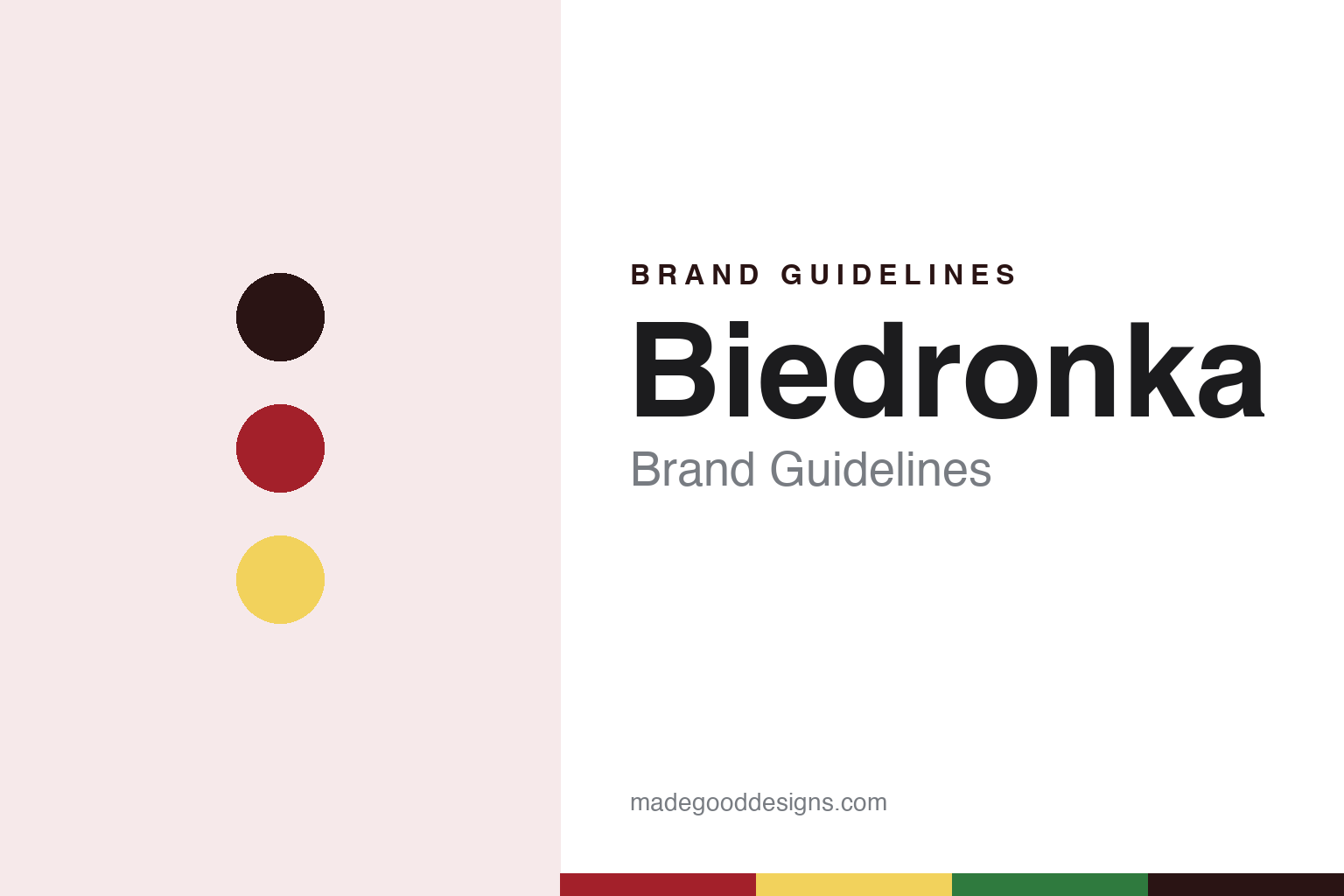
Biedronka Brand Guidelines
The ladybird discount chain of Poland.
Aa
Two constants: a Biedronka red, yellow and green palette and a geometric sans register. Abstract homage — not a Biedronka product or mark; no ladybird, logo or sign is reproduced.
A warehouse in Śrem
Elektromis shops, then a Portuguese owner.
Biedronka, Polish for “ladybird,” was founded in 1995 by Mariusz Świtalski, the owner of the business Elektromis, according to both the English and Polish Wikipedia editions. The sources differ on the opening shop. Polish Wikipedia and Onet, in an April 2026 history piece, place it in Śrem, in a converted Elektromis warehouse, with a Poznań shop opened almost in parallel; Polish Wikipedia dates the Śrem shop to 1 February 1995 and the Poznań one to April 1995, while English Wikipedia names the Poznań shop, dated 6 April 1995, as the first.
The decisive date came two years later. In 1997 the Portuguese food retailer Jerónimo Martins bought 210 Biedronka shops from Elektromis, both Wikipedia editions say, and English Wikipedia treats the purchase as the start of the chain’s expansion. Jerónimo Martins says its own story began with a shop opened in 1792 in the Chiado district of Lisbon. Świtalski went on to found the Żabka convenience chain in 1998.
The store count climbed in steps that the chain marked publicly. Polish Wikipedia records the takeover of more than 120 shops of the German chain Plus in 2008, the 1,500th store in Poznań in March 2010, the 2,000th in Łódź in October 2012, the 2,500th in September 2014 and the 3,000th in February 2019. Onet adds the 800th store, in Krosno, in 2008. At the end of 2025 there were 3,882 Biedronka stores in more than 1,300 towns and villages, Polish Wikipedia says.
Biedronka is operated by Jeronimo Martins Polska, whose correspondence address on the Biedronka website is in Kostrzyn. English Wikipedia counts 3,730 stores and about 84,000 employees at the end of 2024, and names Lidl as the main competitor in Poland.
Colour
A ladybird, seven spots and a green one.
The sign has always been the insect. Onet describes the original 1995 logo as a smiling ladybird with seven spots, one of them green and forming part of the word MARKET on the sign, and says the current logo dates from 2012. English Wikipedia describes the present mark simply as a cartoon ladybird. Polish Wikipedia cites an observation by Marek W. Kozłowski that, compared with the real seven-spot ladybird, the drawn figure has no pronotum or legs and carries its face directly on the wing cases.
The shelves carry the chain’s second identity, its own labels. Polish Wikipedia lists food ranges such as Kraina Wędlin, Marinero and Mleczna Dolina, and non-food lines built under the group’s newer strategy: Hykker electronics, made with the Polish company myPhone, and the Seven for 7 sports and trekking clothing sold since 2017. Polish Wikipedia also records the 2016 loyalty campaign Gang Świeżaków, whose plush fruit and vegetable characters could be collected with stickers, followed by further mascot campaigns on the same lines.
The range itself has widened. Polish Wikipedia says that from 2014 the chain steadily broadened its assortment and moved away from a pure discount model.
On where the goods come from, Jerónimo Martins says that more than 90 per cent of the products Biedronka sells are of Polish origin. English Wikipedia adds that some Portuguese products, mostly wine, are also sold.
Some habits changed late. Polish Wikipedia says Biedronka accepted only cash for many years, introduced phone payments in October 2013 and took payment cards from 16 June 2014. An online grocery shop followed in 2024.
The first store outside Poland opened in Slovakia in March 2025, both Wikipedia editions say; Polish Wikipedia places it in Dunajská Lužná, in the Bratislava region, and Jerónimo Martins describes Slovakia as an operation it has run since 2025. Wiadomości Handlowe reported in November 2026 that the chain had opened its first shop in Bratislava itself.
Typography
How the category presents itself.
Polish and Romanian retailers mostly present themselves through the places where people shop: the fascia above a corner-shop door, the sign on a discount supermarket at the edge of town, the campaign images in a fashion store window, the screens of a marketplace app and the long front of a DIY megastore. Each of these is a design surface the company controls, and the guides in this group read them as the companies publish them, on their own sites, stores and apps.
Store naming in the region is often plain and local. Several chains carry an ordinary Polish word, an animal or a short invented name, and the guides explain what each name means and where it came from, without reading more into it than the sources do. Where a chain changed its sign or colours, the guides give the date of the change and the source that records it.
The corporate pages matter as much as the shopfronts. Many of these businesses were started by founders in the 1990s, later sold to private-equity funds or foreign groups, and in several cases listed on the Warsaw Stock Exchange. The guides set out founders, owners and listings as dated facts, and they state pending takeovers as pending, with the date they were agreed.
What the guides do not do is rank retailers or judge them as better or worse. Store counts, country counts and formats are given only with the date and source that supplied them, and every palette and typeface shown is our own unofficial interpretation, chosen to describe a look rather than to copy one. No logo, fascia, product or campaign image is reproduced.
Aa
A round, geometric sans for price cards and fascias. (Specimen set in Poppins, a geometric sans STAND-IN; NOT the Biedronka logo.)
Biedronka
Promotions under the regulator’s eye.
The chain’s scale has brought it before Poland’s competition and consumer authority, UOKiK, several times. In June 2023 UOKiK fined Jeronimo Martins Polska over the “Tarcza Biedronki antyinflacyjna” promotion run from April to June 2022, finding that customers were misled about its real benefits, its conditions and the availability of its rules; a court upheld that decision in December 2025, TVN24 reported, and the company said it disagreed.
In September 2026 UOKiK fined the company and several haulage firms over an agreement under which carriers serving Biedronka distribution centres did not hire one another’s drivers, a practice the authority dated from June 2017 to at least February 2024, RMF24 reported.
The ownership line, by contrast, has been stable for almost three decades: Biedronka has belonged to Jerónimo Martins since 1997, run through its Polish company from Kostrzyn.
For a design guide, Biedronka shows how a single drawn insect can carry a discount chain from one converted warehouse to thousands of stores and across a border, while the own-label ranges speak for the shelves. Compare it with Żabka, the convenience chain started by the same founder, and with Allegro, another Polish retail name that listed in Warsaw. For this guide we use ladybird red, spot black, shelf yellow, market green and receipt white with a geometric sans, an unofficial interpretation; no product or logo is reproduced.
Explore & save
Keep Biedronka’s identity on hand — save it to a board in the Made Good inspiration library.
Biedronka identity set
Pin the Biedronka red, yellow and green palette and the geometric sans register to your own board.