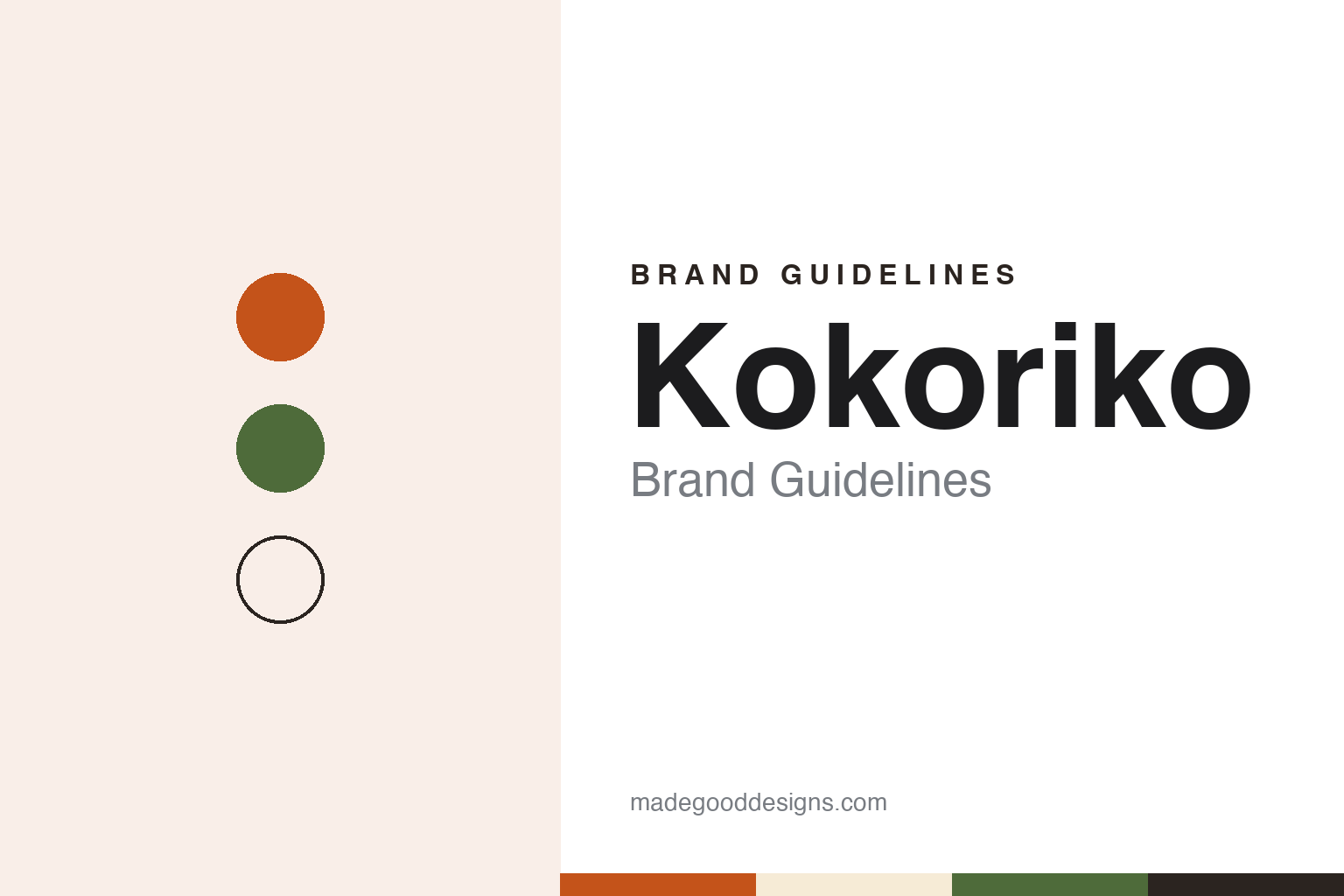
Kokoriko Brand Guidelines
Bogotá’s roast chicken chain since 1969.
Aa
Two constants: an ember, charcoal and cream palette and a grotesque sans register. Abstract homage — not a Kokoriko product or mark; no logo, sign or packaging is reproduced.
AVESCO
A poultry company, a Bogotá shop and a new name in Cali.
Kokoriko’s story starts in Bogotá in 1969. That year the businessmen Eduardo Robayo, Noé Cardona and Emilio Jordán founded the Compañía Comercial e Industrial de Aves, AVESCO Ltda., and opened a small shop in the city called Las Colonias, El Colombiano and Forbes Colombia reported in April 2026. It was there, both say, that the chain settled on the combination it is still built around: roast chicken, potatoes and arepa. The date matches El Tiempo’s company profile of September 1994, published as Kokoriko marked 25 years of trading, and Spanish Wikipedia, which gives the founding date as 9 August 1969.
The Kokoriko name came a little later and in another city. Around 1971, according to the same 2026 reports, the company opened its earliest restaurant under the Kokoriko name in Cali, and from there expanded to Medellín, Barranquilla, Cartagena and Manizales. The operating company kept its own name for decades: in May 1998 El Tiempo still described Avesco as the company that ran the Kokoriko chain in Colombia.
The founding family stayed connected to the business for a long time. When the chain changed hands in 2017, El Tiempo described the Robayo family as the founders of Avesco and Kokoriko and listed them among the shareholders of its holding company at that point.
Colour
Fast food, franchises and a production plant.
By its 25th anniversary the company had grown well beyond a chicken shop. El Tiempo’s 1994 profile set out the steps. In 1983 Kokoriko began to diversify its products and moved into fast food served with an emphasis on service, along with an update of the look of its restaurants. In 1987 it took a significant shareholding in Diners Club S.A., which the paper described as its entry into the financial sector, and began a programme of concessions and franchises. In 1990 it completed its administrative headquarters and a new production plant, fitted with European and American equipment.
The same profile describes a company that made much of what it sold. Alongside the chicken lines, it added bakery, biscuit, ice cream and packaging lines, and delivered its products across the country in its own refrigerated vans. At that point, the company said, it accounted for some 2,000 direct jobs.
Franchising became a large part of the model. In May 1998 El Tiempo reported that the chain had 107 outlets across Colombia, about half of them run as franchises. In January 2008 the paper reported that the chain had close to 100 restaurants, including one in the United States. The same report named two other company brands, Alimentos Kokoriko, sold in some 600 supermarkets, and Alimentos Klik, which supplied about 5,000 institutional clients.
Today the menu is still led by the same idea. The chain’s website, in November 2026, advertises pollo asado and its Kronch line for delivery or collection.
Typography
Restaurant and café chains.
Latin American restaurant, burger, chicken and café chains tend to present themselves first through the street. A shop front carries the name, a short line of colour and often a counter or an ice-cream window that can be read from the pavement, and many chains run more than one format under the same name: a quick-service counter, a table-service restaurant, a kiosk in a shopping centre or a separate ice-cream shop. Drive-through lanes, delivery apps and self-service ordering screens have since joined the shop front as places where the name has to work.
Menus do much of the brand work. Chains in the region usually give their signature dishes their own names, from a house burger to a named roast chicken or a crêpe, and repeat those names across menu boards, packaging and campaigns. Mascots and characters appear in some of these identities, and seasonal campaigns are often built around a new named dish or a limited line rather than around the company itself.
Ownership is often a group matter. Several of the larger chains belong to food or restaurant groups that run a number of brands side by side, sometimes including franchises of international names, and the parent usually describes each brand as a separate business with its own identity. Others have stayed in the hands of their founding families for decades and present that continuity as part of the story.
Corporate pages and the business press fill in the rest: who founded the chain, in which city and year, who owns it now, and where it has opened abroad, usually through franchising in neighbouring countries, Spain or the United States. For a design reader, the useful evidence is what each company itself publishes, and how consistently its name, colours and dishes carry from one format to the next.
Aa
A warm grotesque for a short, spoken name. (Specimen set in Bricolage Grotesque, a sans STAND-IN; NOT the Kokoriko logo.)
Kokoriko
Conboca, IGA and KKO.
Kokoriko has belonged to a series of restaurant groups. In 2000, El Colombiano and Forbes Colombia reported in 2026, the company joined with the ice cream chain Helados Mimo’s to form Grupo Conboca. In April 2017 El Tiempo reported an agreement under which Inmaculada Guadalupe y Amigos en Compañía (IGA), the owner of the Bogotá restaurant Andrés Carne de Res, would bring in Grupo Conboca, with its chains Kokoriko and Helados Mimo’s, the brewery Cervecería Colón and the Palos de Moguer craft beer bars. Conboca’s shareholders, the Robayo family among them, were to contribute their shares to IGA and become its partners, and the Barbados private equity fund Portland Private Equity was to join IGA as a partner. IGA and Conboca already shared some partners, the paper said, including Sigma Inversiones and the private equity fund MAS, and Grupo Conboca had 260 points of sale across its different brands. Spanish Wikipedia, written while Kokoriko was still part of the group, describes Grupo IGA as running Kokoriko alongside Helados Mimo’s and Andrés D.C.
That arrangement lasted about nine years. On 20 April 2026, El Colombiano reported that Kokoriko had been acquired by the Colombian investment fund KKO, ending its link with Grupo IGA, and Forbes Colombia reported the next day that the fund had confirmed the purchase. No figures for the deal were disclosed, Forbes Colombia said. KKO said the restaurants would carry on operating normally.
Kokoriko’s neighbour in this guide is Frisby, the Pereira chain founded in 1977 that built its name on breaded fried chicken. Kokoriko, by contrast, has kept roast chicken served with potatoes and arepa at its centre, the formula El Colombiano traced back to the Las Colonias shop in its April 2026 report.
For a design guide, Kokoriko shows how a chain can carry one short, sound-based name through more than half a century of new owners, while the operating company behind it changes name and shape. Compare Frisby and El Corral, another Bogotá restaurant brand. For this guide we use an ember orange, charcoal and arepa cream with a grotesque sans, an unofficial interpretation; no product or logo is reproduced.
Explore & save
Keep Kokoriko’s identity on hand — save it to a board in the Made Good inspiration library.
Kokoriko identity set
Pin the Kokoriko ember, charcoal and cream palette and the grotesque sans register to your own board.
Source & notes
Frequently Asked Questions
What font can I use to match the Kokoriko look?
This guide describes Kokoriko’s type as “A warm grotesque for a short, spoken name”. Its type specimen is set in Bricolage Grotesque from Google Fonts as a stand-in; Bricolage Grotesque is not Kokoriko’s own lettering.
What colours are in the Kokoriko palette?
This guide’s Kokoriko palette is Ember orange #C4531A, Charcoal #2B2420, Arepa cream #F6EBD6, Herb green #4E6B3A and Paper #FAF8F4. The tones are the guide’s own unofficial interpretation, not official Kokoriko hex codes.
When was Kokoriko founded?
Kokoriko was founded in 1969 (as AVESCO), in Bogotá, Colombia.
Who founded Kokoriko?
Kokoriko was founded by Eduardo Robayo, Noé Cardona and Emilio Jordán in 1969 (as AVESCO).
Who owns Kokoriko?
Kokoriko is owned by KKO investment fund (since April 2026).


