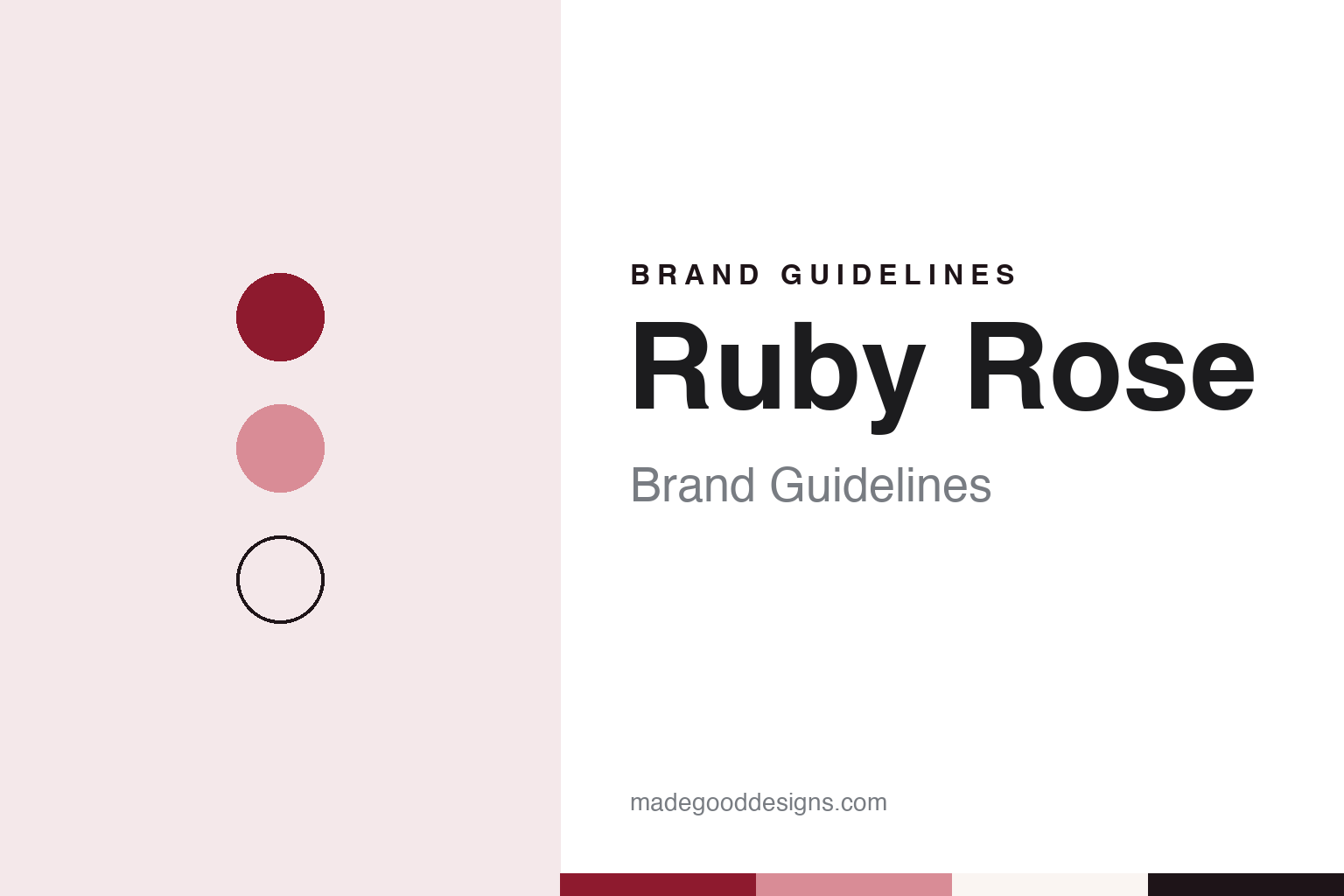
Ruby Rose Brand Guidelines
A family makeup label of Russian origin that found its biggest Latin American market in Brazil.
Aa
Two constants: a ruby red, blush pink and ink palette and a display serif register. Abstract homage — not a Ruby Rose product or mark; no pack, logo or product is reproduced.
From Russia to 25 de Março
A family brand that started small in São Paulo.
Ruby Rose sells makeup in Brazil through perfumeries and online shops, Claudia reported in 2019, but its own account of its history starts elsewhere. In August 2020 the company’s marketing director in Brazil, Cleide Sales, told ELLE Brasil that the company’s story began 42 years earlier in Russia, and that the brand was then present in 17 countries, including the United States, Ukraine and Lebanon.
The Brazilian operation, she said, had started 14 years earlier, which places it around 2006, as a single small house with a handful of staff that delivered only to Rua 25 de Março, the wholesale shopping street in central São Paulo.
In July 2023 Forbes Colombia described Ruby Rose in similar terms: a family brand of Russian origin with more than 40 years in the market and a presence in 20 countries. The magazine said Brazil was the brand’s main market in Latin America, that it had been active there for more than 15 years, and that its sales in the state of São Paulo alone were larger than its total sales across Central America. The two dated accounts differ on the number of countries, 17 in 2020 and 20 in 2023, and give the age of the company in round figures rather than a founding date.
Neither account names the founding family, and the brand’s Brazilian website does not publish a company history. What both describe is a business that grew in Brazil from a wholesale street rather than from department stores, and that kept its manufacturing largely abroad.
Colour
Foundations, lip tints and eye palettes.
According to ELLE Brasil, it took Ruby Rose about a decade in Brazil to find a breakthrough product. That product was a high-coverage liquid foundation, the Base Líquida Matte, which arrived as matte finishes became popular in 2016 and spread after YouTube creators including Mari Maria and Joyce Kitamura featured it. Cleide Sales told the magazine that it was the brand’s first real boom and that the company struggled to keep it in stock. By 2020 the foundation came in four versions, named Matte, Feels, Natural Look and Soft Matte, and the company was releasing two to three new products a month, she said.
The range widened from there. In May 2019 Claudia reported the launch of a Lip Tint line for lips and cheeks in four shades, each with a scent: Citrus, Morango, Cereja and Tutti Frutti, sold in perfumeries and online from the last week of that month. The same 2020 ELLE Brasil article described a newer face-care line called Argila Rosa, made up of a facial soap, a serum, a scrub and a mask.
Eye products became a regular part of the calendar. In October 2021 the iG site Delas reviewed a set of launches that included the Spice Shop and Flame and Ice eyeshadow palettes, a line of coloured eyeliners called Game On in yellow, orange, pink, purple, blue and green, and new mascaras. In August 2026 the portal Terra reported a line called Wonder with 19 products for lips, face, eyes and brows, built around palettes named Siren Valley, with 20 colours, Eden, with 15, Deep Oasis and Neo, the last in four versions.
Ruby Rose also runs a second label for younger customers. In 2023 Forbes Colombia reported that Melu, by Ruby Rose, a brand aimed at buyers aged 15 to 19, had already been presented in Brazil.
Typography
Brazilian beauty brands and how they present themselves.
The Brazilian beauty brands in this group introduce themselves through a small set of fixed elements: a short brand name, a plain wordmark, and named lines that run across perfume, make-up and body care, so that a fragrance family or a lipstick range can carry its own name under the house name. O Boticário took its name from the Portuguese word for an apothecary and began in 1977 as a compounding pharmacy in Curitiba; in 2026 one of its franchise shops was refitted with an interior modelled on the old boticas.
The way the products are sold shapes how the brands appear. Some grew through franchise shops and kiosks in shopping centres, others through direct sales, in which representatives order from a catalogue or a service centre and sell to their own customers, and most now combine shops, sellers and online stores. Campaigns follow the same channels, from television spots for Dia dos Namorados to launches timed to a fixed date such as the lipstick day on 29 July.
Group ownership is common, and this guide describes it plainly, by date. Grupo Boticário was formed as a holding company in 2010 and has since launched or bought brands including Eudora, Quem Disse, Berenice? and Vult. Where a brand has passed to another owner, including an international cosmetics group, the entry gives the owner and the date of the deal; where a brand remains independent, the guide says so only where a dated source does.
Each entry draws on corporate pages for founders, owners and franchise networks, and on dated independent press for anything beyond the company’s own word. Product lines are named as the companies publish them; the guide does not describe what the products do, and the palettes and typefaces shown are an unofficial interpretation rather than any brand’s own.
Aa
A high-contrast display serif for a makeup label. (Specimen set in DM Serif Display, a serif STAND-IN; NOT the Ruby Rose logo.)
Ruby Rose
Made mostly in China, sold through a wide network.
Where the products come from is set out plainly in the company’s own words. In 2020 Cleide Sales told ELLE Brasil that most Ruby Rose products, including its foundation, were made in China, at a main factory owned by the family that founded the brand, and that about 90 percent of what the company sold in Brazil came from there. In Brazil, she said, the company made its mascaras, the Lip Tint and a lip oil from scratch at a contracted laboratory, and the Argila Rosa face-care line was made entirely in Brazil. She said the company wanted to bring more production to Brazil but that this was not yet viable.
By 2023 the picture had widened. Forbes Colombia reported that products were shipped from the group’s factories in Brazil, Turkey, South Korea, China and the United Arab Emirates. The same article described how the brand reached Colombia: through a franchise for Colombia, Ecuador and the United States held by the Medellín businesswoman Claudia Piedrahíta, which the magazine said was the only Ruby Rose franchise in the hands of someone outside the founding family. Her first container of products arrived on 25 December 2019, and the business built its own online shop before moving into physical retail through distributors and chains such as Falabella and Farmatodo, the magazine reported.
The visual side of the brand is not documented in a published guideline. ELLE Brasil shortens the name to RR, and the products are presented through constant launches, named palettes and the work of the brand’s own makeup artists, who are quoted in launch coverage in Claudia and Terra.
For a design guide, Ruby Rose shows how a mass-market makeup brand can build recognition through named collections and a steady release calendar rather than a single signature product. Compare Quem Disse, Berenice?, a makeup brand from Grupo Boticário, and Boca Rosa Beauty, a creator-led label. For this guide we use a ruby red, blush pink and ink with a serif, an unofficial interpretation; no product or logo is reproduced.
Explore & save
Keep Ruby Rose’s identity on hand — save it to a board in the Made Good inspiration library.
Ruby Rose identity set
Pin the ruby red, blush pink and ink palette and the display serif register to your own board.
Source & notes
Frequently Asked Questions
What font can I use to match the Ruby Rose look?
This guide describes Ruby Rose’s type as “A high-contrast display serif for a makeup label”. Its type specimen is set in DM Serif Display from Google Fonts as a stand-in; DM Serif Display is not Ruby Rose’s own lettering.
What colours are in the Ruby Rose palette?
This guide’s Ruby Rose palette is Ruby red #8E1A2E, Blush pink #D98C96, Ink plum #1E1418, Rose clay #B7646E and Powder white #FAF5F2. The tones are the guide’s own unofficial interpretation, not official Ruby Rose hex codes.
When was Ruby Rose founded?
Ruby Rose was founded in Brazil from about 2006, in Russia (company account).