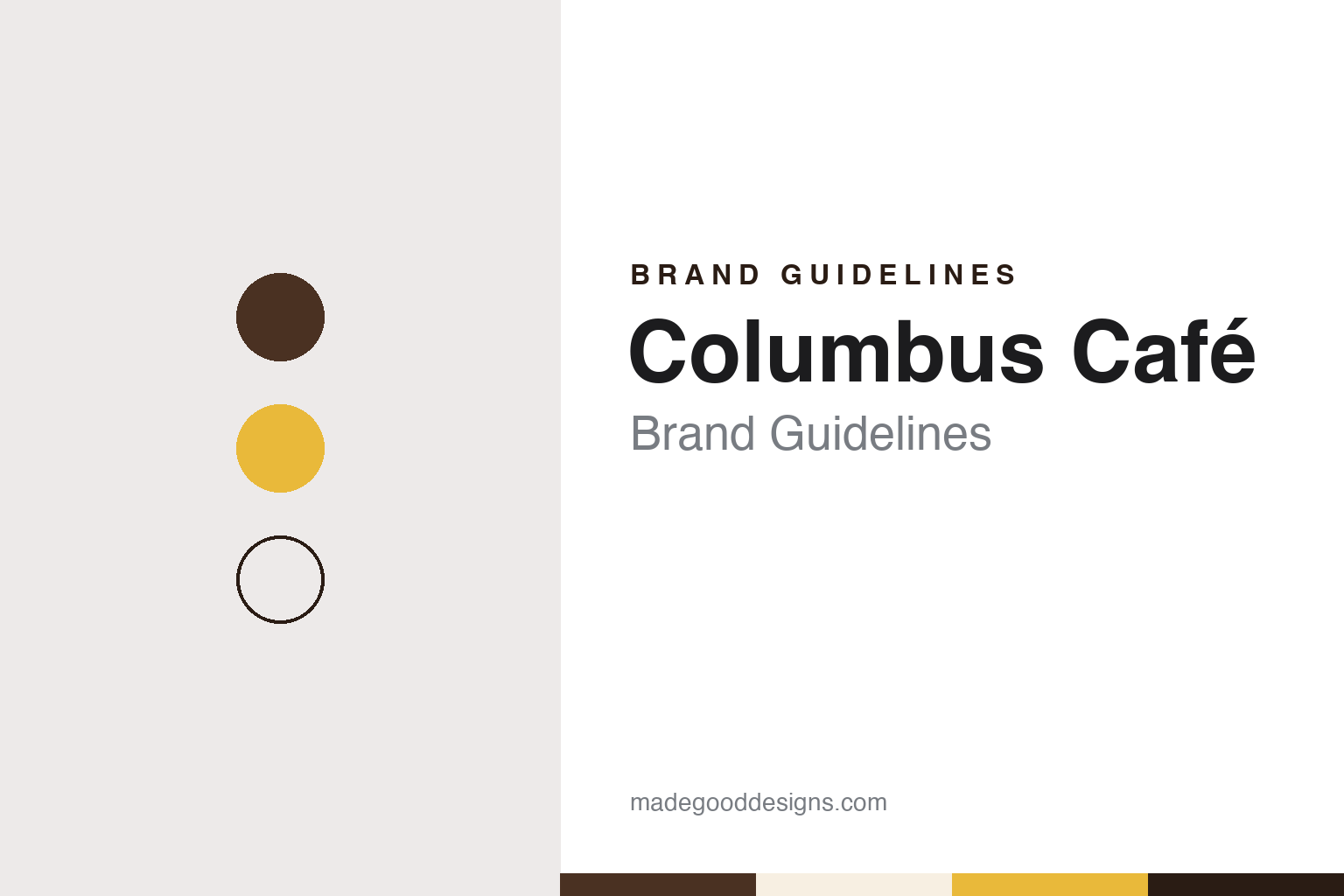
Columbus Café Brand Guidelines
A 1994 French espresso bar, a bear and a muffin yellow.
Aa
Two constants: a coffee-bean brown and muffin yellow palette and a rounded sans register. Abstract homage — not a Columbus Café product or mark; no logo, bear figure or packaging is reproduced.
Columbus Café
An espresso bar chain from 1994, rebuilt after 2007.
Columbus Café opened in France in 1994. Its founder was the entrepreneur Philippe Bloch, whose business partnership with Ralph Hababou had begun in 1986 around the customer-service book Service compris, the franchise trade site Observatoire de la Franchise reported in September 2004. The company’s own timeline places its first café outside France in Brussels in 2001.
The founder’s time in charge ended ten years in. At the annual general meeting of 28 June 2004, at the request of the shareholders and his former partner, Bloch was replaced as chairman of the board and gave up all operational roles, while staying on as a shareholder, Observatoire de la Franchise reported that September. The same report said the company was then working its way out of financial difficulties.
A new owner arrived in 2007. Republik Retail reported in March 2024 that Wagram Finances, a company set up in 1994 to back the development of Columbus Café, was taken over in 2007 by Nicolas Riché and a partner. At that takeover, the same report said, the chain was repositioned completely and 27 of its 30 existing cafés were closed. The company’s history page says Riché became chief executive in 2007 and that Columbus Café began franchising the same year.
Growth since then has come largely through franchise partners. In March 2024 Republik Retail counted 250 points of sale in France and abroad, naming Luxembourg, Belgium, Canada and the United Arab Emirates, with 20 shops in Canada and around 100 franchisees, more than a third of them running several shops. The company dates its North American start to 2020, with a first coffee shop in Montreal. As of November 2026 its website gives a network of 253 coffee shops in France and abroad, mainly in city centres and shopping centres, and lists countries including Belgium, Canada, Portugal, Morocco and several Gulf states. In March 2026 Republik Retail reported a count of 253 establishments in France, so the two figures are presented here with their dates and sources.
Colour
Muffins, espresso and the supermarket aisle.
The shops sell hot and cold drinks, sandwiches, salads and bowls, the company says, but the product most tied to the name is the muffin. The company says its muffins are baked in the shops by its baristas and come in more than twenty recipes. Republik Retail reported in March 2026 that the chain sells more than 1.8 million muffins a year, prepared on site each day, and that a new range called “double gourmandise” pairs a filling with a topping. The method changed with it: the muffins used to be filled before baking and are now filled afterwards, the chain’s research and development director told the publication, and the sweet range is now organised into three muffin families.
Drinks were reworked at the same time. Republik Retail counted 28 new drinks in that 2026 menu change, among them signature milkshakes, hot and cold “elixirs,” iced teas and coffee alternatives such as a golden latte, a chicory latte and an ube latte. The publication also reported that a broader vegetarian savoury range was being tested in pilot shops.
The brand also lives outside its cafés. The company says it began selling coffee capsules compatible with Nespresso, Dolce Gusto and Senseo machines in 2016, while Republik Retail gave 2017 in its March 2024 report; the two dates are given here side by side. That 2024 report described a supermarket range of around 35 products, sold under licence across four aisles, covering pod coffee, ready drinks and accessories. In 2020 the company opened an online shop for its capsules and shop products.
Columbus Café is no longer the group’s only brand. Republik Retail reported in March 2024 that Wagram Finances had been renamed Wagram Food Services and that its portfolio now also included the plant-based restaurant brand Copper Branch and Krispy Kreme, through a joint venture formed in September 2022 in which Wagram holds two-thirds of the capital.
Typography
How European bakery and café chains present themselves.
Europe’s bakery, sandwich, coffee and pizza chains present themselves first through the shop: the fascia over the door, the counter, the bags and cups, and the names of the products on the menu board. Chains in France, Spain, Belgium, Germany and Finland publish their menus by named ranges, such as sandwiches, salads, pastries and coffee, and their websites usually add a store finder, a loyalty app and a section for prospective franchisees.
Many of these brands sit inside larger groups, and ownership is often the clearest way to read their history. The Barcelona sandwich chain Pans & Company passed from the Catalan food group Agrolimen to the Portuguese restaurant group Ibersol in October 2016, according to Ibersol. In 2014, the agricultural trade paper Agra reported that the industrial baker Neuhauser owned two quick-service chains, Pomme de Pain in France and Crobag in Germany, as the grain group Soufflet took control of it. Pomme de Pain later went back to independence when its managers bought it from InVivo in July 2023, Réussir reported.
Shop networks are published by the companies and counted by the trade press, and the counts change. Franchising can carry a brand abroad, sometimes through a master franchise for a whole country, as Pomme de Pain did in Morocco and Tunisia, according to French Wikipedia; airport and railway-station sites can form a separate channel, such as the travel division through which Ibersol runs Café Pans counters in Spanish airports. A chain’s count of restaurants is therefore always a figure for a given date.
Identity changes are usually reported in the trade press when a refit is unveiled: a new logo, a new typeface, new uniforms and a pilot shop in a symbolic location. This guide sets out what can be checked about each brand, who founded it, who owns it and how its shops and packaging have changed, and attributes claims to the company where they rest on its own word.
Aa
A rounded, friendly sans for a coffee-shop register. (Specimen set in Nunito, a sans STAND-IN; NOT the Columbus Café logo.)
The bear and the yellow
A simplified logo, two colours and a new signature in 2026.
A bear sits at the centre of the Columbus Café look. The company’s own story page calls it a “big-hearted bear,” standing for the baristas and franchise partners behind the counter, and the figure has appeared on its shopfronts and cups for years.
In March 2026 the chain unveiled a new brand identity. CB News reported on 17 March 2026 that the work was done by the brand-positioning agency SYD and brought a new logo, a redesigned graphic charter and a new signature, “C’est le moment” (“It’s the moment”). Shopfronts and interiors were changing too, the magazine said, keeping the figure of the bear, redrawn in a new colour code.
Republik Retail gave more detail on 13 March 2026. The chain’s marketing and communication director told the publication that, when she arrived, she found “too many colours, too many messages, too many typefaces.” The logo was simplified, and the visual world was refocused on two main colours: a dark brown that recalls the coffee bean and a yellow named “jaune muffin” (muffin yellow). Her reasoning was about recognition at a glance: cups carried on a train are identified by their colours, she said, and Columbus Café had been harder to spot because it used too many. The new signature grew out of customer and franchisee research in which people spoke less about coffee or Frenchness than about a pause in the day, which she linked to the founder’s original promise of fifteen good minutes in the day.
The same report said the chain chose product launches over a large brand campaign for 2026, putting its new drinks and muffin ranges at the front of its communication.
For a design guide, Columbus Café shows how a franchise brand can tidy a crowded visual system down to one figure and two colours tied to its products. Compare Costa Coffee, a coffee-shop brand built on a single signature colour, and Brioche Dorée, another French bakery-café chain run through a group. For this guide we use a coffee-bean brown and a warm muffin yellow on a steamed-milk cream with a rounded sans, an unofficial interpretation; no product or logo is reproduced.
Explore & save
Keep Columbus Café’s identity on hand — save it to a board in the Made Good inspiration library.
Columbus Café identity set
Pin the coffee-bean brown and muffin yellow palette and the rounded sans register to your own board.
Source & notes
Frequently Asked Questions
What font can I use to match the Columbus Café look?
This guide describes Columbus Café’s type as “A rounded, friendly sans for a coffee-shop register”. Its type specimen is set in Nunito from Google Fonts as a stand-in; Nunito is not Columbus Café’s own lettering.
What colours are in the Columbus Café palette?
This guide’s Columbus Café palette is Bean brown #4A3122, Roast #2A1C14, Muffin yellow #E9B93A, Steamed milk #F7EFE2 and Paper #FFFCF6. The tones are the guide’s own unofficial interpretation, not official Columbus Café hex codes.
When was Columbus Café founded?
Columbus Café was founded in 1994, in France. Columbus Café is known for Espresso bars, muffins baked in-shop, the bear.
Who founded Columbus Café?
Columbus Café was founded by Philippe Bloch in 1994. Columbus Café is known for Espresso bars, muffins baked in-shop, the bear.