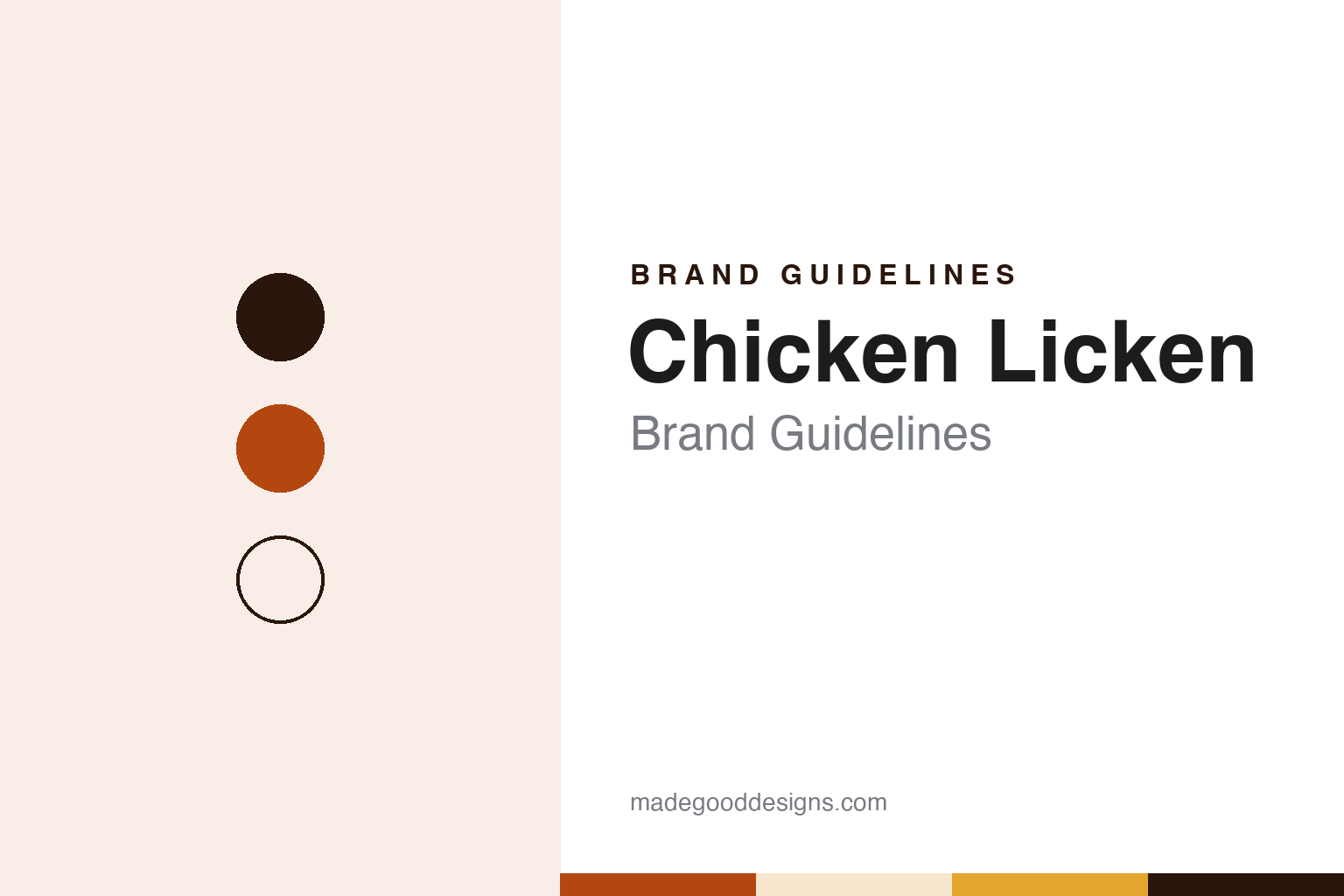
Chicken Licken Brand Guidelines
A 1981 Johannesburg roadhouse, hot wings and a logo kept for decades.
Aa
Two constants: a Chicken Licken hot orange, golden and brown palette and a Rounded sans register. Abstract homage — not a Chicken Licken product or mark; no menu item, logo or sign is reproduced.
The Dairy Den
A Johannesburg roadhouse and a fried-chicken recipe.
Chicken Licken is a South African fried-chicken chain founded in Johannesburg by George Sombonos. English Wikipedia says Sombonos learned the restaurant trade in the 1970s at the Dairy Den, his family’s roadhouse in Ridgeway, a suburb in the south of Johannesburg, and that he bought a fried-chicken recipe from the owner of a fast-food outlet in Waco, Texas, while touring the United States in 1972, then introduced it at the Dairy Den. The Sowetan, profiling him in March 2008, quoted Sombonos saying he mixed the spices under his bed at home before swapping the roadhouse’s chicken recipe for his own.
The roadhouse served customers the law of the time tried to keep out. The Sowetan reported that because the first shop stood on the road to Soweto, many of its customers were black, and that in 1975 Sombonos served black customers in their cars in contravention of apartheid legislation. English Wikipedia adds that in 1976 he brought the drive-through idea to the Dairy Den after seeing it at Wendy’s restaurants in the United States.
The first restaurant under the Chicken Licken name opened in 1981 on the Dairy Den site. Sombonos had planned to call the business Golden Fried Chicken, the Sowetan reported, until a waiter suggested Chicken Licken. English Wikipedia says the name is one of the names of the Henny Penny folk tale, about a little chicken who believes the sky is falling, and that Sombonos set up Golden Fried Chicken (Pty) Ltd in 1981 and registered Chicken Licken as its trading name. Golden Fried Chicken still owns the chain, TimesLIVE reported in March 2022.
Colour
Soweto, Alexandra and the townships.
Franchising began in the townships. English Wikipedia says that in 1982 Sombonos gave away the first two franchises, in Soweto and Alexandra, because the company was still unknown and he was unable to sell them; the Sowetan described those first franchises as a “desperate effort to expand” and reported that he began selling franchises in 1985. English Wikipedia says the chain’s presence in the townships during apartheid built its customer base among black South Africans, that unrest in the mid-1980s disrupted its township operations until 1991, and that after 1994 the company turned towards higher-income areas and shopping malls.
The restaurant counts have grown steadily. The Sowetan reported 220 stores in March 2008, of which 210 were franchised and ten company-owned. TimesLIVE gave about 250 outlets nationwide in March 2022, picturing the branch in Jabulani Mall, Soweto. English Wikipedia lists 18 outlets in Botswana as of 2021, and says outlets opened in several other African countries were later closed.
The menu is built around fried chicken. English Wikipedia says the company’s most popular product is its hot wings, introduced in 1992, and lists Soul Food, Full House, Hot Wings and Popcorn Chicken among its registered South African trademarks; TimesLIVE named the Family Full House Meal among the chain’s promotions in 2025. The chain’s chickens come from Rainbow Chicken and its fryers from Henny Penny, the American equipment maker, English Wikipedia says.
Typography
Design and documentation.
Burger, custard and chicken chains usually present themselves through a small set of fixed things: the name over the door, the shape of the building, the colours on the sign and the packaging, and a short list of named menu items that travel from one restaurant to the next. In the United States many of these chains began as a single family stand. Freddy’s opened in Wichita, Kansas, in 2002 under its founders’ father’s name, and Runza began in Lincoln, Nebraska, in 1949 with a sandwich that gave the company its name.
The menus are often the clearest part of the identity. A chain may be organised around one dish, as Runza is around its beef-and-cabbage bread pocket, or around a pairing, as Freddy’s was when its full name joined frozen custard and steakburgers with an ampersand. Smash burgers, biscuits, fried chicken and flame-grilled chicken play the same role for other chains in this group, in the United States, Singapore and South Africa, and each company publishes its own list of signature items.
Ownership varies widely. Some chains in this guide remain family businesses and say so on their corporate pages; others have passed to private-equity firms or to listed restaurant groups that run several brands at once. Where a chain has changed hands, the dates and buyers here come from trade press and company announcements, and any deal not completed is described as pending.
The restaurant networks are reported in the companies’ own terms: franchised or company-run, regional or international, counted on a stated date. Some chains say they keep close to home by choice, while others publish franchise maps that reach other countries. This guide gives those counts with their dates and sources, and treats colours and typefaces as an unofficial interpretation unless a source documents them.
Aa
A rounded sans — warm, informal and easy to read on a menu board. (Specimen set in Fredoka, a sans STAND-IN; NOT the Chicken Licken logo.)
Chicken Licken
A logo kept since 1981, and the word “soul.”
The identity has changed little. English Wikipedia says the restaurants and packaging have been updated and the menu changes every year, but the company logo has stayed the same since 1981. The brand’s voice lives mainly in television advertising. English Wikipedia says the early commercials were conceived by and starred the actor Joe Mafela, who wrote the “It’s good, good, good” jingle during a 1986 shoot, and that the account moved from Net#work BBDO to the agency Joe Public United in 2016.
Two later campaigns featured in a 2025 advertising ruling. TimesLIVE reported in June 2025 that the directorate of South Africa’s Advertising Regulatory Board had upheld a complaint by Chicken Licken that a KFC television advert released that May unfairly imitated its own work, and that the KFC advert had been withdrawn. Chicken Licken pointed to “I am Sbu,” a 2018 advert in which a science teacher builds a robot version of himself to stand in for him when he craves hot wings, and to an April 2024 advert for the Family Full House Meal starring a fictional athlete, Dave “Legs of Thunder” Mgijimi, who wins a race running backwards.
The word “soul” is the other constant. English Wikipedia says the company registered “soul” as a trademark in 1994, at first for food and later also for restaurant services, and has taken legal action against other businesses using the word. TimesLIVE reported in March 2022 that the company had lost a 2019 case in the Durban high court against a vegan café and a 2020 case in the Johannesburg high court against a Greek street-food business, which it took to the Supreme Court of Appeal, and that in 2022 the Cape Town high court had ordered a Plettenberg Bay restaurant, which had already changed its name, to remove two remaining mentions of the old one from its website.
For a design guide, Chicken Licken shows how a fast-food brand can keep one logo for more than four decades and let its advertising characters carry the personality. Compare KFC, which English Wikipedia names as one of its main competitors in South Africa, and Galito’s, another South African chicken chain. For this guide we use a hot orange, a golden yellow and a deep brown with a rounded sans, an unofficial interpretation; no product or logo is reproduced.
Explore & save
Keep Chicken Licken’s identity on hand — save it to a board in the Made Good inspiration library.
Chicken Licken identity set
Pin the Chicken Licken hot orange, golden and brown palette and the Rounded sans register to your own board.
Source & notes
Frequently Asked Questions
What font can I use to match the Chicken Licken look?
This guide describes Chicken Licken’s type as “A rounded sans — warm, informal and easy to read on a menu board”. Its type specimen is set in Fredoka from Google Fonts as a stand-in; Fredoka is not Chicken Licken’s own lettering.
What colours are in the Chicken Licken palette?
This guide’s Chicken Licken palette is Hot orange #B4470F, Crumb brown #2A160C, Batter cream #F8E6CF, Golden fry #E3A72F and Paper #FCF8F2. The tones are the guide’s own unofficial interpretation, not official Chicken Licken hex codes.
When was Chicken Licken founded?
Chicken Licken was founded in 1981, in Johannesburg, South Africa.
Who founded Chicken Licken?
Chicken Licken was founded by George Sombonos in 1981. Chicken Licken is known for Hot wings, Full House meals, TV adverts.
Who owns Chicken Licken?
Chicken Licken is owned by Golden Fried Chicken (Pty) Ltd.