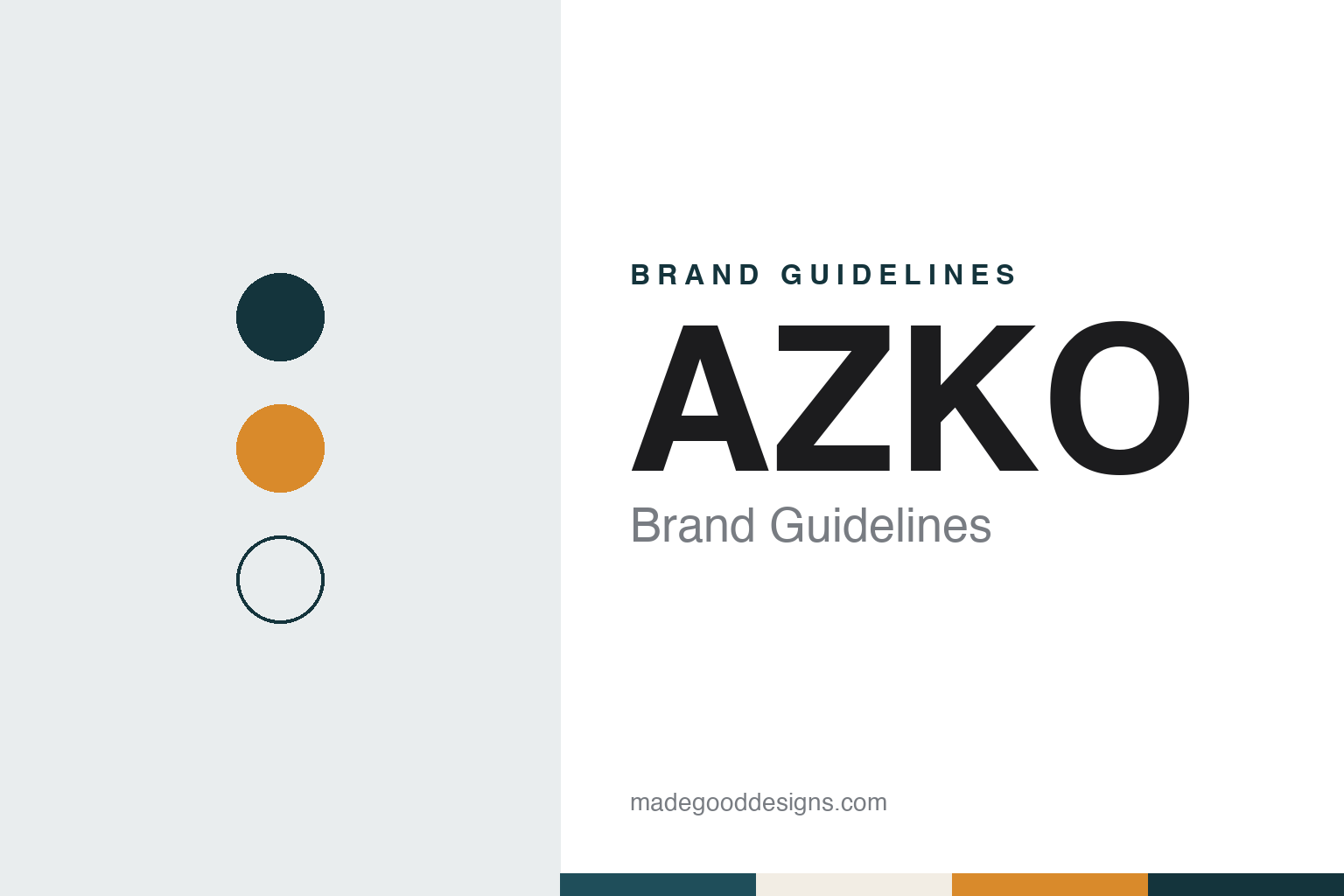
AZKO Brand Guidelines
The Jakarta home-improvement chain that gave up a licensed name and wrote its own, from A to Z.
Aa
Two constants: a deep teal, sand and turmeric palette and a geometric sans register. Abstract homage — not an AZKO product or mark; no sign, logo or store fitting is reproduced.
Kawan Lama Home Center
A tool trader’s family, a licence and a first store in Karawaci.
AZKO is a new name on an old business. The chain belongs to Kawan Lama Group, the Jakarta trading family whose story, Indonesian Wikipedia says, begins in 1955 with a tool shop of about two by three metres in Glodok, the old trading district of the capital. The family formalised the business as PT Kawan Lama Sejahtera in 1980 and spent the 1980s building a distribution network across Indonesia, the same source says, before reorganising its subsidiaries into a group in the mid-1990s.
The retail arm that became AZKO was set up in 1995 as PT Kawan Lama Home Center, according to Indonesian Wikipedia. It took a licence for the name of the American hardware chain Ace Hardware and in 1996 opened its first ACE Hardware store in Karawaci, in Tangerang on the western edge of Greater Jakarta. The company listed its shares on the Indonesia Stock Exchange in 2007, and in 2018 it added ACE Xpress, a smaller store format whose first branch also opened in Tangerang. By 2023, Indonesian Wikipedia says, the company ran 215 ACE Hardware stores and 18 ACE Xpress stores.
For almost three decades, then, the Indonesian chain traded under a borrowed name while being owned and run by an Indonesian group. Its stores carried the Ace name, but the company behind them was PT Ace Hardware Indonesia Tbk, a Kawan Lama business, not a branch of the American retailer. AZKO’s own website now describes those beginnings as the arrival of a franchise brand known for hardware, in a market where, the company says, modern retail concepts were still unfamiliar.
Colour
From ACE Hardware to AZKO, in two steps.
The change came in two stages. First the company changed its own name. At an extraordinary general meeting on 7 June 2024, shareholders renamed PT Ace Hardware Indonesia Tbk as PT Aspirasi Hidup Indonesia Tbk, the business daily Kontan reported on 1 January 2025. The reason, Kontan said, was that management had decided not to continue its licence agreement with ACE Hardware International Holdings, a partnership that had run for 29 years. The company kept its stock-market code, ACES.
Then the stores changed. From 1 January 2025 the shops that had been ACE Hardware became AZKO. Kontan quoted the company explaining the name as a promise of a range from A to Z, made up of products, services and ideas for the home; the company also pointed to its 30 years of serving Indonesian families. The company also said that, unlike the licensed name, AZKO was a brand it could develop fully as its own.
The physical change came store by store. On 9 January 2025 detikFinance reported, from a launch at Living World mall in Alam Sutera, Tangerang, that two stores had been rebuilt in the new format: AZKO Living World Alam Sutera and AZKO Kelapa Gading in North Jakarta. A company director described the new layout to detikFinance as a “Next-Gen” store, with themed inspiration zones, a children’s play area, and digital screens linking the shop floor to online ordering. He contrasted it with the old ACE Hardware displays, which, he said, had mostly shown discounts and the goods themselves.
The Ace name did not vanish from Indonesia for long. In August 2026 the news site Katadata reported that PT Mitra Adiperkasa Tbk, the retail group known as MAP, had brought Ace Hardware back to the country, opening its first store under the name at Sunter Mall in North Jakarta at the end of July 2026. MAP told investors that the American licensor approached it after Kawan Lama decided not to renew, Katadata said. Indonesia therefore now has two separate chains with a shared history: AZKO, the former licensee under its new name, and a new Ace Hardware run by a different group.
Typography
Signs, own labels and owners.
Home-improvement and hardware chains speak to two audiences at once: households fixing, painting or refitting a room, and builders, trades and small contractors buying in bulk. Many chains answer that split with separate store formats under one name. In Chile, Sodimac runs a Homecenter format for home projects and decoration and a Constructor format for building professionals, and its first store in Mexico combined both under one roof in 2018, according to Gestión.
The store sign carries most of the identity. A chain’s name sits on a large warehouse façade, often beside a car park and a drive-in yard for heavy materials, and the same mark then reappears on aisle signs, trolleys, staff aprons and delivery trucks. Own-label ranges, trade-loyalty schemes and tool-hire counters are usually named as part of that same system, so the house style has to work from a billboard down to a shelf label.
Ownership shapes how these brands present themselves. Some began as co-operatives of builders or independent hardware dealers, and some still describe that member or dealer structure on their corporate pages; others belong to large retail groups that also run supermarkets, department stores and shopping centres, and that publish their store networks country by country. Sodimac belongs to Falabella and Easy to Cencosud, two Chilean retail groups whose home-improvement chains have competed in Chile since the 1990s, Peru Retail reported in November 2026.
Corporate history pages are where these companies tell their own story: the founding co-operative, the family or group that took control, the first store abroad. Read as a set, the chains in this series show how one category, from Latin America to North America, Asia, New Zealand and Europe, adapts a shared warehouse model to local ownership and local habits.
Az
A clean geometric sans for a name built from the first and last letters of the alphabet. (Specimen set in Plus Jakarta Sans, a sans STAND-IN; NOT the AZKO logo.)
AZKO
A group of shops, and a family of brands.
AZKO sits inside a wider group. Indonesian Wikipedia lists PT Aspirasi Hidup Indonesia as owned by PT Kawan Lama Sejahtera, with its head office in Jakarta, and names its retail brands as AZKO, ATARU, Pendopo, Toys Kingdom and NEKA. Other Kawan Lama companies, Indonesian Wikipedia says, include the furnishings business Informa, the toy retailer Toys Kingdom and several tool and welding suppliers.
The group also has its own labels. The clearest documented example is Krisbow, a Kawan Lama label for technical tools, machinery, workshop and household equipment that Indonesian Wikipedia dates to 1997–1998, when the group created it as an alternative product line during Indonesia’s monetary crisis of those years. The name comes from that of one of the family’s owners. Indonesian Wikipedia says the brand has no factory of its own and imports its goods from factories in several countries, and that by 2017 it covered more than 10,000 tool products.
Where AZKO’s goods are made is therefore a question of sourcing rather than manufacturing: the chain is a retailer, and the group’s Krisbow label is made for it by outside factories, according to Indonesian Wikipedia.
The brand itself is young. Its name and its new store layout date from 2025, while the business behind them dates from 1995. That pairing — a three-decade operator with a new shopfront identity — is what makes AZKO a useful case: a familiar sign had to be replaced across a network of about 245 stores, which the company chose to refit over three years rather than all at once.
For a design guide, AZKO shows how a licensee can turn a borrowed retail name into a name of its own without changing who runs the stores. Compare Ace Hardware, the American co-operative whose name the chain carried until 2024, and Wilcon Depot, another home-improvement chain in South-East Asia. For this guide we use deep teal, warm sand and a turmeric accent with a geometric sans, an unofficial interpretation; no product or logo is reproduced.
Explore & save
Keep AZKO’s identity on hand — save it to a board in the Made Good inspiration library.
AZKO identity set
Keep the deep teal, sand and turmeric palette and the geometric sans register for your own home-retail board.
Source & notes
Frequently Asked Questions
What font can I use to match the AZKO look?
This guide describes AZKO’s type as “A clean geometric sans for a name built from the first and last letters of the alphabet”. Its type specimen is set in Plus Jakarta Sans from Google Fonts as a stand-in; Plus Jakarta Sans is not AZKO’s own lettering.
What colours are in the AZKO palette?
This guide’s AZKO palette is Deep teal #1F4E5A, Harbour ink #14343C, Warm sand #F2EDE4, Turmeric #D98A2B and Paper #FAF8F4. The tones are the guide’s own unofficial interpretation, not official AZKO hex codes.
When was AZKO founded?
AZKO was founded in 1995 (as PT Kawan Lama Home Center), in Indonesia.
Who owns AZKO?
AZKO is owned by Kawan Lama Group (via PT Kawan Lama Sejahtera).


