Osheaga Brand Guidelines
Montréal’s island music and arts festival.
Aa
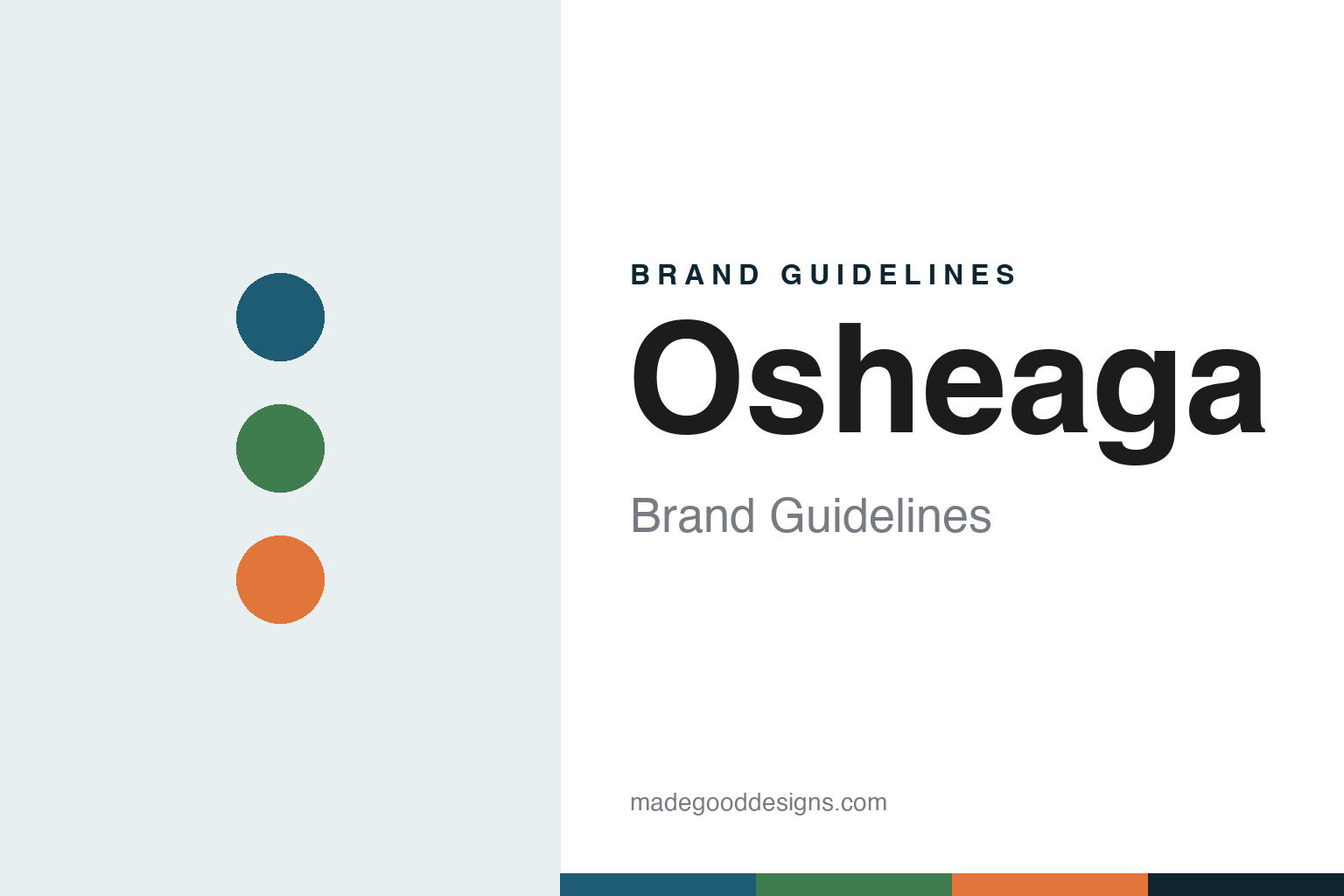
Two constants: a river blue, park green and sunset orange palette and a festival sans register. Abstract homage — not an Osheaga asset or mark; no logo, poster or wristband is reproduced.
An island festival
Labour Day weekend, 2006, on Île Sainte-Hélène.
Osheaga is a music and arts festival held each summer at Parc Jean-Drapeau, on Île Sainte-Hélène in the St. Lawrence River at Montréal. Its first edition took place on 2 and 3 September 2006, over the Labour Day weekend. English Wikipedia, citing Montreal Gazette reporting from 2006, says the event was presented by Nick Farkas, then a concert buyer at Gillett Entertainment Group, a Montréal promoter started in 2002 during George N. Gillett Jr.’s ownership of the Montreal Canadiens. In a July 2026 interview, Pollstar described Farkas as the festival’s co-founder and a senior vice-president of evenko.
The name reaches back to the earliest written record of the island. English Wikipedia, citing The Canadian Encyclopedia and a 2014 Montreal Gazette column, links “Osheaga” to Hochelaga, the St. Lawrence Iroquoian settlement that Jacques Cartier recorded on the island of Montréal. Linguists have read the word as meaning “beaver path” or “big rapids,” after the nearby Lachine Rapids, it says, while a reading favoured in the Mohawk community of Kahnawake gives “people of the hands.”
The festival grew in steps. French Wikipedia says the first two editions ran on the Labour Day weekend in September and that, since 2008, Osheaga has been held at the very end of July or the start of August. According to English Wikipedia, 2011 was the first edition to add a Friday, making it a three-day event, and a sixth stage, the Valley Stage, was added in 2014. The opening bill in 2006 was headed by Sonic Youth, English Wikipedia says, alongside a long list of Canadian and international independent acts.
The organiser changed its name rather than its people. After the sale of Gillett Entertainment Group, the company became evenko in 2010, English Wikipedia reports, citing The Canadian Press of 25 March 2010, and Osheaga has been produced by evenko since then, with Farkas still at its head. English Wikipedia describes evenko as owned by Groupe CH, the ownership group of the Montreal Canadiens, and French Wikipedia lists evenko (Groupe CH) as the festival’s parent organisation. In 2019 evenko entered a strategic partnership with Live Nation, Pollstar reported in 2026; English Wikipedia dates the announcement to December 2019.
Colour
River, mountain, trees and valley.
Osheaga’s identity is tied to its site. The festival sits on an island park across the water from downtown Montréal, and in his 2026 Pollstar interview Farkas described the original plan as taking “what makes Montreal great” — food, music, art and culture — and putting it on the island as “a microcosm of Montreal.” He called it “an urban festival” that is “not actually in the city.”
The stages carry landscape names. English Wikipedia, translating from the festival’s French names, lists the River Stage, Mountain Stage, Green Stage, Trees Stage and Valley Stage, plus a stage run with Piknic Électronik, the weekly electronic-music event held at the same park in summer; each performance area is paired with a sponsor. Emerging artists play shorter sets and headliners close each day, it adds. French Wikipedia notes that Osheaga has been presented in close collaboration with the MEG festival since its beginnings, and that its programme has included shows and exhibitions in venues around the city in the weeks before the main weekend.
The park build is shared. Pollstar reported in July 2026 that evenko uses the same infrastructure for other events on the site, among them the Lasso country festival and the ÎleSoniq electronic festival, which run on the weekends around Osheaga, and Farkas put the festival’s sell-out at 50,000 people a day. The 2026 edition, the festival’s 19th, ran from 31 July to 2 August 2026, with Lorde, Tate McRae and Twenty One Pilots at the top of the bill, Pollstar reported.
There were gaps. The editions planned for 2020 and 2021 were cancelled, English Wikipedia says. In October 2021 evenko held a smaller event of Canadian artists, the Osheaga Get Together, and the full festival returned to the park from 29 to 31 July 2022.
Typography
How festivals present themselves.
A music festival’s identity is built from a few public pieces: its name, its logo, the poster that announces each year’s line-up, the wristband or ticket that gets a visitor through the gate, and the signs and stage names on site. Many festivals take their names from a place, a park or a town, and keep them for decades; Reading Festival has been tied to Richfield Avenue in Reading since 1971, and Download Festival to Donington Park since 2003. Some names have carried a sponsor for a time, as the Reading and Leeds events did when they were billed as the Carling Weekend from 1998 to 2007.
Line-up posters are the most repeated graphic of a festival year. They list the acts in tiers, with the headliners at the top, and are revised as new names are added in waves. Stage names work as a second layer of branding: festivals name stages after sponsors, broadcasters, genres or invented themes, and rename them when a site is redesigned, as Reading and Leeds did in 2026 when the Main Stage became the Grid.
Mascots and recurring characters give some festivals a mark that travels beyond the logo. Download’s dog mascot appears on tickets, stage banners, merchandise and the festival website, according to English Wikipedia. Other festivals rely on a consistent colour, a wordmark or a site landmark instead.
Ownership is part of the picture, and it is usually set out plainly on corporate pages and in the trade press. Some festivals are run by small independent teams; others belong to promoters and groups such as Festival Republic and Live Nation, whose own pages describe their founders, organisers and history. This guide sets out what dated sources say about each festival’s founding, sites and organisers, and marks clearly what rests only on the organisers’ own word.
Aa
A bold festival sans for an island event. (Specimen set in Archivo, a sans STAND-IN; NOT the Osheaga logo.)
Osheaga
A music and arts festival in two languages.
Osheaga has described itself as more than a concert from the start. English Wikipedia says the first edition called itself a “music and arts festival,” and French Wikipedia gives the full French name as the Festival musique et arts Osheaga. The company description of evenko quoted on English Wikipedia sets the name in capitals, as the “OSHEAGA Music and Arts Festival,” one of several events evenko says it creates and produces, including îLESONIQ and LASSO Montréal; the same description says evenko manages venues such as the Bell Centre in Montréal and Place Bell in Laval.
For a designer, the material is one of place. The name points to the island’s earliest recorded history, the stage names point to river, mountain, trees and valley, and the venue looks back across the water at the city. A 2012 photograph on English Wikipedia shows a crowd gathered behind large free-standing letters spelling the festival’s name, with the Montréal skyline beyond. The festival’s names exist in French and English, as the two Wikipedia editions show, and the stage names are given in both languages.
Its calendar is part of the identity too. Held on the Labour Day weekend for its first two years and at the turn of July and August since 2008, Osheaga sits in the middle of the Montréal summer, and Pollstar noted in 2026 that it shares its weekend with Lollapalooza in Chicago.
For a design guide, Osheaga shows how a festival can build an identity from a place name and a site: a name drawn from the island’s first recorded settlement, landscape-named stages and an island park facing a city skyline. Compare Lollapalooza, held the same weekend in Chicago, and Splendour in the Grass in Australia. For this guide we use a river blue, a park green and a sunset orange with a sans, an unofficial interpretation; no product or logo is reproduced.
Explore & save
Keep Osheaga’s identity on hand — save it to a board in the Made Good inspiration library.
Osheaga identity set
Pin the Osheaga river blue, park green and sunset orange palette and the festival sans register to your own board.
Source & notes
Frequently Asked Questions
What font can I use to match the Osheaga look?
This guide describes Osheaga’s type as “A bold festival sans for an island event”. Its type specimen is set in Archivo from Google Fonts as a stand-in; Archivo is not Osheaga’s own lettering.
What colours are in the Osheaga palette?
This guide’s Osheaga palette is River blue #1D5C73, Park green #3F7D4E, Sunset orange #E2763A, Night water #0F2630 and Summer paper #F6F2EA. The tones are the guide’s own unofficial interpretation, not official Osheaga hex codes.