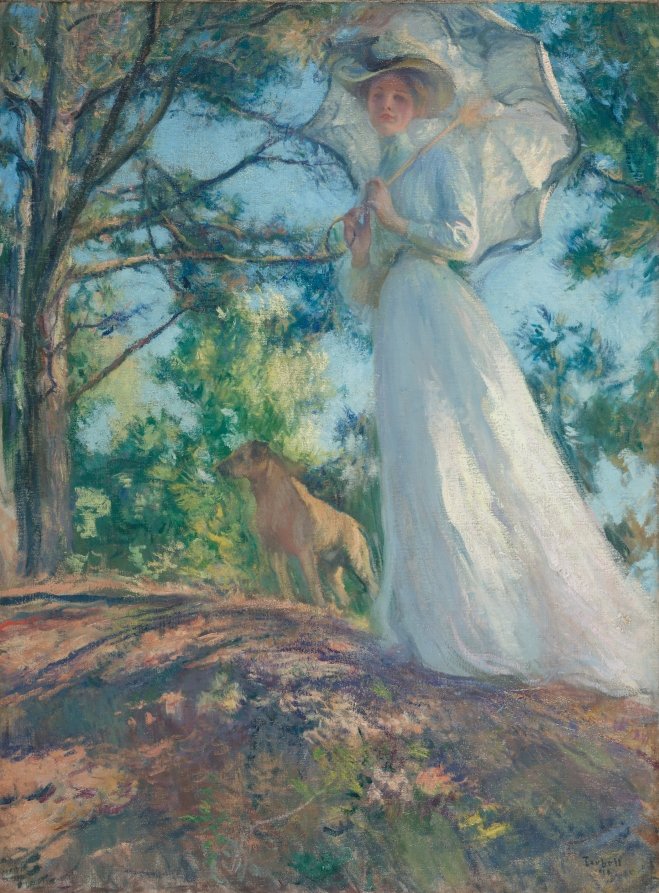
Edmund Tarbell painted the people closest to him in strong daylight and in quiet rooms, and he did it with a designer’s control of value and edge. His outdoor pictures turn a white dress into a field of blue, sage and cream; his interiors place figures and furniture with the care of a page layout. The one image here is released as CC0 by the Cleveland Museum of Art, and more public-domain paintings are gathered in the MGD museum inspiration collection.
Edmund Tarbell in brief
The Metropolitan Museum of Art, the Cleveland Museum of Art and the National Gallery of Art all record Tarbell as American and give his life as 1862 to 1938. He taught in Boston, at the school of the Museum of Fine Arts, and the Cleveland Museum of Art notes that he was a popular art professor whose followers were nicknamed “Tarbellites”.
He belonged to the Ten American Painters, a group of American artists working in an Impressionist manner who first exhibited together in 1898, according to the Vose Galleries biography of his friend and colleague Frank Weston Benson and the Smithsonian American Art Museum. The National Gallery of Art’s bibliography for Tarbell reflects that context, listing Patricia Jobe Pierce’s books The Ten (1976) and Edmund C. Tarbell and the Boston School of Painting (1980), and Carol Lowrey’s essay on him in the 1990 Spanierman Gallery catalogue Ten American Painters.
In 1912, according to the Vose Galleries and Annex Galleries biographies of Benson, Tarbell and Benson resigned from the Museum School after a dispute with its administration. The two stayed linked: the National Gallery lists a joint exhibition catalogue, Frank W. Benson; Edmund C. Tarbell: Exhibition of Paintings, Drawings, and Prints, published by the Museum of Fine Arts, Boston, in 1938. Benson’s own outdoor pictures are covered in our guide to Frank Weston Benson, and the wider movement in our guide to impressionism.
What to look at: a figure staged against light
On Bos’n’s Hill, dated 1901, is a good place to start. The Cleveland Museum of Art explains that Bos’n’s Hill, in New Castle, New Hampshire, was a favourite leisure spot for Tarbell’s family, which included four children, and that the painting shows his wife, Emeline, walking with a parasol and a pet dog. Four years later, the museum adds, the couple bought a summer house nearby.
Look at the structure before the brushwork. The canvas is upright, about 106 by 78 centimetres unframed according to Cleveland, and the figure takes the right-hand side from the parasol near the top edge to the hem near the bottom. A dark tree trunk holds the left edge, and the dog sits between them in the middle distance, small and warm against the green. Three verticals of different weight, light figure, dark trunk and small mid-tone dog, give the picture its balance.
The viewpoint is low. We look up at the woman, so she is set against sky and foliage rather than ground, and the sloping bank of the hill runs as a diagonal from lower left towards her feet. Poster designers use the same trick: shot from below against clean sky, a subject gains height.
Colour: whites built from blue, sage and cream
The dress is the subject of the colour. Measured from the museum’s scan of this painting, it is almost never white. The lightest values are warm creams (#dad9cb, #cccbc0), the mid-tones move into sage and blue-grey (#b0bbb7, #9aa9ab), and the folds in shadow drop to a cool slate (#7a99a0). Sunlight is suggested by the jump between the cream and the blue-grey, not by pure white paint.
The setting repeats those cool notes and adds warmth underfoot. Measured from the same scan, the sky sits between a soft aqua (#88b4bc) and a deeper teal (#6c979b), the darkest foliage reaches #3a4f54, and the ground is a family of muted browns and mauve-greys (#8b7e6f, #665f5c) broken by flecks of pink and yellow where light falls through the trees. The result is a palette with one clear temperature split: cool above, warm below, and the figure as the bridge.
For designers, the lesson is that a “white” background often works harder as a tinted neutral, and that a light subject can read more clearly when its shadow side is a distinct cool hue rather than a darker grey. You can pull these values from the scan yourself with our image colour picker.
Interiors: composing a quiet room
Tarbell is also known for indoor pictures. The Met dates Across the Room to about 1899 and catalogues it under interiors and women; it is a horizontal canvas of about 63.5 by 76.5 centimetres. The National Gallery of Art holds three later oils of figures at home: Josephine and Mercie (1908), Josephine Knitting (1916) and Mother and Mary (1922). The Met also has a still life, Vase of Peonies, dated about 1925.
The National Gallery’s records add useful context about how these pictures circulated. Josephine and Mercie was bought by the Corcoran Gallery of Art in Washington in 1909, a year after it was painted. Josephine Knitting was shown in the Corcoran’s sixth exhibition of oil paintings by contemporary American artists in 1916–17 and bought from it in 1917. Mother and Mary is large, about 112 by 128 centimetres, and was purchased in 1923.
The titles describe a method: sitters named by first name, absorbed in knitting or sitting together. Read them as a brief for calm imagery: one or two figures, one activity, a few chosen objects, and interest that comes from placement and light rather than drama.
Technique and signature
All of the works named here are oil on canvas, according to the museum records. In On Bos’n’s Hill the handling changes with the subject. The dress is laid in long, fluid strokes that follow the fall of the fabric; the foliage is broken into short dabs of blue and green; the ground is scumbled with small patches of pink, violet and ochre so that it flickers like light through branches. Edges are softest where light is strongest, around the parasol and the shoulders, and firmest where the dark trunk meets the sky.
Look at the lower right corner of the Cleveland scan and you will find the signature, a small painted “Tarbell” set into the shadowed ground. The National Gallery records the same habit: Mother and Mary is inscribed “Tarbell.22.” at lower right, and Josephine and Mercie “Tarbell” at lower right. It is a modest mark, placed where it does not compete with the figure, which is a useful model for how to sign or credit a design: consistent position, small scale, colour taken from the surrounding area.
Tarbell’s reputation was also built in print. The National Gallery lists an article by Philip Leslie Hale, “Edmund C. Tarbell, Painter of Pictures”, published in Arts and Decoration in February 1912.
How designers can borrow from Edmund Tarbell today
Build whites from colour. Pick a warm cream for the light side and a sage or blue-grey for the shadow side of any light element, and keep pure white for small highlights only. The On Bos’n’s Hill dress shows how much light a tinted palette can suggest. For more ideas in the same key, see our collection of vintage colour palettes.
Split the temperature. Cool at the top, warm at the bottom, as in the sky and ground of the Cleveland painting. In a layout, a cool header band over a warm base area gives a calm sense of daylight.
Stage one figure against open space. Shoot or draw from slightly below, place the subject to one side, and balance it with a single dark vertical on the other.
Use soft edges where light is strongest. In illustration or photo retouching, let the brightest edges dissolve a little and keep hard edges for the dark accents.
Keep marks quiet. Place logos, credits and signatures in a consistent corner, small, in a colour drawn from the area around them.
Frequently asked questions
Who was Edmund Tarbell?
An American painter (1862–1938) who taught at the school of the Museum of Fine Arts, Boston, and belonged to the Ten American Painters. He painted sunlit figures outdoors, quiet interiors, portraits and still lifes.
What is the Boston School of painting?
A name for the polished figure painting associated with Tarbell, Frank Weston Benson and their students in Boston around 1900, with a strong interest in daylight and interiors. Patricia Jobe Pierce’s 1980 book, listed by the National Gallery of Art, uses the term in its title.
Who were the Tarbellites?
The nickname for Tarbell’s students and followers in Boston, according to the Cleveland Museum of Art, which describes him as a popular art professor.
Where can I see Edmund Tarbell’s paintings?
Museums holding his work include the Cleveland Museum of Art (On Bos’n’s Hill, 1901), the Metropolitan Museum of Art (Across the Room, about 1899) and the National Gallery of Art (Josephine and Mercie, 1908, and Mother and Mary, 1922).