Tour Championship Brand Guidelines
The PGA Tour’s season finale, at East Lake since 2004.
Aa
Two constants: a green, brick and silver palette and a clubhouse serif register. Abstract homage — not a Tour Championship asset; no trophy, logo or mark is reproduced.
Thirty players
A season finale since 1987.
The Tour Championship, which its organiser writes as “TOUR Championship,” is the PGA Tour’s end-of-season tournament. English Wikipedia dates it to 1987, when it was played at Oak Hills Country Club in San Antonio, Texas, and describes a field limited from the start to 30 players: until 2006, the top 30 money winners on the PGA Tour after the penultimate event of the season. It was held in early November then, the week after the Volvo Masters in Europe, so that players who were members of both tours could play both season finales.
For its first decade the event moved from course to course. English Wikipedia lists venues including Pebble Beach Golf Links in 1988, Pinehurst No. 2 in 1991 and 1992, the Olympic Club in San Francisco and Southern Hills in Tulsa. From 1997 it alternated between Champions Golf Club in Houston and East Lake Golf Club in Atlanta, which first hosted it in 1998, and since 2004 East Lake has been its permanent home.
East Lake brings its own history. English Wikipedia says the Atlanta Athletic Club bought the property in 1904 and had Tom Bendelow lay out the course, which Donald Ross redesigned in 1913; after a fire destroyed the original clubhouse in 1925, the architect Philip Shutze designed the two-storey Tudor-style clubhouse that stands today. The club hosted the Ryder Cup in 1963. It was also the home course of Bobby Jones, who, as Atlanta News First recalled in August 2026, completed golf’s original Grand Slam in 1930 by winning the British Amateur, the British Open, the U.S. Open and the U.S. Amateur in the same calendar year.
Colour
FedEx Cup and format changes.
The biggest change came in 2007, when the PGA Tour created the FedEx Cup play-offs. English Wikipedia says the Tour Championship moved from November to mid-September and became the last of four play-off events, with its 30 players now chosen by FedEx Cup points rather than by prize money. From 2007 to 2018 the week produced two champions, the winner of the tournament and the leader of the season-long points race, as ESPN summed it up in May 2025. A schedule realignment in 2013 made it the final event of the PGA Tour season, and from 2019 the play-offs were cut to three events and the finale moved to late August, according to English Wikipedia.
The course was rearranged for the event too. From 2016 the PGA Tour reversed the nines at East Lake so that the Tour Championship finishes on a par 5 rather than on the club’s closing par 3, English Wikipedia says, citing a PGA Tour announcement made that year.
In 2019 the tour introduced starting strokes: the FedEx Cup points leader began the week at ten under par and the rest of the field started on a sliding scale behind, so that the winner of the tournament would also be the FedEx Cup champion. ESPN reported on 27 May 2025 that the PGA Tour had dropped that format, with its player advisory council and policy board approving the change. From the 2025 edition at East Lake, held from 21 to 24 August, all 30 players started at even par, and the winner after 72 holes took the FedEx Cup and a five-year PGA Tour exemption, ESPN reported.
The trophy draws directly on East Lake’s history. English Wikipedia describes the Calamity Jane trophy as a sterling silver replica of Bobby Jones’s putter of that name, presented to the winner since 2005 and made the tournament’s official trophy in 2017, with earlier winners given one retroactively.
Typography
Tournaments, venues and formats.
Professional golf tournaments and team cups present themselves through a small set of recurring elements: an event name, often joined to a title sponsor’s name, a trophy, a host course and a date in the season’s calendar. The organiser behind each event is usually named plainly, whether a professional association, a tour or a governing body, and sponsors and organisers can change over the decades while the event name carries on.
Trophies do much of the visual work. Many events are identified with a single cup that passes from one champion to the next, with a smaller replica kept by the winner, and the trophy’s history, from its donor to its travels, often becomes part of the event’s own story. Team cups add the colours of the sides that contest them.
The course is the other constant. Some events rotate between host clubs, so their identity has to travel from venue to venue; others have a permanent home, where a single hole, a clubhouse or a stretch of water becomes the image most closely tied to the event. On site, the look carries through tee markers, flags, scoreboards, grandstands and hospitality areas, all sharing the event’s name and colours during tournament week.
The events’ own histories are written as dated records: the year and venue of the first edition, changes of format such as the move from match play to stroke play, changes of date in the calendar, and the list of past host courses. This guide sets out what can be checked about each event from dated sources — who organises it, where it is played and how its format has changed — and describes the identity in words, with an unofficial palette and stand-in typefaces rather than any official mark.
Aa
A clubhouse serif for a 1904 course. (Specimen set in Libre Caslon Text, a serif STAND-IN; NOT the Tour Championship logo.)
Tour Championship
One club, two decades, changing rules.
The tie to East Lake has given the tournament its most constant setting for two decades. Atlanta News First noted on 26 August 2026 that the 2026 edition would crown a FedEx Cup champion at East Lake for the 23rd consecutive year.
The name itself is plain. The tournament’s name refers to the tour rather than to a city, a host club or a founder, and the organiser writes it with “TOUR” in capitals. Much of its visual character has therefore come from its setting rather than from its title: the 1904 course, the Tudor-style clubhouse, and a trophy shaped like the putter of Bobby Jones, the club’s home player.
Its format has changed more often than its home. In under four decades it has gone from a money-list finale in November, to the last of four FedEx Cup play-off events in September, to a three-event postseason ending in August, to the starting-strokes experiment of 2019 and back to a level start in 2025. Each change altered what the week meant, from a closing tournament to the deciding round of a points race, while the 30-player field stayed the same size throughout.
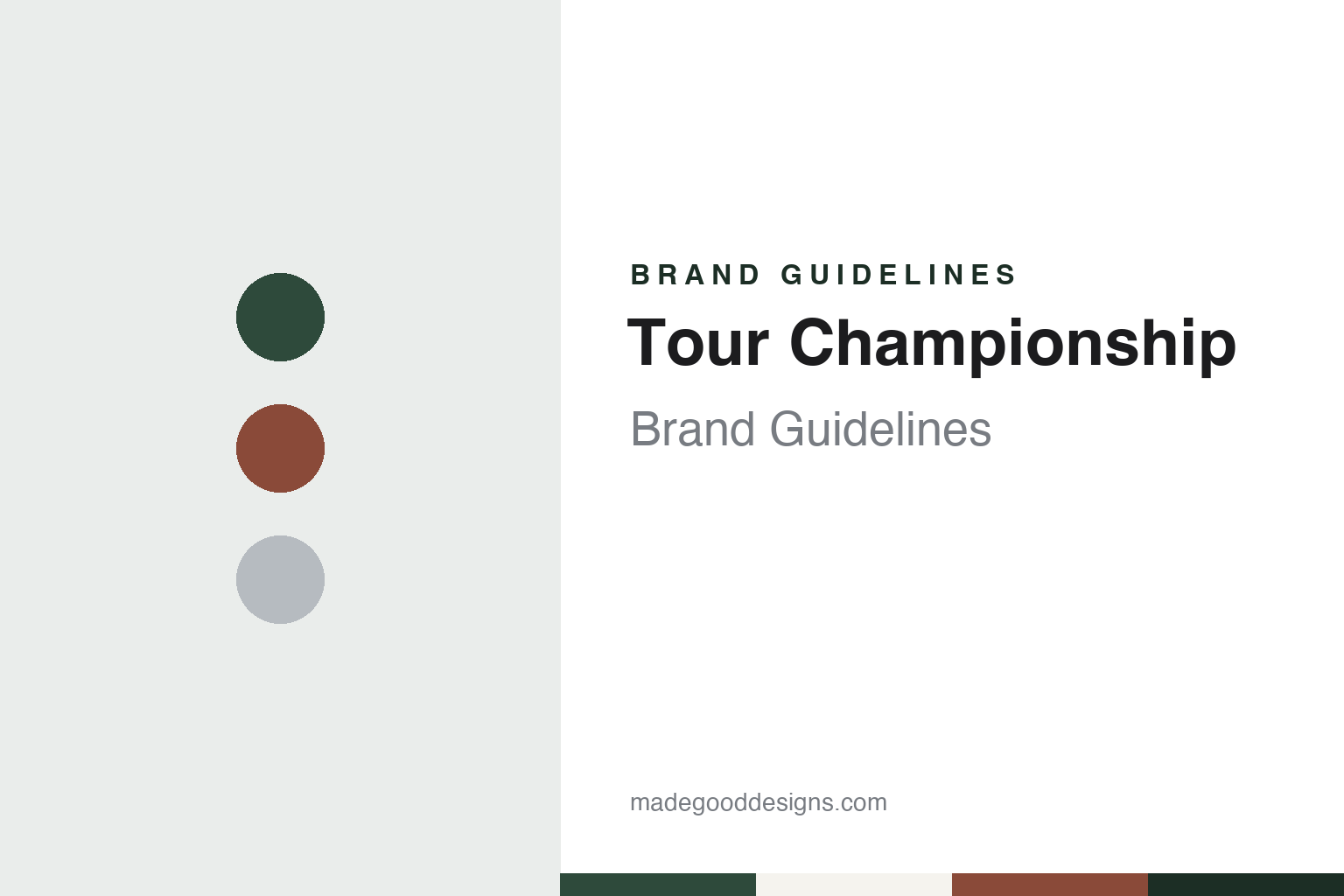
For a design guide, the Tour Championship shows how a season finale can borrow a club’s heritage — an early course, a Tudor clubhouse and a putter-shaped trophy — while the rules of the competition change around it. Compare the PGA Tour, which organises it, and The Players Championship, the tour’s event at TPC Sawgrass. For this guide we use a deep green, a brick red and a silver grey with a serif, an unofficial interpretation; no product or logo is reproduced.
Explore & save
Keep Tour Championship’s identity on hand — save it to a board in the Made Good inspiration library.
Tour Championship identity set
Pin the green, brick and silver palette and the clubhouse serif register to your own board.
Source & notes
Frequently Asked Questions
What font can I use to match the Tour Championship look?
This guide describes Tour Championship’s type as “A clubhouse serif for a 1904 course”. Its type specimen is set in Libre Caslon Text from Google Fonts as a stand-in; Libre Caslon Text is not Tour Championship’s own lettering.
What colours are in the Tour Championship palette?
This guide’s Tour Championship palette is East Lake green #2E4A3B, Deep pine #1C2E25, Clubhouse brick #8A4A39, Putter silver #B6BBC0 and Paper #F5F3EE. The tones are the guide’s own unofficial interpretation, not official Tour Championship hex codes.
Where is Tour Championship based?
Tour Championship is based in East Lake Golf Club, Atlanta (since 2004).