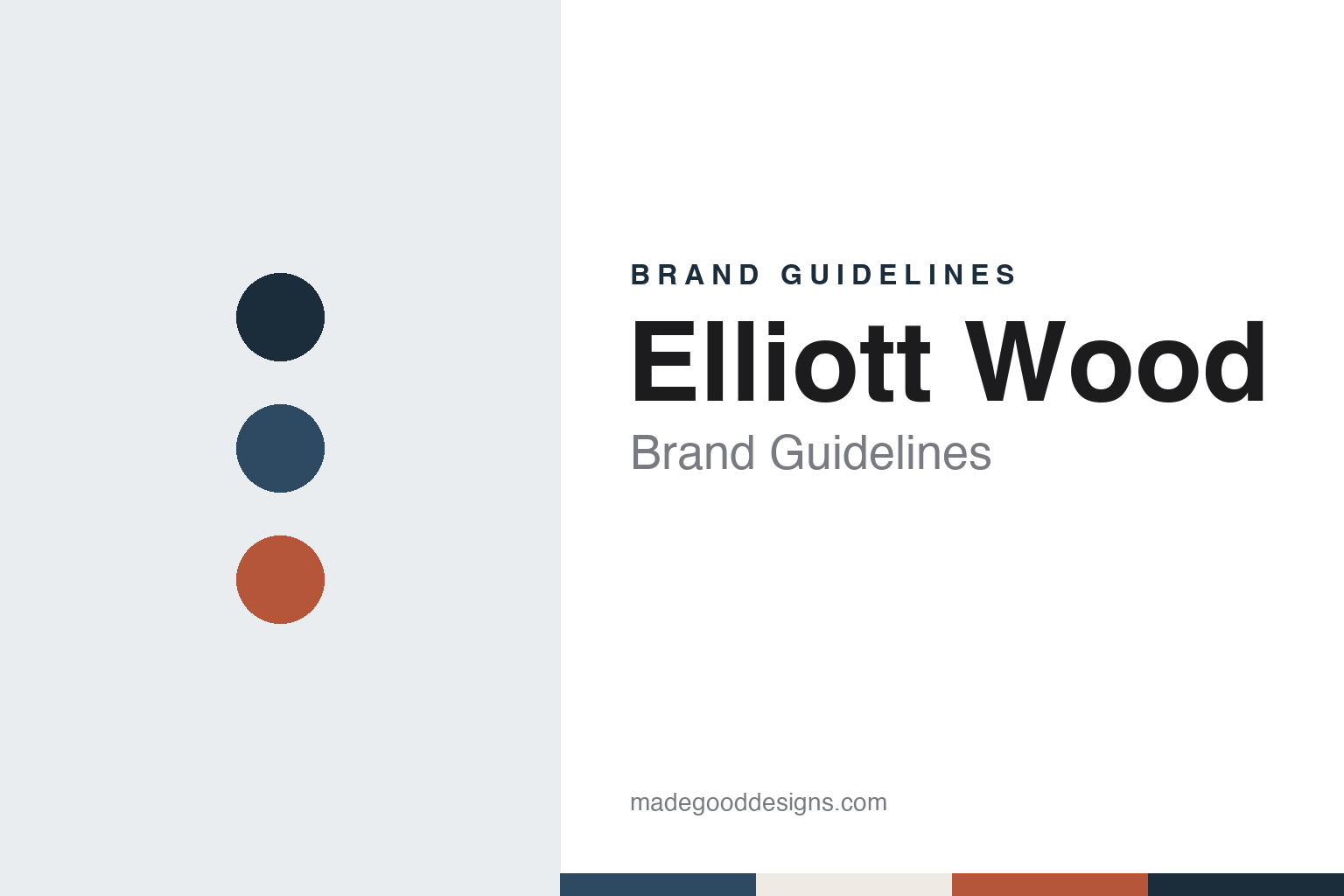
Elliott Wood Brand Guidelines
The London structural engineers founded in 1994.
Aa
Two constants: an Elliott Wood blue, stone and brick palette and an Archive serif register. Abstract homage — not an Elliott Wood drawing or mark; no structure, logo or project image is reproduced.
Two names on the door
A practice founded in 1994.
Elliott Wood is a structural and civil engineering practice founded in 1994 by Gary Elliott and Paul Wood, according to English Wikipedia; the practice takes its name from the two founders. Its own website says it has been working “for over 30 years,” which matches that date, and lists Gary Elliott as chief executive and founder. Project credits in the architecture press often give the longer form, Elliott Wood Partnership.
The practice works from three offices. Its website gives contact numbers for Fitzrovia in central London, Wimbledon in south-west London and Nottingham. English Wikipedia describes the same three locations and gives a staff of about 140 across them. The website’s team page lists a chief operating officer, a group of board directors including Lisa Drake, and team directors who lead structural engineering, sustainability, development infrastructure and digital work.
Its services have widened from the structural engineering in its original description. The website now lists five: structural engineering, sustainability consulting, digital and BIM services (building information modelling), development infrastructure, which brings together transport planning, highways, civil engineering, flood risk and water management, and conservation and heritage. English Wikipedia notes work on historic buildings and on sculptures and glass structures, alongside housing, offices, hotels, schools and cultural buildings in the United Kingdom and abroad.
The name needs one note of care: English Wikipedia also has an entry for a nineteenth-century army officer called Elliott Wood, who has no connection with the practice.
Colour
Houses, homes and workspaces.
Much of the practice’s published work appears through the architects it works with. In October 2008 Dezeen published the House on Swain’s Lane in north London by Eldridge Smerin, a house that replaced an earlier one on the site, and listed Elliott Wood Partnership as structural engineer, alongside a concrete consultant and a services engineer. In September 2019 the magazine published Belle Vue, a brick-clad retirement housing scheme in Hampstead by Morris+Company, again with Elliott Wood credited as structural engineer.
Some projects put the engineering closer to the front of the story. In March 2022 Dezeen reported on The Hithe in Rotherhithe, a demountable community space and incubator for start-ups by the architecture studio IF_DO, commissioned by Southwark Council to occupy a vacant site for up to 11 years. The magazine said its simple timber and steel frame was developed with structural engineer Elliott Wood and fabricator Weber Industries, and sits on foundations left from the site’s earlier uses. The scheme holds 12 workspace units, a central gathering area, a kitchen and a yard on the north side, and Dezeen reported that it was designed to avoid looking temporary, with green-painted timber cladding and two large lantern windows.
Material choices have also drawn press attention. In July 2024 Dezeen quoted James Souter, a director at Elliott Wood, on cement-stabilised rammed earth, which he had used on several projects; the magazine described how adding cement allowed monolithic walls with the textured, layered surface of rammed earth, without the large overhanging roof a raw earth wall would usually need in the United Kingdom.
The practice presents its own recent work in the same material terms. For 30 Duke Street St James’s, an office building by Make Architects for the developer GPE, it says it is providing structural, sustainability and BIM services, and that about 78 per cent of the steel structure, some 440 tonnes, was formed from reclaimed steel taken mainly from other buildings in the client’s portfolio. It also says stone, timber handrails and glass blocks were salvaged for reuse.
Typography
Design and documentation.
Structural and façade engineering consultancies rarely sell a product, so their identity rests on a name and a record. Many carry the surnames of founders or partners, sometimes joined by a plus sign or an ampersand, sometimes run together in lower case, and many shorten to initials in everyday use. The wordmark is usually typographic rather than pictorial: a plain sans or a restrained serif, set on a quiet background, with one accent colour at most.
The work itself does most of the talking. Websites, brochures and monographs lead with project photography of bridges, stadium roofs, glass façades, towers and temporary pavilions, often shot at dusk or from below to show cables, members and joints. Alongside the photographs come drawings, sections, physical and digital models and construction sequences, and the projects are credited together with the architects and builders who worked on them, since an engineer’s name rarely appears on a building alone.
Writing about these firms tends to follow the same pattern. Founders and partners are described in their professional roles, with dates for when they joined or took over; ownership is set out plainly, whether a partnership, a firm owned by its employees or a practice absorbed into a larger group; and renamings and mergers are dated. History pages trace a practice back through earlier names, and office pages list the cities where teams are based, often with the year each office opened.
This guide follows that approach. It sets out what dated sources say about each firm: who founded it, how its name and ownership changed, where it works and which projects independent publications credit to it. It describes what was engineered rather than what it achieves, and it treats the palette and typefaces shown here as an unofficial interpretation, not the firms’ own identity.
Aa
An archive serif — two founders’ names. (Specimen set in Source Serif 4, a serif STAND-IN; NOT the Elliott Wood logo.)
Elliott Wood
Drawings, desks and a certification.
Two side projects shape how the practice presents itself. The first is The Building Archives, which its website describes as a collection of thousands of structural drawings from across the United Kingdom, built on the Bylander Archives. The drawings were first made in pen and ink, then recorded on microfilm, and are now a digital resource that can be searched and ordered. The website says the archive currently holds records from the Bylander Waddell Partnership, Clarke Nicholls Marcel and Foggo Associates, covering buildings from the early 1900s to the present day, from department stores to provincial factories and private houses.
The second is Society Building, a co-working space and networking community for people who work in the built environment. The practice’s website lists sites in Fitzrovia and Wimbledon, and a third in Bristol created with the architects Allford Hall Monaghan Morris at their studio there, with fixed desks, drop-in space and meeting rooms for hire.
In July 2023 the practice announced that it had become a certified B Corporation. Its own phrase, “Engineer a Better Society,” runs through its pages and gives the co-working space its name. The website pairs that line with a project list arranged by sector, including workplace and hotel and leisure, and with news items on individual buildings.
The identity, then, rests on its founders’ two surnames, used as the practice name for more than three decades, and on a record of credits spread across many architects’ projects rather than a single signature structure. The website’s main sections, About, Action, Projects and Latest, keep that record in view.
For a design guide, Elliott Wood shows a practice that turns its own archive and workspace into part of its public face. Compare Expedition Engineering, another London engineering practice, and AKT II, a London structural engineer. For this guide we use a drawing blue, a stone and a brick red with a serif, an unofficial interpretation; no product or logo is reproduced.
Explore & save
Keep Elliott Wood’s identity on hand — save it to a board in the Made Good inspiration library.
Elliott Wood identity set
Pin the Elliott Wood blue, stone and brick palette and the Archive serif register to your own board.
Source & notes
Frequently Asked Questions
What font can I use to match the Elliott Wood look?
This guide describes Elliott Wood’s type as “An archive serif — two founders’ names”. Its type specimen is set in Source Serif 4 from Google Fonts as a stand-in; Source Serif 4 is not Elliott Wood’s own lettering.
What colours are in the Elliott Wood palette?
This guide’s Elliott Wood palette is Drawing blue #2E4A62, Night ink #1B2C3B, Portland stone #EFEBE4, London brick #B5563A and Paper #F8F6F2. The tones are the guide’s own unofficial interpretation, not official Elliott Wood hex codes.
When was Elliott Wood founded?
Elliott Wood was founded in 1994, in London, England. Elliott Wood is known for Structural engineering, The Building Archives.
Who founded Elliott Wood?
Elliott Wood was founded by Gary Elliott and Paul Wood in 1994.