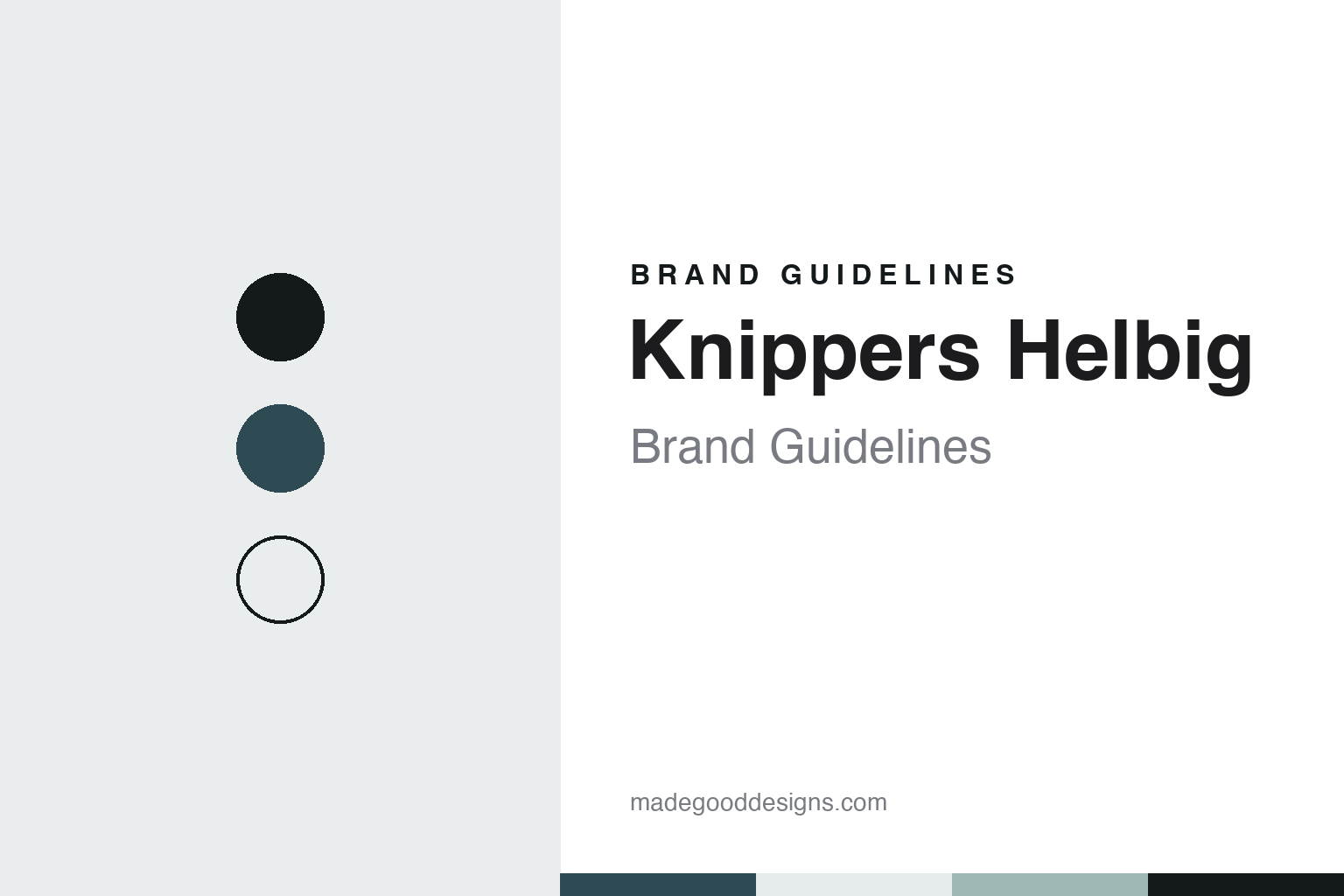
Knippers Helbig Brand Guidelines
The Stuttgart engineers of roofs, shells and façades.
Aa
Two constants: a slate, glass and paper palette and a technical sans register. Abstract homage — not a Knippers Helbig drawing or mark; no project, logo or wordmark is reproduced.
Advanced Engineering
Two engineers, one city and a long name.
Knippers Helbig was founded in Stuttgart in 2001 by the engineers Jan Knippers and Thorsten Helbig, according to English Wikipedia and the company, which says its Stuttgart office dates from that year and remains its headquarters and largest office. The Cooper Union in New York, where Helbig teaches as an adjunct associate professor, describes him as a founding partner of the firm and gives the same founding year.
The name has changed shape over time. German Wikipedia gives the original name as Knippers Helbig Advanced Engineering, and that is how Dezeen credited the firm in August 2010. A 2009 Dezeen project credit used the short form “KHing.” Today the company writes its name as a single lower-case word, knippershelbig, across its website, its office pages and its legal names: a German GmbH for the European offices and an Inc. for New York.
Both founders came to the practice with academic roles. German Wikipedia says Jan Knippers studied structural engineering in Berlin, completed a doctorate at the TU Berlin in 1992 and then worked as a project engineer at Schlaich Bergermann Partner, the Stuttgart structural practice, before taking over the institute for building structures and structural design, itke, at the University of Stuttgart in 2000. It says he co-founded the firm in 2001, co-led it for many years and has run his own practice, Jan Knippers Ingenieure, in Stuttgart since 2018. The current company page names Thorsten Helbig as partner, with Roman Schieber and Matthias Oppe as managing directors.
Colour
Stuttgart, New York, Berlin and Munich.
The practice grew outward from Stuttgart in three steps, each dated by the company. It opened in New York in 2009, in an office in Lower Manhattan; it opened in Berlin in 2014, an office the company says has grown to roughly 20 people; and it opened in Munich in September 2025. The company describes itself as an international structural and façade engineering firm with around 100 people, and says its offices keep in touch through weekly virtual meetings and joint events.
Its work divides into two disciplines that it lists side by side: structural engineering and façade consulting, with further pages on bridges, specialty structures, digital design and research. English Wikipedia says the firm concentrates on the development and programming of complex parametric or generated geometries for roofs, and on façades of steel and glass. The Cooper Union adds a list of materials the office has worked with, from robotically made canopies of woven carbon-fibre-reinforced polymer to textile-reinforced concrete, fibre-reinforced ceramics and mass timber.
Four projects show the range. In Germany, Dezeen reported in August 2010 that Birk und Heilmeyer Architekten and Knippers Helbig Advanced Engineering had completed the Jübergtower in Hemer, a 23.5-metre observation tower for the regional garden festival, made of 240 straight members of glued laminated larch arranged as a hyperboloid and opened on 17 April 2010. In China, the company says it handled structural engineering, façade design and special structures for Shenzhen Bao’an International Airport, designed by Massimiliano Fuksas: a building about 1.6 kilometres long with a façade of about 300,000 square metres, built from roughly 60,000 honeycomb-shaped panels developed parametrically on a diamond-patterned steel frame. English Wikipedia also credits the firm with that façade.
In the United States, Dezeen listed Knippers Helbig as façade consultant on Steven Holl Architects’ Nancy and Rich Kinder Building at the Museum of Fine Arts, Houston, in November 2020, a building wrapped in laminated glass tubes with semicircular sections hung from steel supports. And for Renzo Piano Building Workshop’s Academy Museum of Motion Pictures in Los Angeles, the company says it engineered a spherical steel-and-glass grid shell 45 metres across, with tubular steel arches, diagonal twin cables and shingled glazing, plus glazed steel bridges linking it to the renovated former department store.
Typography
Design and documentation.
Structural and façade engineering consultancies rarely sell a product, so their identity rests on a name and a record. Many carry the surnames of founders or partners, sometimes joined by a plus sign or an ampersand, sometimes run together in lower case, and many shorten to initials in everyday use. The wordmark is usually typographic rather than pictorial: a plain sans or a restrained serif, set on a quiet background, with one accent colour at most.
The work itself does most of the talking. Websites, brochures and monographs lead with project photography of bridges, stadium roofs, glass façades, towers and temporary pavilions, often shot at dusk or from below to show cables, members and joints. Alongside the photographs come drawings, sections, physical and digital models and construction sequences, and the projects are credited together with the architects and builders who worked on them, since an engineer’s name rarely appears on a building alone.
Writing about these firms tends to follow the same pattern. Founders and partners are described in their professional roles, with dates for when they joined or took over; ownership is set out plainly, whether a partnership, a firm owned by its employees or a practice absorbed into a larger group; and renamings and mergers are dated. History pages trace a practice back through earlier names, and office pages list the cities where teams are based, often with the year each office opened.
This guide follows that approach. It sets out what dated sources say about each firm: who founded it, how its name and ownership changed, where it works and which projects independent publications credit to it. It describes what was engineered rather than what it achieves, and it treats the palette and typefaces shown here as an unofficial interpretation, not the firms’ own identity.
Aa
A technical sans — the firm writes its name as one lower-case word. (Specimen set in IBM Plex Sans, a sans STAND-IN; NOT the Knippers Helbig logo.)
knippershelbig
One lower-case word for two names.
The firm’s public face is quiet and technical. Its website opens on a plain statement, “an international structural and façade engineering firm,” followed by a short list of its four cities and a grid of project photographs. Each project page follows the same order: the place, the services provided, the architect, a one-line description of the structure, then paragraphs on geometry, materials and construction. Project names and architects are given equal weight, which suits a practice whose work is usually published under someone else’s design.
That is also how the firm appears in the architectural press. In Dezeen’s credit lists it sits among the consultants, as structural engineer on the Jübergtower and as façade consultant on the Kinder Building, rather than in the headline. The name itself carries the story: two surnames joined as one lower-case word, with the earlier “Advanced Engineering” suffix dropped. Its filter of materials on the projects page reads like a specification list, from glass, wood and membrane to clay, textile concrete and composite, and its typologies run from education and culture to transport, sport and housing.
The written register matches. Project texts describe spans, member sizes, cable diameters and panel counts in plain numbers, and the company dates each office’s opening on its own page. Founders and managers are introduced by name and role, each with a short line on what motivates their work, rather than by biography.
For a design guide, Knippers Helbig shows how an engineering practice can build an identity from geometry, credits and precise numbers rather than slogans. Compare schlaich bergermann partner, the Stuttgart practice where Jan Knippers worked as a project engineer, and Werner Sobek, another Stuttgart engineering firm. For this guide we use a slate, a misty glass green and paper tones with a sans, an unofficial interpretation; no product or logo is reproduced.
Explore & save
Keep Knippers Helbig’s identity on hand — save it to a board in the Made Good inspiration library.
Knippers Helbig identity set
Pin the Knippers Helbig slate, glass and paper palette and the technical sans register to your own board.
Source & notes
Frequently Asked Questions
What font can I use to match the Knippers Helbig look?
This guide describes Knippers Helbig’s type as “A technical sans — the firm writes its name as one lower-case word”. Its type specimen is set in IBM Plex Sans from Google Fonts as a stand-in; IBM Plex Sans is not Knippers Helbig’s own lettering.
What colours are in the Knippers Helbig palette?
This guide’s Knippers Helbig palette is Shell slate #2E4A52, Ink #141A1C, Glass mist #9DB8B4, Pale facade #E6ECEB and Paper #F7F8F7. The tones are the guide’s own unofficial interpretation, not official Knippers Helbig hex codes.
When was Knippers Helbig founded?
Knippers Helbig was founded in 2001, in Stuttgart, Germany. Knippers Helbig is known for Structural and façade engineering.
Who founded Knippers Helbig?
Knippers Helbig was founded by Jan Knippers and Thorsten Helbig in 2001.