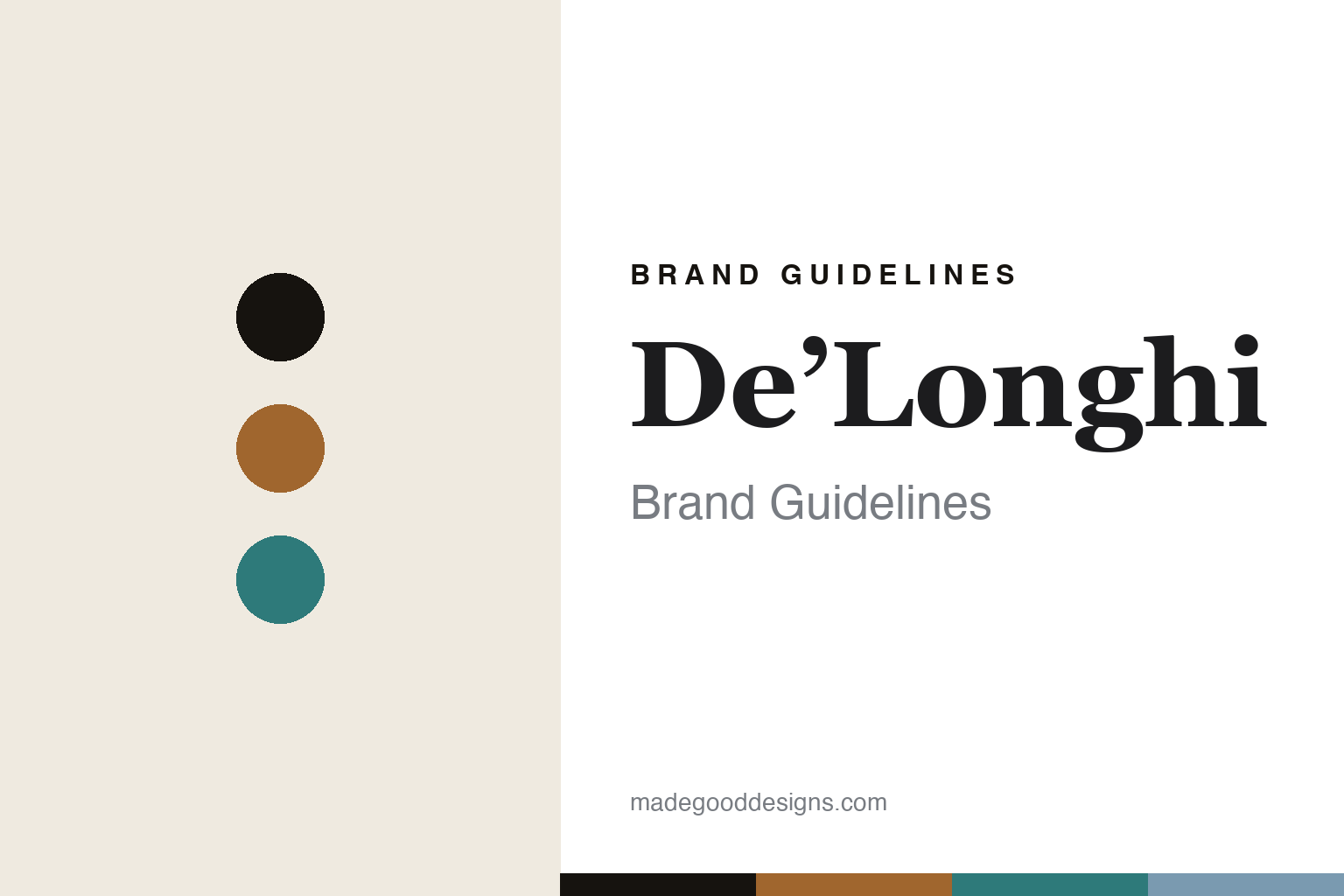
De’Longhi Brand Guidelines
The retro espresso machine.
Aa
Two constants: a retro-pastel palette and a retro serif register. Abstract homage — not the De’Longhi machines or wordmark.
The retro espresso machine
De’Longhi dresses Italian engineering in retro colour.
De’Longhi is a lesson in retro-modern Italian design as the identity. With origins in a 1902 Treviso workshop and incorporated as De’Longhi around 1950, it grew into a global coffee-machine leader and made the design-forward espresso machine its signature object.
Its identity is the espresso machine. De’Longhi makes espresso and coffee machines — from the La Specialista to fully automatic ranges — alongside Pinguino portable air conditioners, oil-filled radiators and the retro Icona and Distinta pastel kitchen ranges. Italian engineering, dressed in colour. A machine that looks as good as it works.
(Honest notes: De’Longhi is Italian, from Treviso. Its origins lie in a 1902 industrial-parts workshop, and it was formally incorporated as De’Longhi around 1950 — so we treat 1902 as heritage and 1950 as the company. Its branded consumer business really took off from the 1970s (the oil-filled radiator), with its first pump espresso machine in 1993; espresso is the modern signature, not the 1902 origin. On ownership, it is publicly listed on Borsa Italiana (Milan) since 2001 yet remains family-controlled — and as of April 2025 Fabio De’Longhi is chairman, with Giuseppe De’Longhi the former (honorary) chairman, so we don’t call Giuseppe the current chair. Manufacturing is spread across Italy, Romania and China, so we don’t imply everything is made in Italy. The De’Longhi Group also owns Kenwood, the Braun household licence, Nutribullet, La Marzocco and Eversys. There’s no official brand hex — these tones are an unofficial interpretation. This is design commentary and does not promote any product.)
Colour
De’Longhi lives in a retro-pastel palette. Click a swatch to copy the hex.
De’Longhi’s identity is retro, warm and Italian — a copper, an ink, a teal, a pastel blue, and a cream. The palette leans retro pastel — the register of the Icona and Distinta ranges, where mid-century colour meets modern engineering. It signals warmth and craft rather than novelty. The honest caveat: with no published brand hex, these tones are an original, unofficial interpretation, not first-party values.
The lesson is a retro-pastel palette signals design-led appliances. De’Longhi’s world is a warm, colourful, engineered object. For designers, it is a reminder that dressing serious engineering in retro colour is a real strategy — that a pastel kettle and a copper espresso machine can make a technical category feel desirable — and that a coherent retro range can span coffee, toasters and kettles. Because a copper can fail as small text, keep type dark and let the colour live in the accents, palette and band. The takeaways: dress the engineering; use retro colour; range it coherently; and treat any single hex as unofficial.
Typography
The register is a retro serif — warm, characterful, Italian.
De’Longhi’s identity carries a warm, characterful, Italian spirit — a retro-modern, engineered object. A high-contrast display serif captures the mood: it is elegant and expressive, the register of Italian design heritage. Set in a retro-pastel palette, the retro serif feels warm and characterful — exactly the personality De’Longhi carries. It is expressive rather than plain, mirroring a design-led machine. (De’Longhi’s real machines and wordmark are works we describe but do not reproduce, and the exact typeface is not ours to use.) Because it is not ours to use, the honest description is “a retro serif spirit,” shown here in a stand-in. The type behaves like the brand: warm, characterful and Italian.
Aa
A retro serif spirit — warm and characterful. (Specimen set in DM Serif Display, a high-contrast display serif STAND-IN; NOT the De’Longhi wordmark.)
Retro-modern design as identity
De’Longhi stands for the retro espresso machine.
De’Longhi is a lesson in making retro-modern design the identity. A retro-pastel palette, a retro serif and a design-led machine make Italian style the whole brand — warm, characterful, engineered. The look is the differentiator. The differentiator is serious engineering wrapped in colour and heritage so it feels desirable, not merely technical.
Put to work, the identity is engineering made beautiful. A designer building in this spirit would refuse to let a technical category look clinical, and instead give it warmth, colour and a coherent retro language, so an espresso machine or a kettle reads as an object you want on the counter. The lesson De’Longhi teaches is that design language scales a brand: a consistent retro-modern look across the Icona and Distinta ranges lets a listed, global company feel like a single Italian design house rather than a catalogue of unrelated appliances.
For designers and brand-builders, De’Longhi offers a clear takeaway: make the engineering desirable. The lessons: dress the engineering; use retro colour; range it coherently; and be honest about the story. It is also a reminder to stay accurate: its origins are a 1902 workshop incorporated as De’Longhi around 1950 in Treviso, it is publicly listed yet family-controlled, and — importantly — Fabio De’Longhi is now chairman (2025), not Giuseppe — the palette here is an unofficial interpretation. And it is a reminder that made-where honesty matters even for an Italian design name: acknowledging that manufacturing is spread across Italy, Romania and China, rather than implying all-Italian production, keeps the design story trustworthy. It is a reminder, too, that a design house can also be a group: De’Longhi owns Kenwood, the Braun household licence, Nutribullet, La Marzocco and Eversys, so the single retro identity sits atop a much larger portfolio. De’Longhi made the espresso machine the brand — proof that retro-modern design can be the difference.
Explore & save
Keep De’Longhi’s identity on hand — save it to a board in the Made Good inspiration library.
De’Longhi identity set
Pin the retro-pastel palette and the retro-serif register to your own board.