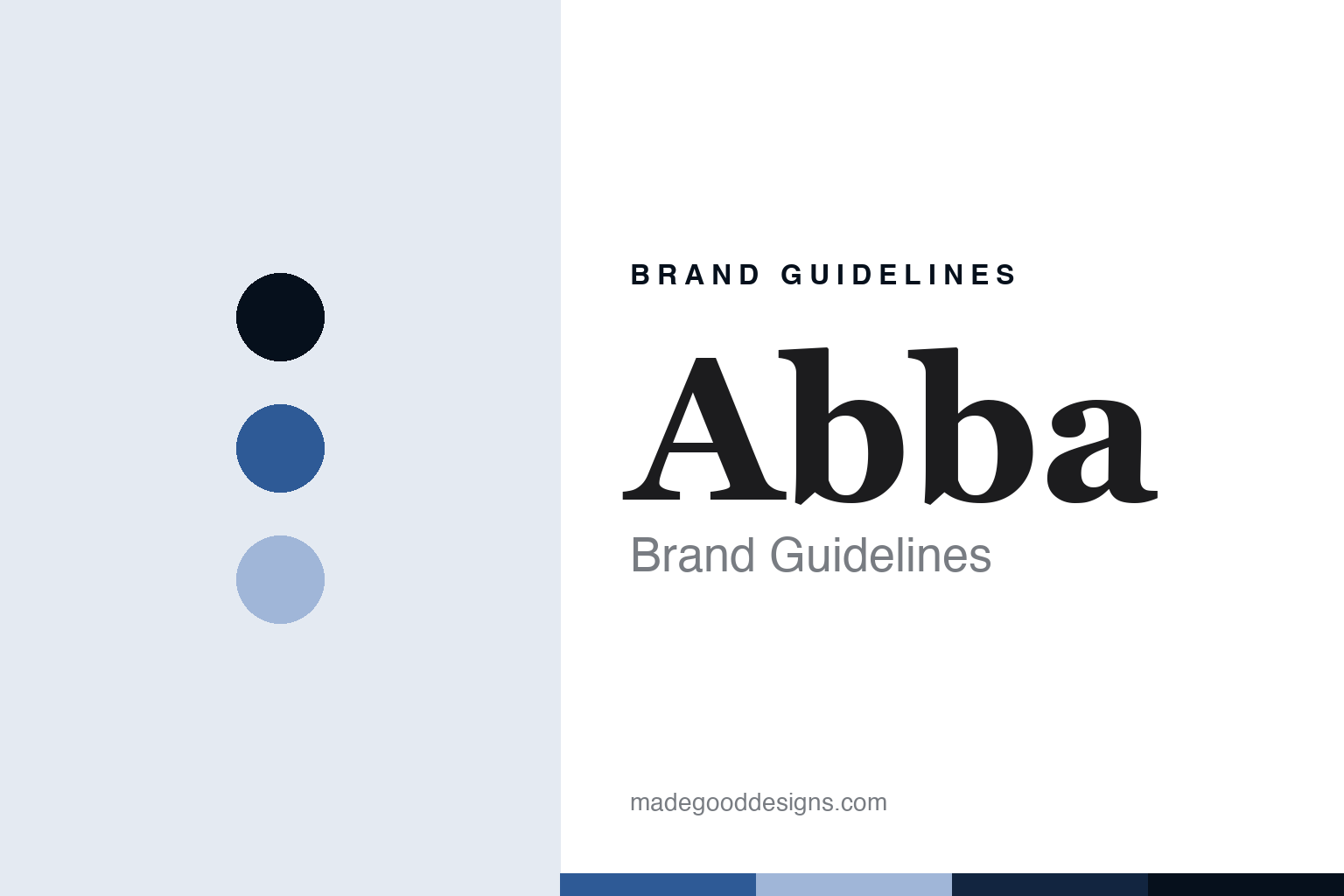
Abba Brand Guidelines
The Swedish seafood on every table.
Aa
Two constants: a Nordic-blue palette and a Nordic-serif register. Abstract homage — not an Abba product or mark.
The Swedish seafood on every table
Abba is the 1838 Swedish seafood house of pickled herring and the Kalles kaviar tube — owned by Orkla.
Abba opens the round as the North’s everyday seafood — the Swedish house, dating to 1838, whose pickled herring and Kalles kaviar tube, with its boy’s-face illustration, are fixtures of Swedish tables, and one of Sweden’s oldest food brands. Abba makes preserved and tinned seafood, and its answer to a round about Europe’s canneries is the everyday: the herring and the tube, on every Swedish table. A brand, from the North.
Its identity is the Swedish seafood on every table. Abba’s 1838 heritage, its Kalles icon and its Swedish making are the story here. A brand, Swedish. The Swedish seafood on every table.
(Honest notes, so the story stays precise. Abba — at abba.se — makes pickled herring, its flagship, plus the Kalles kaviar, a creamed smoked-cod-roe spread in a tube launched in 1954 and a Swedish design icon, anchovies, tuna, mussels, fish balls and roe. It dates to 1838, one of Sweden’s oldest food brands, and its name comes from AB Bröderna Ameln, the Ameln brothers’ company, from which the letters A-B-B-A are drawn, registered in 1906, not from any A. Bergström, which is a mistaken etymology we drop. The 1838 origin traces to Bergen and Stockholm, so we treat the Bohuslän west coast as production heritage rather than the birthplace. On where it is made — a theme of this vein — it is produced in Kungshamn, in Bohuslän, on Sweden’s west coast. On ownership, it is owned by the Norwegian group Orkla, through Orkla Foods Sverige, which acquired the business in 1995, and Abba Seafood was merged into that company in 2013, so the brand lives on though it is not a standalone company. We also note that the pop group ABBA is unrelated, the seafood company predating it. Its Kalles tube and boy’s-face illustration are IP we describe but do not reproduce; there is no official brand hex; these tones are an unofficial interpretation. This is design commentary.)
Colour
Abba lives in a Nordic blue. Click a swatch to copy the hex.
Abba’s identity is Swedish, everyday and sea-blue — a Nordic blue, an ink, a sky, a deep blue, and a paper. The palette leans Nordic blue and sky: a cool, northern register that nods to a Swedish table and a herring tin rather than a loud palette. It signals an everyday seafood heritage. The honest caveat: with no published brand hex, these values are an original, unofficial interpretation, not first-party colours.
The lesson is a Nordic blue signals a Swedish, everyday identity. Abba’s world is a heritage, made object. For designers, it is a reminder that a Nordic blue and a soft sky can carry a food brand — the tone of the Swedish west coast. Because these tones can fail as small text, keep type dark and let the colour live in the accents, palette and band. The takeaways: own an everyday staple; make a design icon; get an etymology right; and treat any single hex as unofficial.
Typography
The register is a Nordic serif — Swedish, heritage, considered.
Abba’s identity carries a Swedish, heritage, considered spirit — an everyday seafood house, not a fashion. A Nordic serif captures the mood: cool, classic and a little venerable, the register of a name from 1838. Set in a Nordic-blue palette, the Nordic serif feels Swedish and heritage — exactly the personality Abba carries. It is a staple rather than a logo, mirroring tinplate and brine. (Abba’s real Kalles tube is a thing we describe but do not reproduce, and the exact typeface is not ours to use.) Because it is not ours to use, the honest description is “a Nordic-serif spirit,” shown here in a stand-in. The type behaves like the brand: Swedish, heritage and considered.
Aa
A Nordic-serif spirit — Swedish and heritage. (Specimen set in Cormorant Garamond, a Nordic-serif STAND-IN; NOT the Abba logo.)
Around Europe’s canneries
Abba stands for the Swedish seafood on every table.
Abba opens the round as the North’s everyday seafood. A Nordic-blue palette, a Nordic serif and a design icon make one thing — the Swedish seafood on every table — the whole identity: Swedish, everyday and sea-blue. The Kalles tube is the icon, and 1838 is the heritage. The point is a Swedish house whose herring and kaviar are fixtures of the table, one of the country’s oldest food brands.
Put to work, the identity is an everyday heritage told straight, as design. A maker in this spirit would own a staple, make a design icon, and get an etymology right. A reader in this spirit would keep the facts right: Abba dates to 1838, one of Sweden’s oldest food brands, its name from AB Bröderna Ameln, not A. Bergström; its flagship is pickled herring, with the Kalles kaviar tube, a 1954 design icon; the 1838 origin traces to Bergen and Stockholm, with Bohuslän as production heritage; it is produced in Kungshamn; and it is owned by the Norwegian group Orkla since 1995. Abba opens the round’s cannery span and its Nordic entry, and its heritage sits with Connétable among the round’s oldest houses. The honest editorial moves are to date it to 1838, to correct the etymology to AB Bröderna Ameln, to say produced in Kungshamn, to name Orkla as owner, and to flag the pop-group coincidence. The lesson Abba teaches is that an everyday staple can be a whole identity, and getting the etymology right keeps it credible.
For designers and brand-builders, Abba opens around Europe’s canneries: own an everyday staple — and get an etymology right. The lessons: build on a daily staple like herring; make a design icon like the Kalles tube; correct a mistaken etymology; name a corporate owner plainly; and never reproduce a package. It is also a reminder to stay precise: Abba is the 1838 Swedish seafood house of pickled herring and the Kalles kaviar tube, owned by Orkla — with the palette here an unofficial interpretation. Read that way, Abba is less a tin than a table: the Swedish seafood on every one. The lesson for a brand is that a staple and an honest record reinforce each other, and correcting the etymology keeps the heritage earned. Abba made the-Swedish-seafood-on-every-table the identity — proof that a staple can open a round.
Explore & save
Keep Abba’s identity on hand — save it to a board in the Made Good inspiration library.
Abba identity set
Pin the Nordic-blue palette and the Nordic-serif register to your own board.